How a whirlpool freezer works? This guide walks through exactly what to check and when an experienced technician should step in.
Understanding how whirlpool freezer works turns a sealed white box into a system you can troubleshoot. A freezer does not create cold — it removes heat from inside the cabinet and releases it into the room using a refrigerant loop, then seals that cold in with insulation and a gasket. Once you know the parts and their order, symptoms like frost, warm spots, or constant running start to make sense.
The refrigerant loop in how whirlpool freezer works
Four core parts do the work. The compressor pressurizes refrigerant gas, heating it. That gas flows through the condenser coils on the back or bottom, where it sheds heat to the room and turns to liquid. The liquid passes a metering device into the evaporator coils inside the cabinet, where it expands, turns very cold, and absorbs heat from the air and food. The gas then returns to the compressor and repeats. This is why dirty condenser coils hurt so much — heat cannot escape, so the whole loop runs hot and the freezer struggles.
Frost-free vs manual-defrost
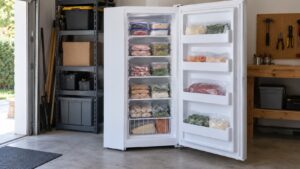
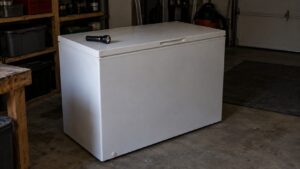
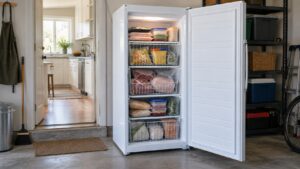
How the cold reaches your food differs by type. A frost-free upright like the WZF79R20DW uses a fan to blow air over a hidden evaporator and through the cabinet, plus an automatic defrost heater that melts coil frost several times a day. A manual-defrost chest like the WZC5216LW has the evaporator built into the walls and no fan; cold sinks and stays low, which is why opening the lid loses less cold than opening an upright door — but frost must be cleared by hand.
Why frost forms
The evaporator runs below freezing, so any humid air that gets in condenses to ice on it. In a frost-free model the defrost cycle handles that automatically; if the heater or thermostat fails, frost builds until it blocks airflow and the cabinet warms. In a manual model, frost simply accumulates and is expected. Our frost-buildup guide explains what is normal for each.
Temperature control
A cold-control thermostat (or an electronic sensor and board on newer units) measures the cabinet temperature and switches the compressor on and off to hold the set point. If that control fails, the freezer may run constantly or never run at all — the reasoning behind our running-constantly guide.
Why a freezer holds cold so well
Two design choices explain why a freezer recovers from a power cut or a door opening better than a refrigerator. First, thick foam insulation in the walls and lid slows heat from leaking in, which is why a full freezer can stay safe for a day or more during an outage if you keep the door shut. Second, the frozen food itself acts as a cold reservoir — every pound of ice and frozen food has to absorb a lot of heat before it warms, so a packed freezer rides out interruptions far better than an empty one. A chest design adds another advantage: because cold air sinks, opening the top lid spills very little of it, whereas an upright door lets the cold pour out at floor level. Understanding this thermal mass is practical, not just academic — it is why technicians tell you to keep the freezer full and the door shut, and why a freezer that cannot hold cold despite a full load points to a real cooling problem rather than simple heat loss.
Putting it to use
With this map, troubleshooting is logical: warm and silent points to the compressor or control; warm with heavy frost points to airflow or defrost; constant running points to heat getting in or a weak sealed system. Because a standalone freezer reports no error codes, this symptom-based reasoning is exactly how a technician diagnoses one. If the loop itself has failed — a refrigerant leak or dead compressor — that is a sealed-system repair for an experienced technician. You can schedule a diagnosis online; our specialists use genuine OEM parts with a 30-day labor warranty. For technical documentation, see Whirlpool.