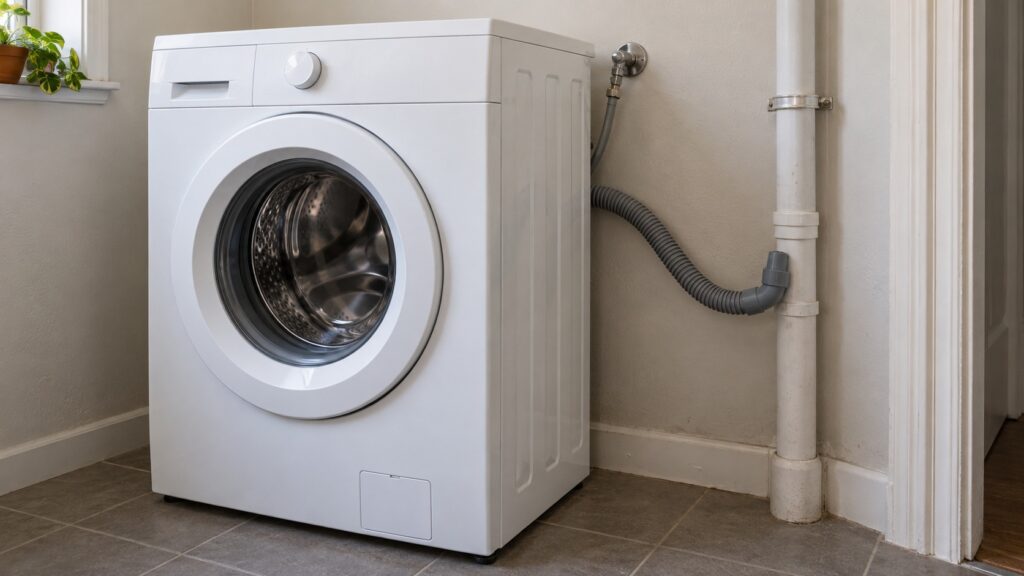
A Whirlpool washer drain standpipe setup is simple when it follows three rules: the standpipe is the height your owner’s manual calls for, the drain hose goes only a short way into it and is held in place with the supplied clip, and the connection is not sealed airtight, so air can break the siphon. Our Whirlpool washer installation guide gives a standpipe height of 39 to 96 inches and says to insert the hose no more than about 4.5 inches. Check both against your own manual before you rely on them.
What is a washer standpipe and why does the hose go into it?
A standpipe is the open vertical drain pipe that the washer empties into. It stands out of the wall at a set height and runs down to a trap and the home’s drain line. The washer’s drain pump pushes water up and out through the drain hose, and the hose hangs over the top of the standpipe so the water falls in. The pipe is open at the top on purpose. That opening lets air in, which keeps the water from being pulled out of the tub by suction.
Our Whirlpool washer how-it-works guide explains the drain pump and the path water takes out of the tub, which helps you see why the hose end matters so much.
How high should the standpipe be?
Our Whirlpool washer installation guide lists a standpipe between 39 and 96 inches high, or a laundry sink, as the place to drain. In general a range exists because an opening that is too low risks water spilling over during the pump-out, and one that is too high is more than a washer pump is meant to lift; the manual gives the figure that applies to your model. Your owner’s manual is the authority for your exact model, and local plumbing rules can add requirements, so check both before you cut, move or extend any pipe.
If the standpipe in your laundry area is too low or too high for the washer, do not improvise with tape or tubing. A plumber can reset the pipe to the right height and make sure it ties into the drain correctly.
How far should the drain hose go into the pipe?
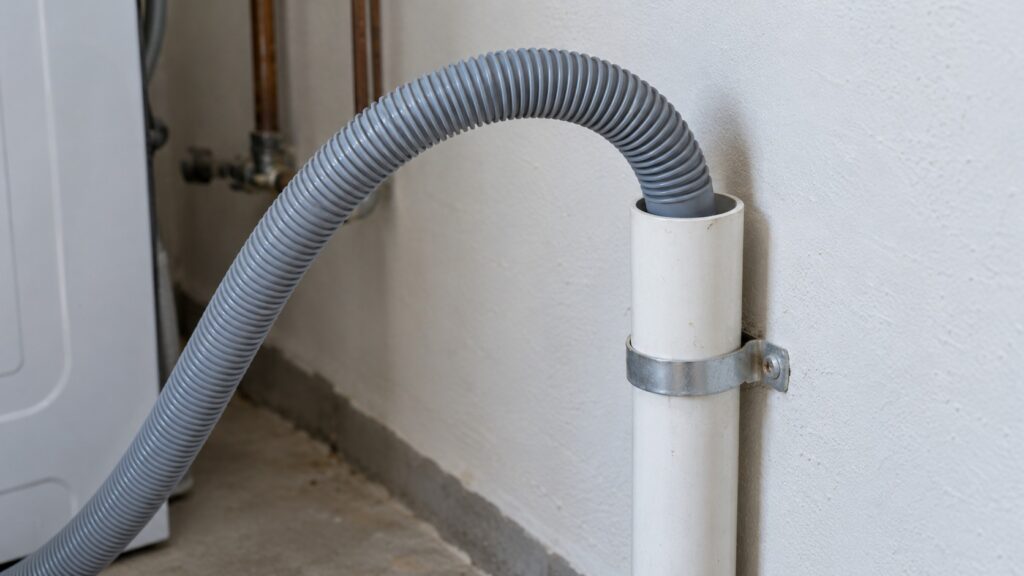
Only a short distance. The installation guide says no more than about 4.5 inches, secured with the hose clip that came with the washer. A hose pushed too deep can drain constantly or slowly because it creates the siphon the air gap is meant to prevent. A hose that is not secured can pop out when the pump pushes water, and the result is water on the floor. Form the hose into a gentle arch over the pipe, with the clip holding it so it cannot slide out or drop down.
Do not push a rag or tape into the gap around the hose to make it tidy. Sealing the pipe airtight removes the air gap, and without it the water can be siphoned out of the tub at the wrong time.
What problems show up when the standpipe setup is wrong?
A drain hose pushed in too far or sealed tight can make the washer drain while it fills, so the tub never seems to hold water and the cycle drags on. A hose that is kinked or crushed behind the washer can slow the drain or stop it. A hose that is not clipped can jump out of the pipe. Each of these can look like a failed pump, and each can be fixed without any parts. Our Whirlpool washer will not drain guide goes through the causes in order, and the F8E1 long fill guide explains why a hose that drains too early can look like a fill problem.
When you pull the washer out to check, switch the power off at the outlet only if it is dry and safe to reach. If there is water on the floor near the outlet or the cord, switch off the breaker at the panel while standing on a dry floor and never pull a plug from a wet outlet.
What should you check before the first load?
Before you rely on a new connection, run a test cycle with no laundry and watch the hose at the standpipe while the washer pumps out. Look for a hose that moves, a drip at the pipe or the connection to the wall, and a drain that seems slow. Check that the standpipe is firmly fixed and has no cracks. Also look at the floor under the washer for dampness, and run your hand along the back of the hose, since a pinhole shows up as a wet line.
Level the washer as well. A washer that rocks can pull the hose out of the pipe over time. Our installation guide lists leveling feet and the check for shipping bolts among the steps that prevent most first-week service calls.
When is a laundry sink the better choice?
If there is no standpipe, our installation guide accepts a laundry sink as the drain. The same rules apply: secure the hose so it cannot slip out, keep it from being sealed airtight into the drain and keep the sink basin clear so the drain does not back up. A sink that drains slowly on its own is a plumbing problem that a washer will make worse. Do not use a sink with a stopper closed or a drain that is partly blocked.
Lint can build up in a laundry sink or standpipe over time. Run clean water through and watch how fast it clears. A slow pipe is a job for a plumber, not for a washer technician.
When should you call a technician or a plumber?
Call a plumber if the standpipe is the wrong height, damaged, leaking, loose or backing up. Call an appliance technician if the standpipe is right, the hose is routed correctly and the washer still drains badly, since that points to the washer’s pump or its filter. Do not remove the washer’s back or lower panels yourself. That work is a technician’s job. Our Whirlpool washer repair page explains how a visit works.