If you searched for a Whirlpool Cabrio washer, you are probably holding a manual, a control panel or a service note full of words that are not explained anywhere in plain language. Cabrio is a name people search for when they look up a Whirlpool washer or dryer. Our own model pages do not list a Cabrio line, so this glossary does not claim which models carry the name, whether it is still sold or what each model does. Instead it explains the words you will meet on a top-load washer panel and in its paperwork, in the order you are likely to run into them, and points you to the owner’s manual for anything model-specific.
What does Cabrio mean on a Whirlpool washer?
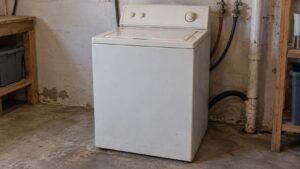
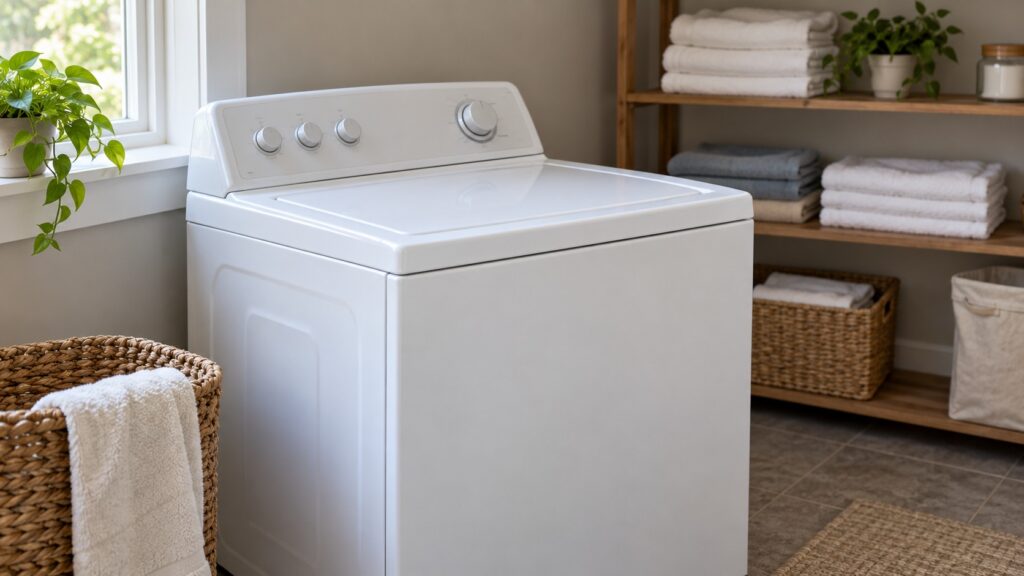
Cabrio is a product name, not a technical term. People type it into a search box when the badge on their machine says it, or when someone told them what it is called. Our model pages for Whirlpool washers use model numbers such as WTW4307SW, WTW6157PW and WTW7120HW and describe them as top-load washers, and none of them uses the word Cabrio. For that reason we will not tell you which settings or parts a Cabrio washer has. Find the model number on the label, usually near the lid opening or on the back, and read the matching owner’s manual.
Once you know the model number, you can find out how your washer works by looking up the words below. The same logic applies to the dryer that sometimes goes with it: its model number, not its nickname, tells you what the controls do.
What is the difference between an agitator and an impeller?
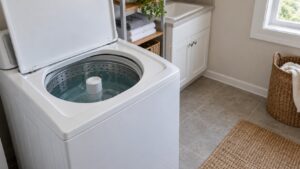
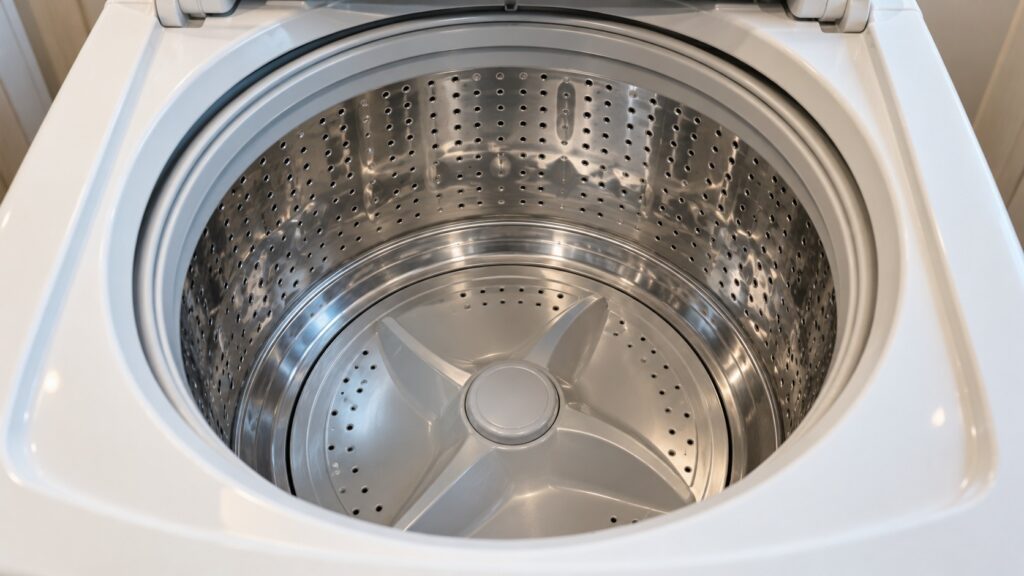
Both are the part that moves clothes around in the tub of a top-load washer, but they look and work differently. An agitator is a post in the middle of the drum that turns or twists to push clothes through the water. Several of our Whirlpool model pages list a 2-in-1 removable agitator, which means the post can be left in or taken out for bulky loads. An impeller is a low wheel or plate at the bottom of the tub; it spins to create a flow of water and clothes instead of using a tall post. Searches that mention a washer without a tall center post are usually about this design.
Which one your washer has is not something to guess from the outside: lift the lid, look at the middle of the drum and read the manual’s description. Never reach into the tub while it is moving, and never try to remove a part that does not come out by hand according to the manual. If a post or plate wobbles, slips on its shaft or makes a grinding sound, stop using the washer and call for service.
What do Deep Water Wash, Quick Wash and Auto Sensing mean?
These three phrases appear in the key features of several Whirlpool top-load pages on our site. Deep Water Wash is an option for loads that need more water around them. Quick Wash is a shorter cycle meant for lightly worn clothes. Auto Sensing means the washer senses the load and adjusts its cycle, which is why two loads of different size can run for different lengths of time. Our pages do not give any minutes, water amounts or temperatures for them, and neither do we; what each setting does on your exact model is in the owner’s manual.
Some pages also list a Presoak option, a soil level selector or a Load and Go dispenser. A presoak is a soaking period before the wash. A soil level selector lets you tell the washer how dirty the load is. A Load and Go dispenser holds enough detergent for several loads and doses it automatically; it is a feature of some models, not every top-loader.
What do the words on the control panel and in the paperwork mean?
High-efficiency detergent is a low-sudsing detergent made for washers that use less water. Using regular detergent in too large an amount can cause an excess suds code. The wash basket is the perforated drum that holds the clothes during the spin. The lid lock is a latch that keeps the lid closed while the drum spins and tells the control that it is safe to start. Unbalanced load means the clothes have bunched to one side of the drum, and the washer slows or stops to avoid shaking. A fill is the time the washer takes to bring water in; a drain is the time it takes to pump it out.
Our model pages say the codes we see most on top-loaders are F8E1 (a long fill, shown as LF on some displays), F9E1 (a long drain), the lid-lock failure codes, the off-balance and suds codes and F7E1 (motor or drum). Our Whirlpool washer error codes glossary decodes all eleven codes the site lists, and the F0E1 unbalanced load guide walks through the most common owner fix.
What about Cabrio dryer words?
The dryer that matches a top-load washer has its own vocabulary. Dryer feature names such as AutoDry and Wrinkle Shield differ between models, and what each does on your dryer is in its owner’s manual. Our Wrinkle Shield glossary explains the dryer names our pages use. A thermal limit, a thermistor and a vent are parts of the dryer’s airflow and heat path; any work on them, and any work on a gas dryer’s burner, belongs to a technician.
For washer care, our washer maintenance checklist lists what is safe for an owner to do, and our installation guide covers leveling and hoses. If you see water at the base of the washer, sparks or a burning smell, switch off the breaker at the panel while standing on a dry floor, and never pull a plug from a wet outlet. Then schedule a visit, or read about our Whirlpool washer repair.