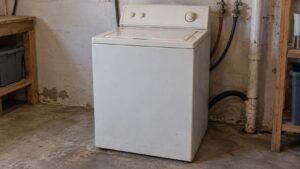
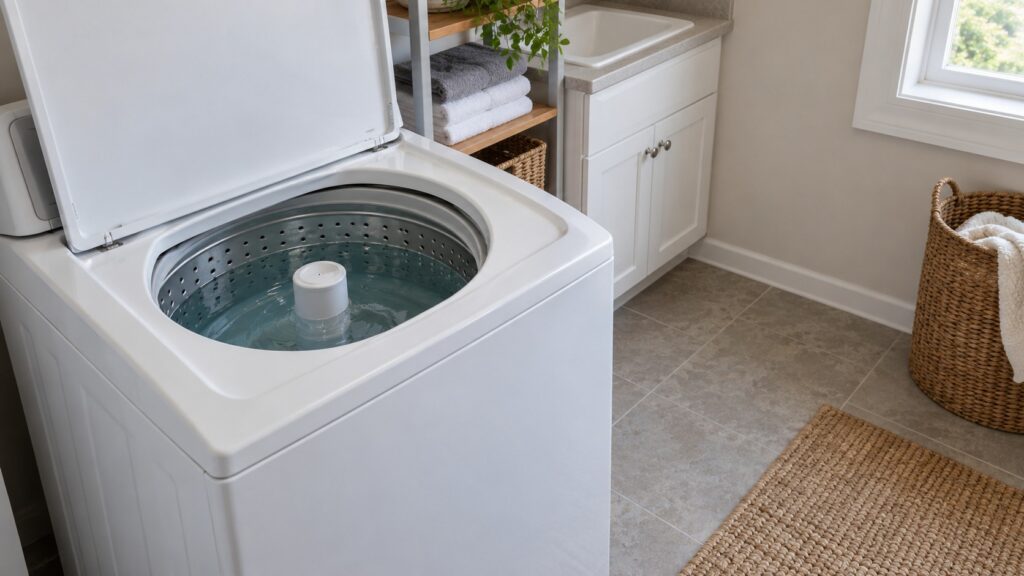
A Whirlpool washer drain pump is a small electric pump low in the machine that pushes water out of the tub, past a filter and up the drain hose into your standpipe or laundry sink. The control turns it on during each drain and spin step, and a sensor tells the control whether the tub has actually emptied. When the pump is blocked, weak or failed, the washer leaves water in the tub, spins poorly or stops with a long-drain code, which is why this one part sits behind so many no-drain and no-spin complaints.
What does the drain pump do in a Whirlpool washer?
Every wash cycle ends with water in the tub, and the pump is what gets it out. Our Whirlpool washer will not drain guide describes the path plainly: the washer pumps water out through a small drain pump, past a filter and up a drain hose into your standpipe or laundry sink. The pump is a small motor turning an impeller, a little fan-like wheel that flings water through the outlet. It runs when the control tells it to, and it stops when the tub is empty.
You hear it more than you see it. A healthy pump produces a steady whir while water leaves the tub. Our guide says a grinding or rattling noise points to debris caught in the impeller, and a loud hum with no water moving points to a blockage or a seized pump.
What does the filter in front of the pump do?
The filter, sometimes called the coin trap, protects the pump. Lint, hair, coins and a lost sock are caught there before they can reach the impeller. Our drain guide says a clogged pump filter packed with lint, hair, coins or a lost sock is the most likely cause of a no-drain problem. On many Whirlpool washers the filter sits behind a lower access panel, but where it is and how it comes out differ by model, so use your owner’s manual to find it and to see whether it is meant for the owner to open.
If your manual shows a filter access door for the owner, put towels down first, because water will come out when you open it, and follow the manual’s steps. If the manual does not show one, or you are unsure, leave the cabinet closed and call a technician.
How does the washer know the tub is empty?
The washer does not guess. A level sensor watches the water in the tub, and the control gives the pump a set time to empty it. Our guide says that if the level sensor does not confirm an empty tub in that window, the control logs F9E1 on front-load WFW models and on top-load WTW models. That is why a slow drain can end in a code rather than just a long cycle: the control is checking that the pump is doing its job. Our Whirlpool washer how-it-works guide explains the whole cycle, with the drain as the last step before the spin.
The spin depends on the drain. A washer cannot spin a tub that is still full of water, so a drain problem often looks like a spin problem, and our Whirlpool washer not spinning guide starts with the drain for that reason.
What makes a drain pump stop working?
Four things cover most cases. A blocked filter or hose starves the pump of flow. A kinked, crushed or badly routed drain hose slows the water. A hose pushed too far into the standpipe can siphon. And the pump motor can fail on its own, or catch something in the impeller. Our drain guide lists these in that order, and it notes that a pump that drains on some cycles and not others usually means a partly failed pump or an electrical connection that is breaking down under heat.
Too much detergent can also get in the way. Excess suds can cushion the pump so it cannot clear the tub, and our guide ties that to an F0E5 sud lock. Use the right detergent for your machine and measure it.
What can you check without opening the washer?
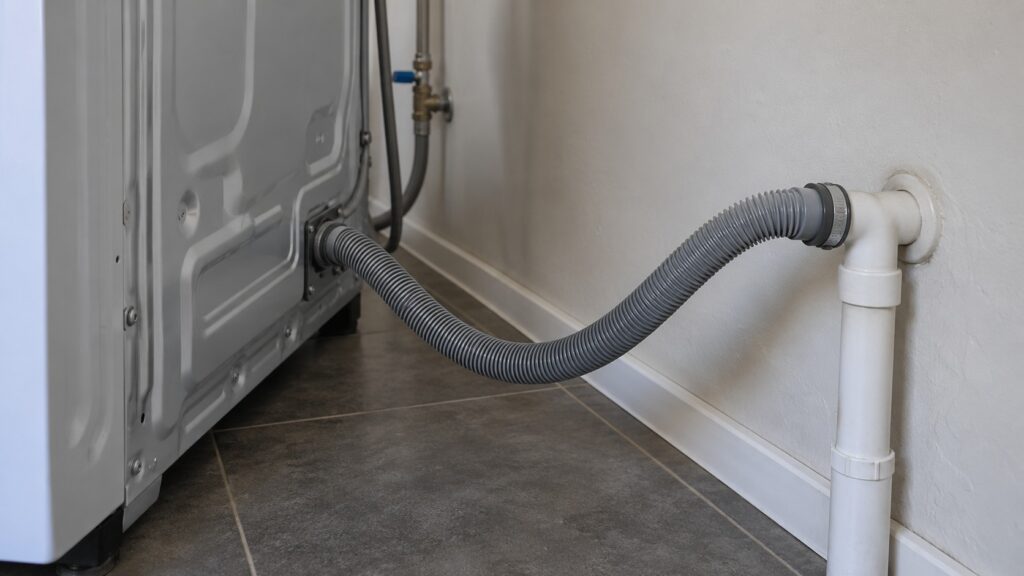
Look at the outside of the system. Make sure the drain hose is not kinked behind the washer and is not squashed against the wall. Check the hose end in the standpipe. Our washer installation guide says the hose should go only a short way into the standpipe and must not be sealed airtight. Run Drain and Spin if your washer offers it, and listen to the pump. A humming pump that moves no water, or a pump that makes no sound at all, are different clues to tell your technician.
If water is on the floor, turn off the washer and the water supply. If it has reached an outlet or the cord, switch off the breaker at the panel while standing on a dry floor and never pull a plug from a wet outlet. Do not take off back, side or lower panels to reach the pump, because wet electrical parts are dangerous.
When should you call a technician?
Call when the hose and the filter are clear and the washer still will not drain, when the pump hums without moving water, when you hear grinding, when the pump leaks or when the washer shows a long-drain code. A pump replacement is a part job for a technician, and a diagnosis tells you whether the pump or something else is the cause. Our Whirlpool washer repair page explains how a visit works.