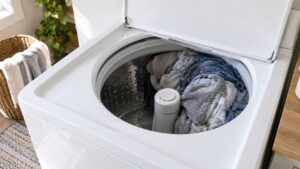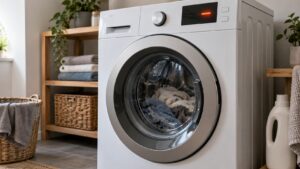
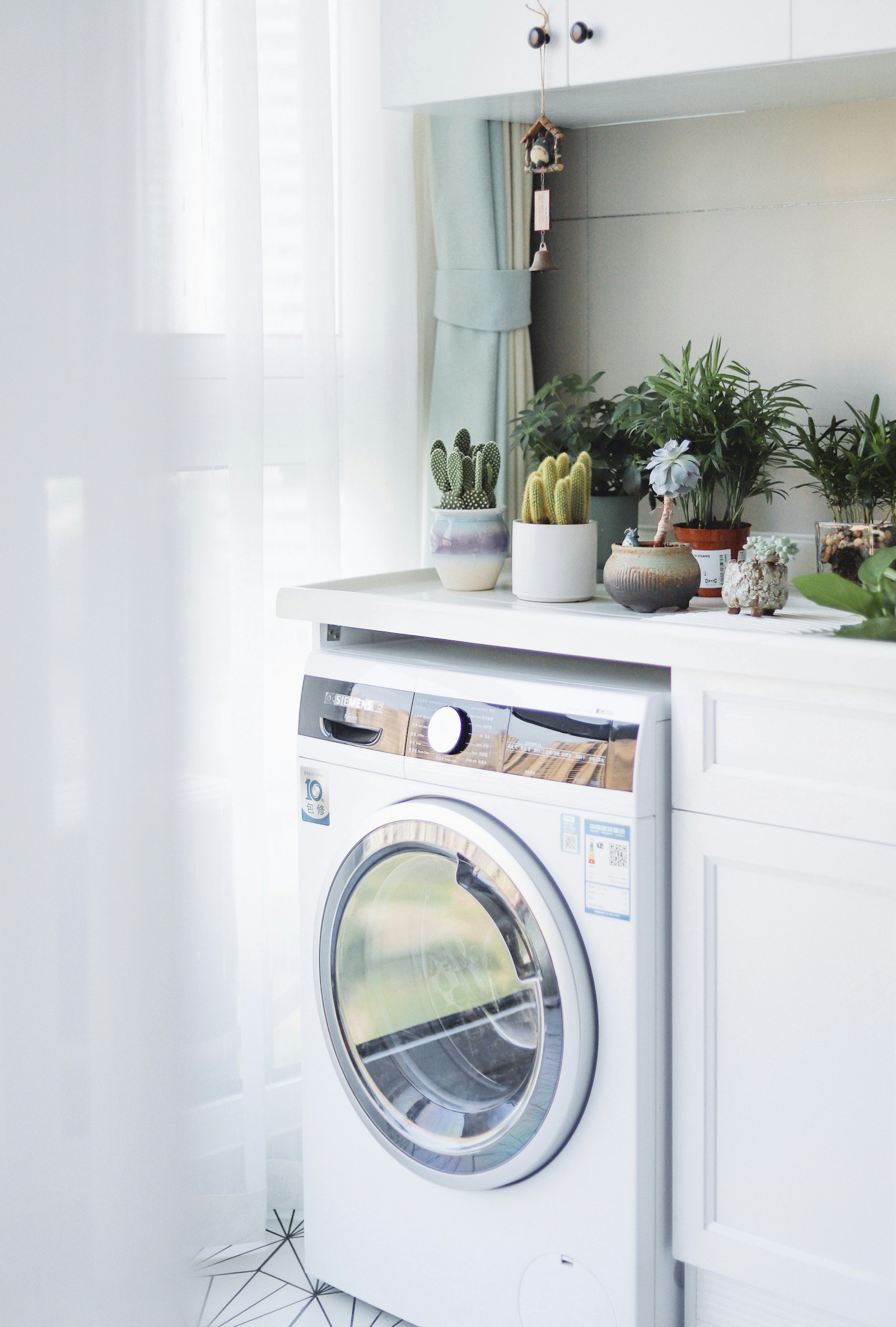
A whirlpool washer not spinning is one of the most frustrating laundry problems because the wash finishes, but the clothes come out dripping and heavy. The fix depends on whether the drum will not spin at all or simply does not spin fast enough to wring the water out. Whirlpool washers report several distinct codes for this — most often F7E1 (motor speed) and F7E5 (shifter actuator) — and the symptom pattern usually tells you which system has failed before a technician ever opens the machine.
Common reasons a whirlpool washer not spinning happens
- Unbalanced or overloaded drum. A single heavy item, like a comforter, throws the load off balance and the washer refuses to spin to protect itself (often shown as F0E1).
- Lid or door not locking. A washer will not spin if it cannot confirm the lid is latched. On front-load WFW models a door-lock failure appears as F5E2; on top-loaders a lid-switch failure appears as F5E1.
- Shifter actuator problem (F7E5). On direct-drive WTW and Cabrio top-loaders, a shift mechanism moves the drive between agitate and spin. If it fails, the machine agitates but never spins.
- Motor speed problem (F7E1). The control is not receiving a valid speed signal, so the basket never reaches commanded spin speed — sometimes with a burning smell from worn bearings.
Steps to try yourself
- Redistribute the load. Open the lid, spread clothes evenly, and add a towel or two to balance a single bulky item, then run Drain & Spin.
- Check the lid or door latch. Make sure nothing blocks the latch and that the door clicks fully closed.
- Listen during spin. A motor that hums but stalls suggests F7E1; agitation with no spin suggests F7E5.
- Power-cycle the washer. Unplug for five minutes — this clears many transient motor and lock failures.
For the full breakdown of these problems, see our list of Whirlpool washer error codes, which separates the load-related codes from the genuine mechanical failures.
It also helps to separate two failure patterns that look alike at the door. A washer that completes the wash, agitates normally, and only leaves the clothes soaking wet usually has a drive or shifter problem rather than a motor that is completely dead. By contrast, a washer that stalls the instant spin should begin, sometimes with a faint burning smell, points toward the motor itself or its bearings. On front-load WFW machines the door must lock before any spin can start, so a door-lock failure (F5E2) will stop the spin even when the motor and drive are perfectly healthy, which is why ruling out the simple lock and balance causes always comes first. Worn suspension rods on a top-loader, or tired shock absorbers on a front-loader, can also let the basket wobble far enough that the control aborts the spin to protect itself, so a washer that spins fine empty but refuses to spin a full load is often telling you the suspension is wearing out.
When to call a technician
A confirmed F7E5 shifter actuator or an F7E1 motor-speed problem means a real part has failed — the actuator, the speed sensor, the motor bearings, or the motor control board. These are diagnosed with a meter and replaced with genuine OEM parts. Our skilled technicians run the built-in spin diagnostic to confirm which component is responsible before quoting anything; you can schedule a repair and get an honest diagnosis. Whirlpool publishes model-specific spin specifications at whirlpool.com.
How to prevent spin problems
Do not overload the drum, wash bulky bedding with a balancing item, and never force a front-load door. Catching a slow or noisy spin early often means replacing a single bearing or actuator instead of a full motor assembly. If your washer agitates but will not spin, our Whirlpool washer repair service handles shifters, motors, and lid locks with a 30-day labor warranty.