Whirlpool induction cooktop lifespan is not a number we can give you: there is no figure on our site, and a cooktop’s age matters less than what has failed and how it was used. What we can tell you is how to decide. Many “dead cooktop” complaints are really cookware, placement or a control lock, which cost nothing to fix. A genuine fault can be a coil or a power board, which a technician has to diagnose. A cracked glass top changes everything. This guide helps you sort those cases and decide between repair and replacement.
How long does a Whirlpool induction cooktop last?
We do not publish a lifespan, and we would not trust a single number for a cooktop. How long it runs depends on how it is used, how it is cleaned, the cookware and the quality of the installation. A better question is whether the problem you have is the kind that gets fixed. The glass top has no moving parts, and the coil under each zone does its work with an alternating current and a magnetic field, as described in our page on how a Whirlpool induction cooktop works. The electronics beneath it are the part that eventually fails, and when they do it is a board or coil repair, not a simple swap you can do by hand.
Is it really broken, or is it the cookware?
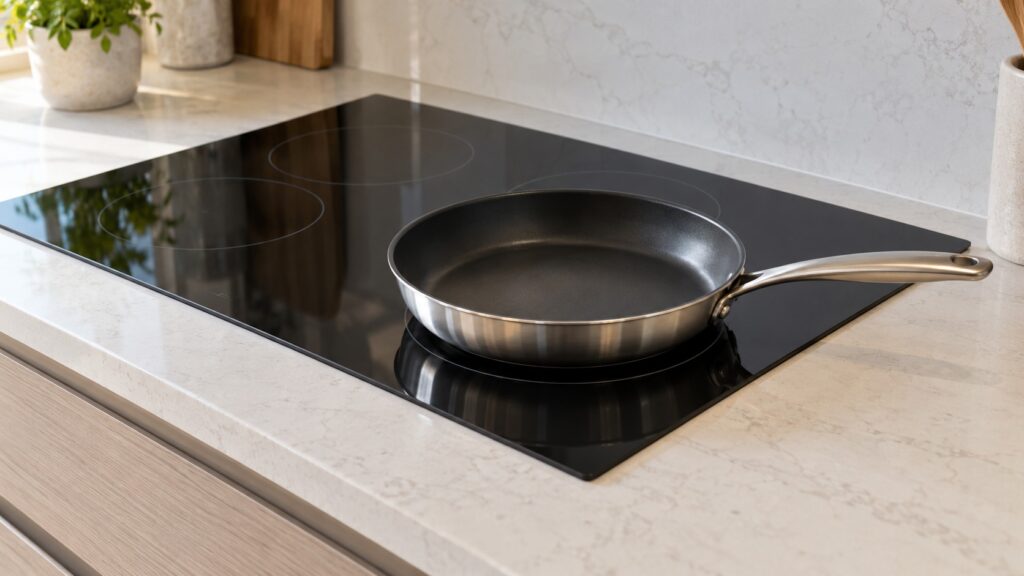
Most “my induction cooktop doesn’t work” cases are not a failure. Induction heats the pan itself, so the pan must be magnetic, large enough and centered over the zone. Our guide on induction cooktop not detecting a pan lists the checks: a household magnet should stick firmly to the bottom of the pan, the base should roughly match the printed zone, the pan should sit squarely and the base should be flat. If a pan that passes all of that still works on some zones but not one, that zone may have a coil problem. That is the point at which a repair becomes worth considering.
Also check the control lock. A control lock is often mistaken for a fault, and our cooktop control lock page explains it. Moisture on a touch panel can also make the controls act dead until it dries. Clearing those first can save you a service visit.
Which induction faults are worth repairing?
A failure that is limited to one part is the best case for repair. Our model pages for the WCI55US0JB and WCI55US0JS describe 30-inch four-element induction cooktops with a Booster, and the WCIT7536SS and WCIT7530SB are Temp Cook models with sensors. Whatever the model, a single dead zone, a control that has stopped responding or an element that will not switch off are all faults a technician can test, and in some cases the fix is replacing one part. A repair makes sense when the rest of the cooktop is in good shape: a clean surface, intact glass and no history of repeated faults.
Our controls unresponsive page explains that a dead touch panel can come from the control lock, moisture or a failed control board. Which one it is needs testing, not guessing. For a general idea of what repair involves, see our cooktop repair page. We are an independent service: whether a repair or a new cooktop is the better value depends on the fault, the quote and the condition of the glass, and a technician can give you the figures after an inspection.
When does replacing the cooktop make more sense?
Replacement can be the better choice in a few situations. The first is a cracked or chipped glass top. Our cracked glass page describes it as impact or thermal stress that exposes live elements and needs immediate shutoff, and it lists the repair as one that needs a technician. If the glass is cracked, stop cooking, switch off the cooktop at the breaker panel and do not use it. Many cracked tops are not worth repairing, but a technician should confirm. The second is repeated failures, where one repair is followed by another part a few months later. The third is when the cost of the repair and the diagnostic visit starts to look like a good part of a new cooktop. The fourth is when the cooktop no longer suits how you cook.
No rule replaces judgment here. Our cooktop repair cost page explains what goes into a repair visit. Look at the fault, the age and the repair history together instead of a single number. A technician can tell you whether the problem is isolated.
What should you do before you call?
Run through a short list. Test with a pan that sticks to a magnet and fits the zone, on each zone in turn. Make sure the control lock is off and the panel is dry. Wipe the glass so that pans make full contact, following our glass cooktop cleaning guide. Write down the model number, which zone has the problem, and whether it fails at once or part way through cooking. Do not lift the glass or open the cooktop from below to look at the coils or the board. Those parts carry high voltage, and that is a technician’s job. If there is a burning smell, sparks or water on the controls, switch off the breaker at the panel while standing on a dry floor.