
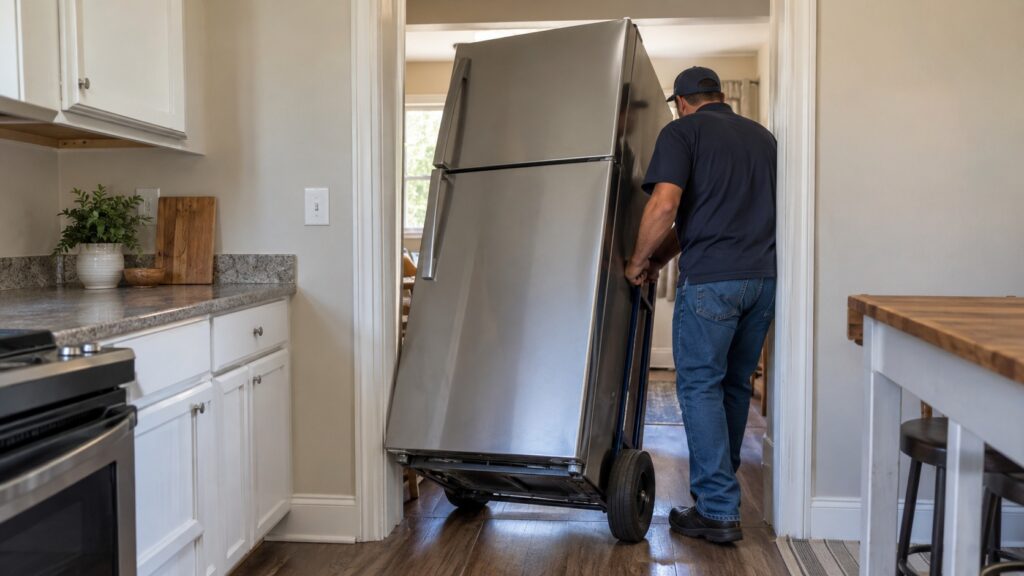
If a new refrigerator will not fit through a tight doorway, measure the whole path first, then consider whether Whirlpool refrigerator door removal is the right fix, and follow the exact steps in your owner’s manual or installation sheet, because the hinges, the wiring and the water line are different on each model. Our Whirlpool refrigerator installation guide notes that French-door units are deep and that you may need to remove a door to get the refrigerator inside. Removing a door is a careful two-person job, and a door with a dispenser or a display needs extra care.
Do you really need to remove the door?
Not always. Start by measuring. Take the width and the height of the doorway, then follow the whole route the refrigerator will take: hallways, turns, stairs, the final doorway and the spot in the kitchen. Compare each with the refrigerator’s depth, width and height on its spec sheet. Our Whirlpool refrigerator installation guide says to measure the opening and the doorway path first, because French-door units are deep.
Often the door of the room is the easier thing to take off. A room door can usually be lifted off its hinges without tools beyond a screwdriver, and that gains a little width for free. Removing handles on the refrigerator, if the manual allows it, can help, too. Door removal on the refrigerator itself is the next step when the measurements still do not work.
Which refrigerators are the hardest to get through a doorway?
The deep and wide ones. Our model pages list the WRF767SDHZ as a 36-inch-wide French-door model of 27 cu ft, and the WRS325SDHZ as a 24.6 cu ft side-by-side with an in-door water and ice dispenser. A top-freezer such as the WRT318FZDW, at roughly 30 inches wide, is a more forgiving size. The more room the refrigerator has inside, the more it takes up on the way in, so compare the model’s measurements to your path before you buy.
If your doorway is very tight, a delivery crew will know how to get the refrigerator in. Ask about door removal when you order, so they bring the right tools and know what to expect.
What should you know before you start?
Read the instructions for your model first, because there is no single method. Doors differ in how they attach, and some carry electrical connections for lights, a display or a dispenser, and a water line for the dispenser or ice. Unplug the refrigerator and shut off the water supply before you touch any door that has a line or wiring, and never tug on a line or a connector. If your manual says door removal is not an owner’s job, or you cannot tell what is connected, stop and call a technician.
Plan the space too. Clear a safe place to lay the door, with a blanket or cardboard under it. Take photos of every connection and every piece of hardware as you go. Keep screws, pins and brackets in a labeled container so nothing is lost.
How do you handle a heavy door safely?
With two people, one on each side, and with the door supported at all times. A refrigerator door is heavy, and an unsupported door can fall, damage the floor and hurt a hand or a foot. Release and lift it only as the manual describes, and do not twist it. This guide does not give the order of removal because it differs by model. Lay it flat on a soft surface rather than leaning it against a wall, since a leaning door can slide. Wear gloves for grip, and keep your fingers clear of hinge points and edges.
Do not pry at a door or a hinge with a screwdriver. If a part will not release as the manual says, there is a reason; ask a technician rather than forcing it.
What should you check when the door goes back on?
Refit the door as the manual describes, with the help of your photos, and make sure every connection is firm before you restore power. If any water line or wiring connection looks wrong, stop and call a technician. Check that the door closes on its own and the gasket sits flat all the way around, then look for gaps. Our installation guide says a refrigerator should be slightly tilted back so the doors self-close, with the front raised about a quarter inch above the back, so check the level after the refrigerator is in position. The installation guide also says to let the refrigerator run empty for at least 24 hours before loading it.
If the dispenser line was disturbed, turn the water on slowly and check each joint for drips before you push the refrigerator back. Our Whirlpool refrigerator water leaking guide covers what to look for if water appears later.
When should you call a technician?
Call before you start if the door has a dispenser, a display or any line or wiring you cannot identify, if your manual does not describe door removal or if the refrigerator will not fit even with a door off. Call afterward if the door does not seal, the dispenser does not work or the display is dead. If water reaches an outlet, switch off the breaker at the panel while standing on a dry floor and never pull a plug from a wet outlet. Our Whirlpool refrigerator repair page explains how a visit works.