Whirlpool EveryDrop is the water filtration line used across Whirlpool refrigerators — the cartridge that treats the water going to your dispenser and your ice maker. It is the most frequently replaced part in the appliance and the one most often replaced late, which is why it accounts for a disproportionate share of complaints about taste, ice quality and slow dispensing.
Why the interval is a date and not a flavor
Carbon filtration works by adsorption: contaminants stick to an enormous internal surface area until that area is occupied. It is a finite capacity, and once it is used the cartridge passes water essentially untreated. Nothing about the cartridge announces this — there is no color change, no resistance, no noise.
The indicator light on the refrigerator counts time or volume rather than measuring anything, which makes it a reminder rather than a sensor. By the time a taste is noticeable, the cartridge has been doing very little for some weeks. Six months, on a date written down, is the whole discipline.
Fitting one, and the two mistakes
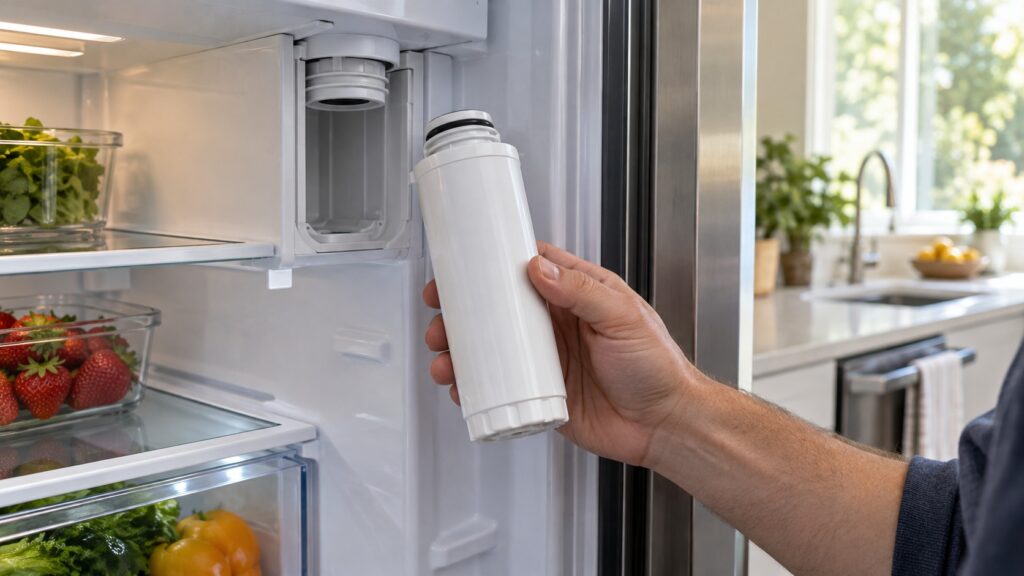
- Seat it fully. A cartridge not turned home leaks — sometimes into the compartment, sometimes behind the liner where you will not see it for months.
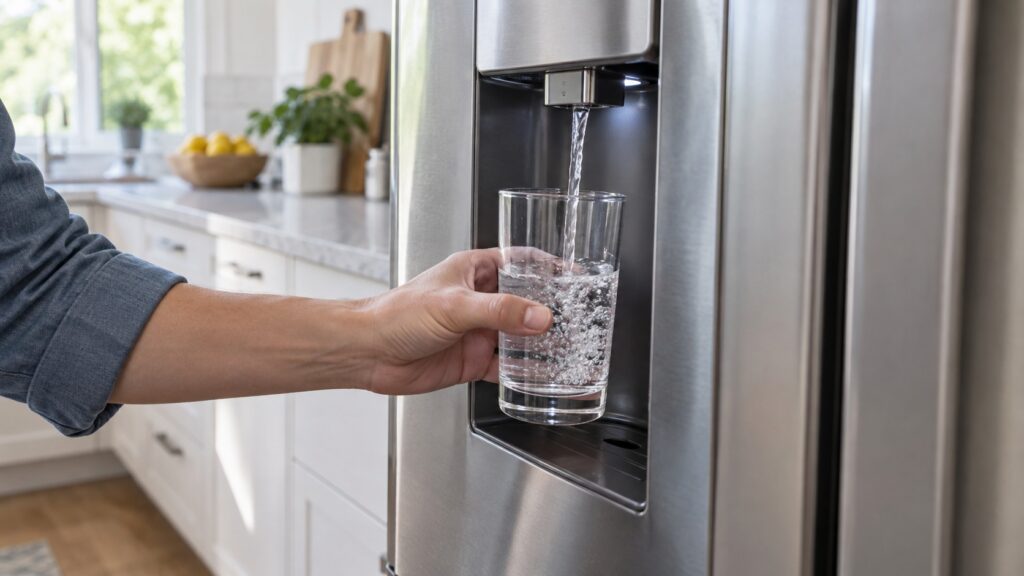
- Flush it. Several gallons through the dispenser before trusting the water, and discard the first two batches of ice. The gray flecks are carbon fines from manufacturing.
- Reset the indicator so the count starts again. It is a reminder, and a reminder that was never reset is worse than none.
- Keep the old housing cap if the model uses one. Fitting a cartridge without it is how people end up with an unsupported connection.
Slow dispensing is usually the filter
A blocked cartridge restricts flow, and the symptom people report is a dispenser that trickles or an ice maker producing small, hollow cubes. Both are the same cause: the machine is not getting the volume it expects in the time it allows.
The test is simple and settles it. Bypass the filter if your model has a bypass plug, or fit a new cartridge, and see whether flow returns. If it does, you had a filter problem. If it does not, look at the supply valve, the line and the inlet valve instead — see our page on water problems at the refrigerator.
What a filter cannot do
This is where expectations and capability part company. A carbon cartridge improves taste and removes particulates and chlorine; it does not soften water. Hardness passes straight through, which is why limescale still forms in the ice maker mold and on the fill tube in a hard-water area, and why a filter changed diligently does not stop it.
It also does not sterilize, and it is not a substitute for a supply that is safe to begin with. If the concern is a specific contaminant, the answer is the certification on the specific cartridge rather than the brand name — different models in the line are certified for different things.
Ice and water taste: filter first, then the freezer
When ice tastes wrong, the filter is the first suspect and the freezer is the second. Ice is porous and sits in an open bin absorbing whatever is around it, so an unwrapped package or a freezer that has not been cleaned will flavor it regardless of filtration. Washing the bin quarterly in warm water — no detergent, nothing scented — deals with the second cause.
After any long absence, discard the first few batches. Ice sublimates and concentrates whatever it has absorbed while nobody was using it. Our page on ice that tastes bad works through the order, and the cleaning and filter guide covers the routine.
Counterfeits, and how to avoid buying one
Water filters are one of the most counterfeited appliance parts, because the cartridge is a consumable with a recognizable shape and a good margin. A counterfeit generally fits and generally flows — which is exactly the problem, since the thing it fails to do is the thing you cannot see. There is no certification behind it, and no way to know what, if anything, it removes.
The practical defenses are dull and effective. Buy from a source you would return a refrigerator to. Treat a price far below the going rate as information rather than a bargain. Look for the certification marks printed on the cartridge itself rather than on the box. And be wary of listings whose photographs are of the box rather than the part.
Bypassing, and when it is legitimate
Most models accept a bypass plug in place of a cartridge, and using one is a reasonable choice in two situations: a household on a whole-house filtration system that already treats the supply, and a diagnostic test to find out whether a cartridge is causing a flow restriction.
What it is not is a way to save money indefinitely on municipal water you find acceptable — unfiltered water in an ice maker deposits more in the mold and the fill tube over time, and the cost of that is a service call rather than a cartridge.
When to call
A dispenser that is slow with a new cartridge, water appearing inside or beneath the refrigerator, an ice maker that fills inconsistently, or a housing that leaks after a change — those are the valve, the line or the housing rather than the filter.
We are an independent repair company, not a factory service arm. Pricing starts from a diagnostic visit and we confirm the estimate before any work begins. Whirlpool refrigerator repair covers the water circuit, and you can schedule a visit online. For the rest of the appliance, see our maintenance checklist.