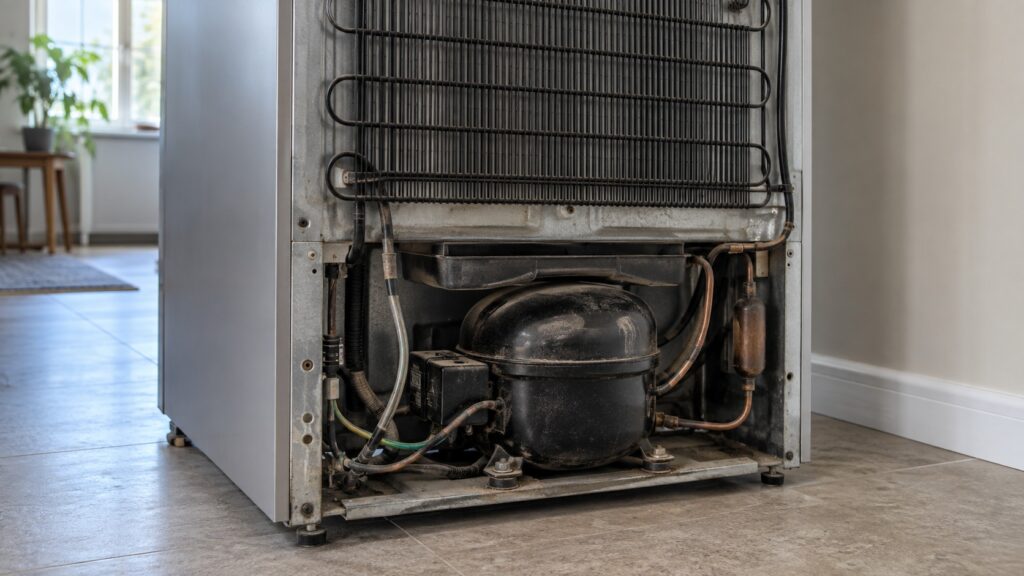
Whirlpool refrigerator compressor repair or replace decisions usually favor repairing the compressor rather than junking the whole appliance, but only up to a point: the compressor is the single most expensive individual part in a refrigerator’s cooling system, so the decision comes down to the refrigerator’s age, whether the compressor is still under a sealed-system warranty, and whether anything else on the unit is also showing wear. Our refrigerator buying guide is worth reading too if replacement turns out to be the better option.
How do you know the compressor is actually the problem?
A refrigerator with a failing compressor typically shows one of two patterns: it runs constantly, loudly, and never quite reaches its set temperature, or it makes an unusual repeating hum, click, or buzz and then goes quiet without the interior actually cooling down. Both patterns are consistent with a compressor that’s struggling to build or maintain the pressure the sealed system needs. That’s different from a refrigerator that isn’t cooling but runs quietly and normally — that pattern more often points at a blocked airflow, a failing evaporator fan, or a defrost system fault rather than the compressor itself. Our guide on a Whirlpool refrigerator not cooling covers that broader set of causes, since compressor failure is only one of several things that can produce the same basic complaint.
Why is a compressor repair so much more expensive than most other refrigerator repairs?
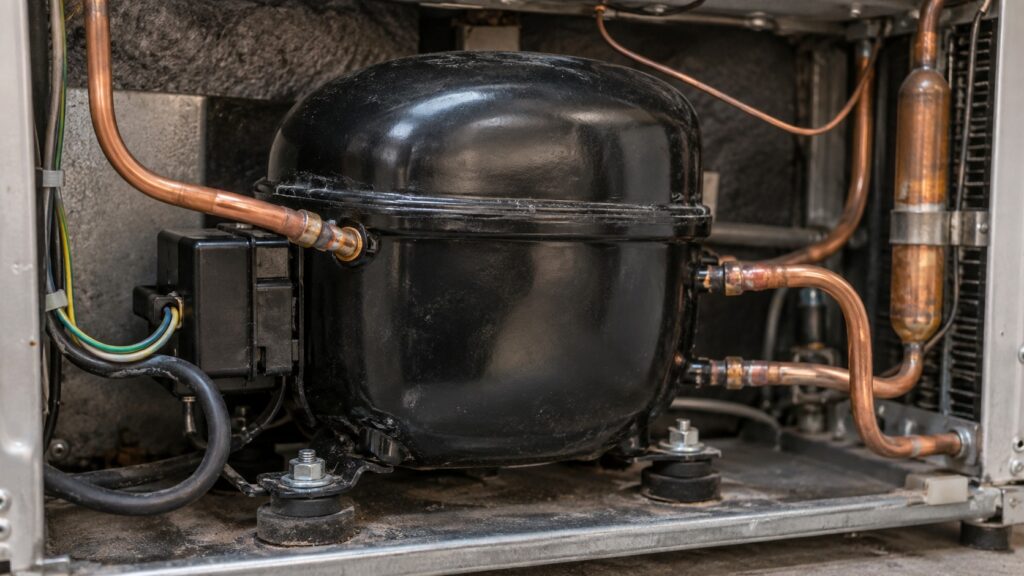
The compressor sits inside a sealed refrigerant system, which means replacing it isn’t a simple part swap the way replacing a fan or a switch would be. A technician has to reclaim the existing refrigerant, remove and replace the compressor itself, then evacuate the system and recharge it with the correct refrigerant charge before it will run properly again — each of those steps takes specialized equipment and licensing that a straightforward parts swap doesn’t require. That’s the main reason compressor repair costs run noticeably higher than most other refrigerator fixes, and it’s also why compressor problems are the ones most worth getting a second opinion on before committing to either repair or replacement.
Is the compressor covered under a longer warranty than the rest of the refrigerator?
Often, yes — many Whirlpool refrigerators carry a sealed-system warranty on the compressor and related sealed components that runs longer than the standard one-year appliance warranty, sometimes five or ten years depending on the model and when it was purchased. If your refrigerator is within that window, it’s worth checking your paperwork or contacting Whirlpool directly before paying for a compressor repair out of pocket, since a compressor covered under warranty changes the entire calculation in favor of repair regardless of the unit’s age otherwise. This is the single most valuable thing to confirm before assuming a compressor failure means an expensive bill.
What makes replacing the whole refrigerator the better choice instead?
Age and accumulated wear are the deciding factors once warranty coverage is off the table. A refrigerator in its first decade of use, with no other significant repairs behind it and a compressor failure as an isolated issue, is usually worth repairing — the cost of the compressor job is meaningfully less than a new refrigerator, and the rest of the unit has years of useful life left. Once a unit is well past that point, or the compressor failure has already damaged other parts of the sealed system — a common outcome when a compressor fails and pushes debris through the refrigerant lines — the repair cost climbs while the remaining expected lifespan of everything else stays the same or shrinks. At that point a new refrigerator, often more energy-efficient than an aging unit besides, tends to be the better value.
Can a compressor be repaired instead of fully replaced?
In most cases, no — a compressor that’s failed mechanically or electrically is replaced as a complete unit rather than repaired internally, since it’s a sealed component not designed to be opened and serviced in the field. What can sometimes be repaired instead is a component around the compressor — a start relay or overload protector that’s failed while the compressor itself is still good — and that distinction is worth having a technician confirm before assuming the compressor itself needs replacing. A failed start relay can produce symptoms similar to compressor failure, including a repeating click that never leads to the compressor actually running, at a fraction of the repair cost.
Is it worth getting a second opinion before paying for a compressor replacement?
Yes, and this is one of the few refrigerator repairs where a second opinion routinely pays for itself. Compressor replacement is expensive enough, and the misdiagnosis risk from a failed start relay or overload protector common enough, that a brief second look before committing to the larger job is worth the time. Ask specifically whether the technician tested the start relay and overload protector independently of the compressor itself, rather than assuming compressor failure from the symptoms alone — a clicking, humming refrigerator that never starts cooling can come from either, and only a direct test on the part itself tells them apart reliably.
What should you check yourself before assuming it’s the compressor?
Confirm the refrigerator is getting steady power and that nothing around it is blocking the condenser coils or fan underneath or behind the unit — restricted airflow around the compressor area can cause it to run hot and loud in a way that looks like compressor failure but resolves once the airflow path is cleared. If the refrigerator has been recently moved or the area behind it hasn’t been cleaned in a long time, that’s worth checking first, since it costs nothing and rules out the least expensive possible cause before assuming the worst. Our refrigerator maintenance checklist covers that kind of routine care in more detail. Beyond that, diagnosing an actual compressor fault reliably needs a technician’s tools, since guessing wrong here means paying for a repair that doesn’t fix the problem.
If your Whirlpool refrigerator’s compressor is showing signs of failure, our technicians can confirm the diagnosis and check your warranty coverage before you commit to either repair or replacement — schedule a visit and we’ll walk through both options with you.