The whirlpool dishwasher repair or replace question usually arrives after a leak, a flood of suds, or a machine that has simply stopped mid-cycle. Almost all of those are parts rather than endings. A dishwasher is a pump, a motor, a heater, some valves and a door — and only two items on that list ever make replacement the better answer.
Rule out the filter before anything else
A blocked filter produces the complaints people replace dishwashers for: poor cleaning, a machine that will not drain, standing water in the base, and an odor that survives every cleaning product. It is a cylinder that lifts out and rinses in a minute, and it is the single most valuable check on this page.
The same goes for the spray arms. Holes blocked by seeds, labels or limescale change the spray pattern, and the result is a load that comes out clean on one side. Both arms come off by hand on most machines. Our filter cleaning guide covers the routine and our page on poor cleaning covers the rest.
Leaks are mostly cheap
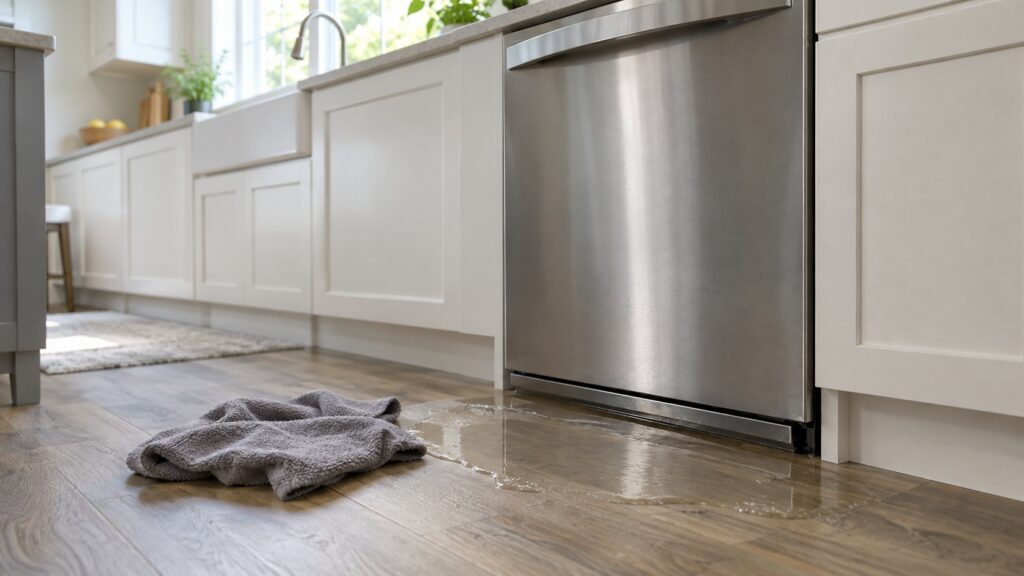
A leaking dishwasher sounds terminal and usually is not. The common sources, in the order we find them, are the door seal, the door latch holding the door slightly open, an overfilled tub caused by a faulty float or inlet valve, a hose clamp, and the drain hose connection. Every one of those is an inexpensive part.
The one that changes the answer is a leaking tub — a crack or a corroded seam in the stainless or plastic body itself. That is not repairable in any sensible way, and it is the clearest replace case there is. Our leaking guide works through identifying the source, which matters because the cheap causes and the expensive one produce the same puddle.
Suds are almost never the appliance
A machine foaming over is nearly always dish soap that found its way into the detergent compartment, or far too much of the right detergent in soft water. The fix is to run rinse cycles until the foam clears, and then not to do it again. No part has failed, and we have been called to more than one machine that was about to be replaced over this.
Where the line actually sits
- Under about eight years: repair is usually the better value, including the board and the wash motor.
- Eight to twelve years: repair the cheap items without hesitation; think about a board or a motor.
- Past twelve years: a major component is a close call, and the cheap parts are still worth doing.
- Any age, tub leaking or corroded: replace. That is the appliance failing rather than a part.
Note that a dishwasher is not a built-in in the way a wall oven is. Replacement is an ordinary swap into a standard opening, so the cabinetry argument that shifts the answer for ovens and wine cabinets does not apply here.
What running costs do to the sum
An older machine uses substantially more water and energy per load than a current one, which does shift the arithmetic on a marginal repair — but far less dramatically than it is usually presented. A dishwasher runs a few times a week, not continuously, so the saving is real and slow. It is not a reason to replace a machine that needs a fifty-dollar pump.
Where it does count is on a machine already needing a major component at ten or twelve years. There, the energy difference is one more small weight on a scale that was close anyway.
The faults that repeat, and what they are telling you
A single failure is a part. The same failure twice is a message. A drain pump that fails again within a year or two is usually being killed by something upstream — glass fragments getting past a damaged filter, or a drain line with a sag that holds debris. A door seal that keeps failing points at a latch that is not pulling the door square, so the seal is compressed unevenly on every cycle.
The one worth taking seriously is a control board that has failed twice. Boards do not usually die of old age; they die of heat, moisture or a supply problem. A second board failure is worth diagnosing rather than simply replacing, because the third will follow the same path.
Noise, and what each kind means
Dishwashers are not silent, and the sounds are distinguishable. A steady hum that rises and falls through the cycle is the wash motor and is normal. A grinding at the start of the drain phase is usually debris in the pump — often a seed or a fragment of glass, and often clearable. A rhythmic knocking is a spray arm hitting something in the rack, which is a loading problem rather than a fault.
What is worth acting on is a high whine that has developed over months, which points at a motor bearing. Caught early that is a motor replacement; ignored, it takes the pump housing with it.
What a diagnosis establishes
Four questions decide it. Is the tub sound? Does the wash motor run and pump properly? Is the fault a discrete part, and is that part available? And how old is the machine? A dishwasher that fails only the third question — a board no longer made — is the one genuinely awkward case; everything else resolves cleanly.
None of that can be settled from a description, because a puddle from a door seal and a puddle from a cracked tub look the same on the floor.
Getting an honest number
We are an independent repair company, not a factory service arm and not a dealer, so we have nothing to sell you on the replacement side. Where a repair is not worth doing, we say so and explain why. Pricing starts from a diagnostic visit and we confirm the estimate before any work begins.
Whirlpool dishwasher repair covers pumps, valves, doors and controls, and you can schedule a visit online. If you are replacing rather than repairing, our buying guide covers the two decisions that actually matter, and the installation guide covers the opening.