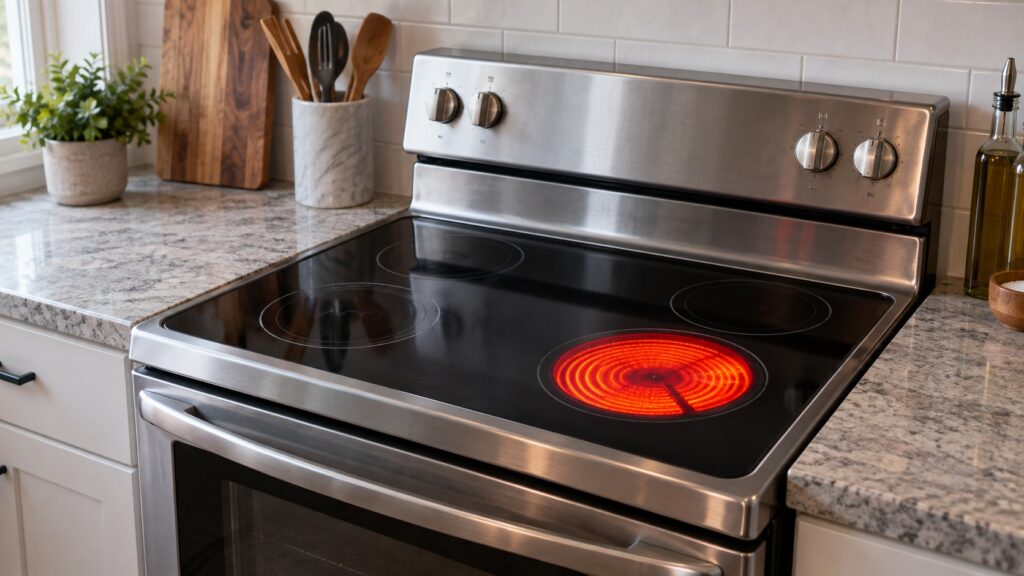
Whirlpool FlexHeat is the name for a dual-ring heating element on certain Whirlpool electric cooktops and ranges — a single burner built with two concentric heating zones so it can act as a small burner for a saucepan or expand to a larger zone for a griddle or a big stockpot. Instead of buying a separate small and large burner for different cookware, FlexHeat gives you both in the same spot on the cooktop.
How does a FlexHeat burner actually work?
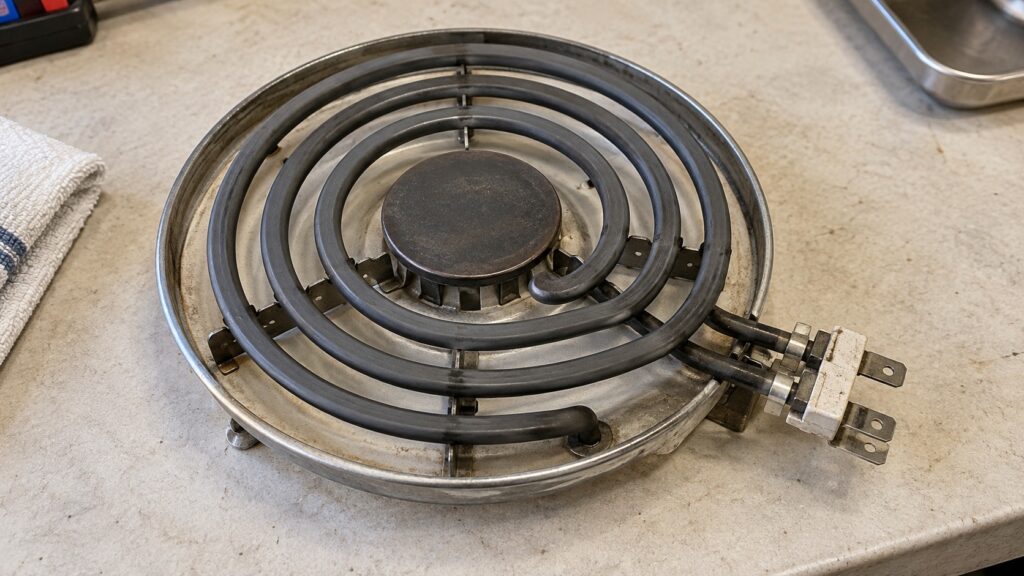
A FlexHeat element is built as two separate heating rings sharing one burner location — an inner ring sized for a small saucepan and an outer ring around it that switches on when you select the expanded setting. Selecting the inner-only mode heats just the center, appropriate for a small pot; selecting the expanded mode powers both rings so the full burner surface heats, appropriate for a griddle, a wide skillet, or a large stockpot. The two rings share electrical connections but heat independently based on which mode you’ve selected, so switching between them mid-cook is as simple as turning the control.
Why would you want a dual-ring burner instead of separate fixed burners?
A traditional range layout gives you a fixed set of burner sizes across the cooktop, and if your cooking that day doesn’t match that layout — say, you need two large burners but the range only has one — you’re stuck working around it. FlexHeat solves this by making one burner position flexible to the cookware you actually have on it that day, rather than committing the whole cooktop’s layout to a fixed assumption about what sizes you’ll need most often. It’s most useful on ranges with a smaller overall burner count, where every position doing double duty matters more than on a large professional-style range with six or eight burners to spread cookware across.
Does FlexHeat affect how evenly the burner heats compared to a standard element?
Not meaningfully, as long as you’re using the mode that matches your cookware size. Running the expanded mode with a small pot sitting only over the inner ring wastes energy heating an outer ring nothing is touching, and can create an uneven hot spot pattern on the cooktop surface around the pot’s edges. The element is designed to perform like a standard single-size burner within whichever ring configuration you’ve selected — the flexibility is in matching burner size to cookware, not in the heating characteristic of either ring on its own.
What can go wrong with a FlexHeat element over time?
Because a FlexHeat burner is really two heating circuits in one location rather than one, it has more connection points and more places a failure can isolate to just one ring rather than the whole burner. A common symptom is one ring working while the other doesn’t — the inner ring heats fine but the outer ring stays cold even when the expanded mode is selected, or vice versa. That’s a sign one ring’s connection or switch has failed rather than the whole element, and it’s worth having that confirmed before ordering a full replacement element, since replacing only the failed ring’s connection is sometimes possible depending on how your model is built.
If a whole burner position stops heating entirely in every mode, that points at the shared power feed to that position rather than either individual ring, and it’s a different diagnosis than a single-ring failure. Our guide on a Whirlpool range not heating covers oven-side heating faults, while burner-specific heating issues are closer to what a technician checks during a range maintenance visit.
How should you clean and care for a FlexHeat cooktop?
On smoothtop versions, treat the surface the same way you would any glass cooktop — a scraper for stuck-on spills once the surface is cool, and a cleaner rated for ceramic glass rather than an abrasive pad that can scratch the finish over the two rings’ boundary. On coil versions, the drip pans under each ring should be kept free of buildup, since caked residue there insulates the element from the pan and slows heat transfer in a way that can look like the element itself is weakening when it’s really the pan underneath that needs cleaning.
Spills that run into the gap between the inner and outer ring deserve particular attention, since that boundary area collects debris more than a single continuous element surface would. Left uncleaned over time, that buildup is a common contributor to one ring underperforming relative to the other.
Is FlexHeat worth choosing over a fixed-burner range when you’re buying?
If your cooking regularly shifts between small and large cookware — weekday meals in a saucepan, weekend batch cooking in a stockpot or on a griddle — FlexHeat gives you that flexibility without dedicating two separate burner positions to cover both cases. If your cookware sizes are fairly consistent and you rarely need the largest setting, a fixed-burner range in the same price tier isn’t giving anything up by comparison; the value of FlexHeat is specifically in variable cookware use, not in raw heating performance. Our range hood buying guide is worth reading alongside any range purchase, since a wider expanded-mode burner setting also means more heat and steam to vent properly above the cooktop.
Because the outer ring only activates when the expanded mode is selected, it’s easy to go a long time without noticing a failed outer ring at all if most of your cooking uses small cookware over the inner zone alone — the fault only becomes obvious the first time you actually need the larger setting for a stockpot or griddle and it doesn’t heat. That delay between failure and discovery is worth keeping in mind if you’re troubleshooting a burner that “used to work fine” on everyday cooking but underperforms specifically on larger cookware.
If a FlexHeat burner on your range isn’t heating evenly or one ring has stopped working, our technicians can confirm which ring or connection is at fault — schedule a visit and we’ll check the element before you order a part.