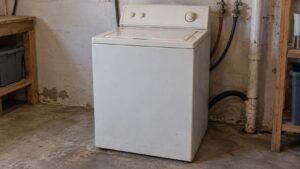
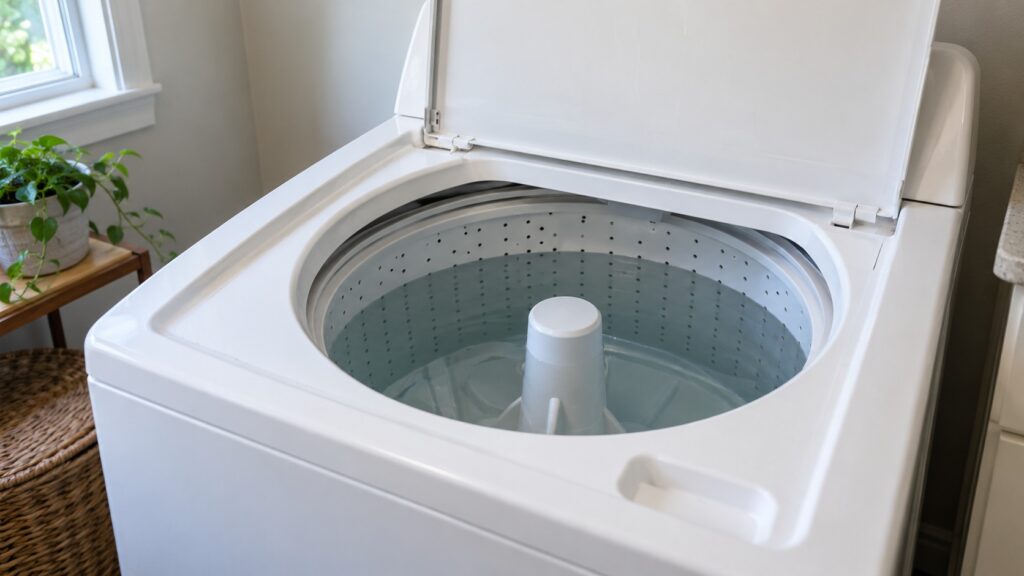
The Whirlpool washer water level is decided by reading pressure, not by looking at the tub. A pressure sensor, fed by a thin air tube from the side of the tub, reports the water level to the control board; on some models a flow meter helps too. The board opens the inlet valves until the sensor says the level is right, and it throws a code if the reading never arrives in time or goes too high.
How does a Whirlpool washer know how much water is in the tub?
Inside the cabinet, a small hose runs from the side of the tub up to a round sensor on the control side. As water rises in the tub, it compresses the trapped air in that hose. The sensor feels that air pressure and turns it into a signal for the control board. Our F8E1 long-fill guide calls this small hose the air-dome tube and describes it as the line that lets the pressure sensor read the water level. A level reading, in other words, is a pressure reading.
That is why the sensor needs no float or contact with the water. It is also why a kink, a clog or a loose connection at that tube can make a perfectly good washer misread its own level. Our Whirlpool washer how-it-works guide describes the four stages of the cycle; this page zooms in on the one question the control asks over and over: is there enough water yet?
What happens during fill, step by step?
Once you start a cycle, the board opens the inlet valve or valves, hot, cold or both, depending on the cycle and the temperature setting. Water flows in while the board watches the pressure signal. When the signal reaches the target for the load size and cycle, the board closes the valves and moves on to the wash stage. If the reading is not reached in the allowed time, it stops waiting and logs F8E1. If water rises past its safe level, it logs F8E3. Nothing in that logic needs you to be present, and it repeats at each fill: the main wash, the rinse and any extra rinse.
The key point is the order. In general the washer waits for the level to be confirmed before it moves on to the next stage. A fill problem can therefore look like a wash or spin problem: if the washer stalls early, it never reaches the later stages.
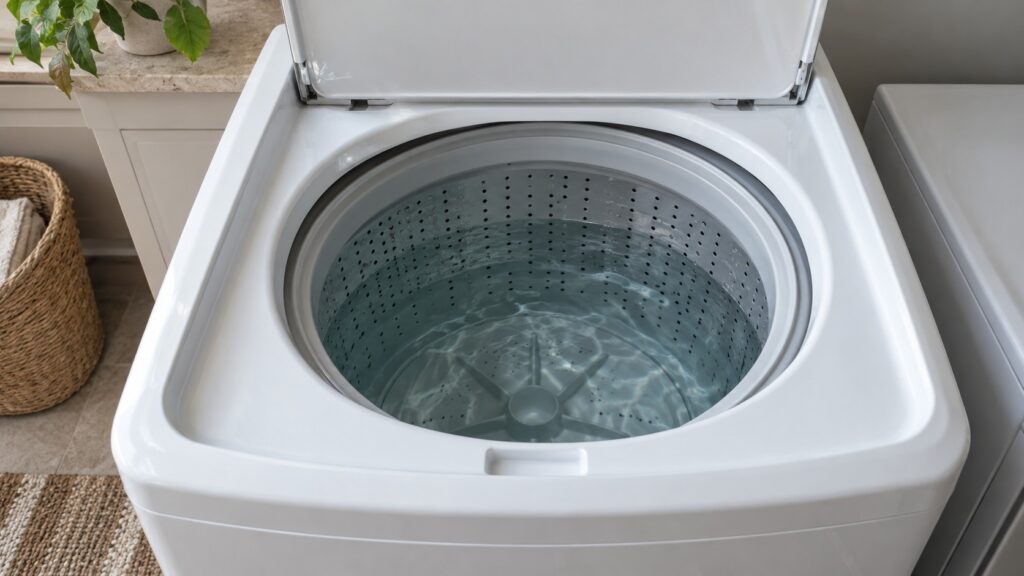
Why do top-load and front-load washers read the level differently?
The principle is the same on both, but the water they need is not. The WTW5057LW is a top-load washer with a Deep Water Wash option, and the name of that option points to a deeper fill, but our page does not say how much; the owner’s manual does. Front-load WFW models, such as the WFW5620HW with Steam, are a different design. The model pages for both list F8E1, F9E1 and the lock codes among the calls we see most.
That is one reason we do not give a single water depth for every Whirlpool washer. The target level depends on the model, the cycle and the load, and the exact numbers are in your owner’s manual or on the model’s spec sheet. Treat any figure on a forum or a video as unverified until you have checked it against your own washer.
What does a bad reading look like at home?
Symptoms follow from the logic above. If the sensor or tube misreads the level, the washer can mis-time the fill, and a fill that never reaches the target shows up as F8E1. If water will not leave the tub, the sensor keeps seeing a high level and the cycle cannot move on, which is the F9E1 long-drain code that our Whirlpool washer will not drain guide explains. A washer that fills, then stalls and never spins is covered in Whirlpool washer not spinning.
In every case, the code matters more than the guess. Look it up on our washer error code pages before you pull anything apart.
What can you check safely without opening the cabinet?
Start outside the machine. Open both supply valves all the way, because hand-tight is not always fully open. Look behind the washer for a kinked or crushed fill hose. Make sure hot and cold hoses are both connected. If you are comfortable shutting off the water and unplugging the washer first, the small mesh screens at the valve inlet can be rinsed of debris; we describe that step in the F8E1 guide. Check that the drain hose is not kinked and is routed per the owner’s manual. If a power cycle makes sense, unplug the washer for five minutes and plug it back in, as our not-spinning guide describes, but only if the floor and outlet are dry.
Stop there. The pressure sensor, the air tube and the inlet valves live behind panels with live electrical parts and water connections. Leave them to a technician, who will cut power and water first.
When does a technician need to look at the level system?
Call when supply and hoses are fine and the washer still fills slowly, overfills or logs F8E1 or F8E3 again after a reset. A technician tests the inlet valve solenoids and the pressure circuit before replacing anything, and checks the air tube for a kink or a blockage, a cause that is easy to miss. Our washer repair page explains how a visit works, and you can book a visit online.