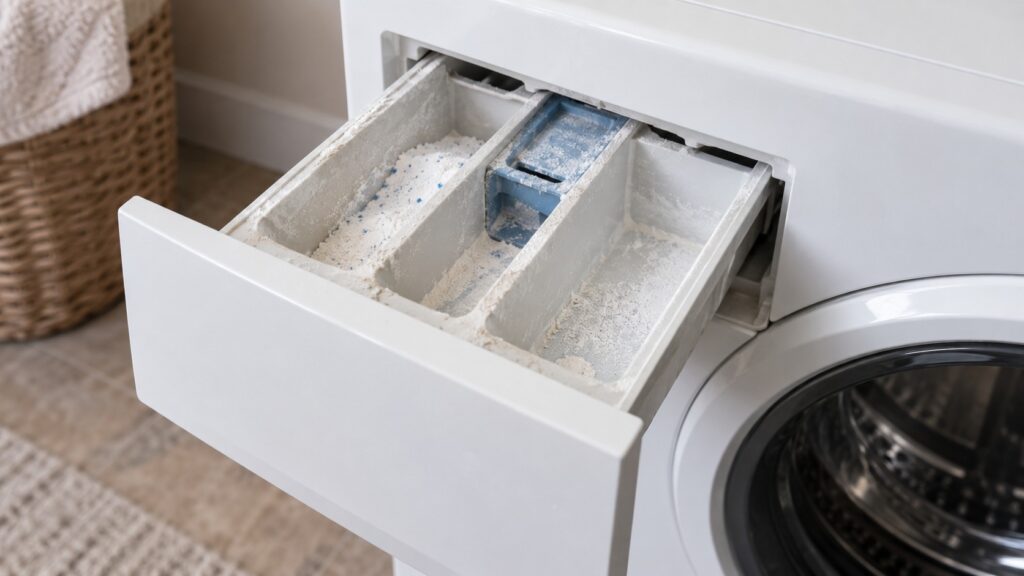
To clean a Whirlpool washer dispenser, empty it, pull the drawer out as far as it will go, soak and scrub off the hardened detergent and softener sludge, rinse the housing behind it, dry everything and slide the drawer back in. The way the drawer releases differs by model, so check your owner’s manual for the release for your washer. A clean dispenser stops residue from building up and from adding to a musty smell.
Why does a Whirlpool washer dispenser get dirty?
High-efficiency washers use very little water, so detergent and fabric softener do not always rinse completely out of the drawer. What stays behind dries into a crust in the compartments, and softener turns into a thick, sour sludge at the back of the drawer and in the siphon cap. Using more detergent than the load needs makes it worse, and so does using regular detergent in a high-efficiency machine. Leftover residue also gives odor-causing bacteria something to feed on, which is why a dirty dispenser and a musty washer often go together.
Our guide to cleaning a Whirlpool washer and stopping the smell covers the drum and the door gasket. This page is only about the dispenser.
Which Whirlpool washers have which kind of dispenser?
The model pages on this site list a detergent dispenser on the front-load WFW5605MW, which also lists Steam, Quick Wash and Vibration Control. The WFW5620HW lists a Load & Go XL dispenser that holds enough detergent for up to 40 loads. Other WFW models, including the WFW6620HW, WFW8620HW and WFW9620HW, list Load & Go XL as well. We do not have step-by-step instructions on the site for how each of these dispensers is taken apart, and the way you release the drawer differs from model to model, so we do not describe it here. Read the cleaning section of your owner’s manual first.
If your washer has a Load & Go XL reservoir, follow the manual for how that part is cleaned. Do not assume it works like a standard drawer.
How do you clean the dispenser drawer?
Start with an empty machine and an empty dispenser. Then work through these steps.
- Pull the drawer out fully. If it has a release tab or button, use it as the manual describes. Never force it.
- Take out any removable inserts, such as the softener cup or the siphon cap, noting how they sit so they go back the same way.
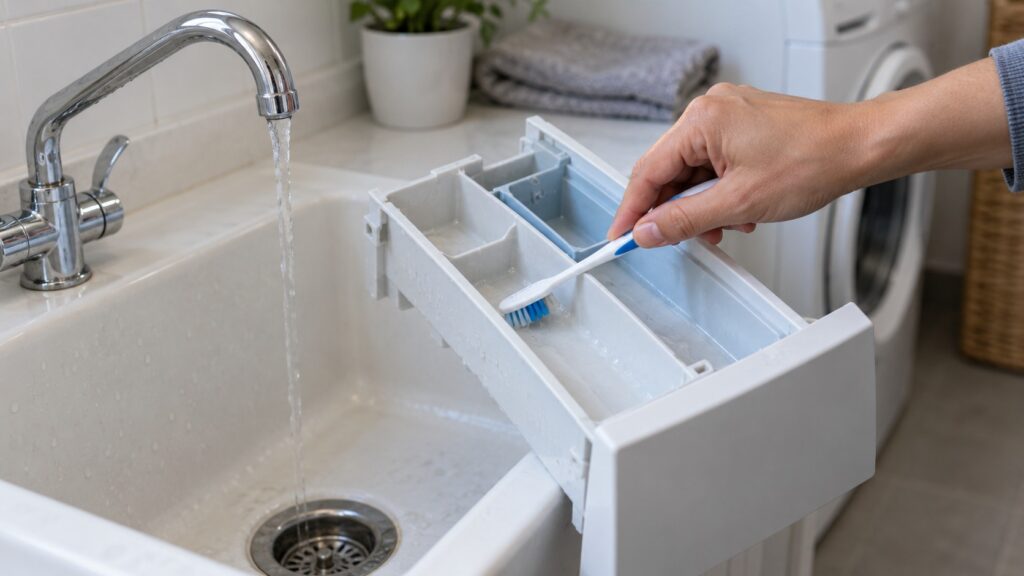
- Soak the parts in warm water and scrub the crust and sludge with a soft brush or an old toothbrush. A soft brush gets into the corners without scratching the plastic.
- Rinse everything under running water until no slippery film remains.
- Dry the parts with a cloth and set them aside to air dry.
Avoid sharp tools. A scraper can gouge the plastic, and a rough surface collects more residue next time.
How do you clean the housing behind the drawer?
With the drawer out, look into the opening with a flashlight. The housing behind the drawer is where sludge hides, and it is the part most people never clean. Wipe what you can reach with a damp cloth or a soft brush on a handle, taking care not to push residue deeper. Do not spray a lot of water into the opening, because the water has to go somewhere. A damp cloth and patience work better than a spray. If you see standing water or mold that you cannot reach, that is a sign to stop and let a technician look, rather than taking things apart yourself.
Never mix cleaning products, and keep chlorine bleach away from other cleaners. If you use a washer cleaner tablet or a bleach cycle, run it as the label and your manual say.
How do you keep the dispenser clean longer?
A few habits cut down how often you need to do this. Measure detergent according to the label and the size of the load. Use high-efficiency detergent in a high-efficiency washer. Run the Clean Washer cycle on a monthly schedule, as described in our Whirlpool washer maintenance checklist. Leave the washer door open between loads so the drum can dry, and wipe the drawer opening when you notice dampness.
Over-dosing is the common thread. Extra detergent does not clean better; it leaves more residue behind, and a suds problem can trigger the F0E5 code on this type of washer. If your washer has already shown a drain or fill code, see our Whirlpool washer F8E1 long fill and will not drain guides, because those are separate faults.
When is a dirty dispenser not the real problem?
If the drawer is clean and the washer still smells, leaves detergent on clothes or fills slowly, the cause may be elsewhere in the machine. A partly clogged drain, a sagging hose or a pump that does not fully empty the tub are examples that we describe on the odor page. Do not take the dispenser housing or the machine’s cabinet apart to look. That is a technician’s job, and it is not needed for ordinary cleaning. Our Whirlpool washer repair page explains how a visit works.