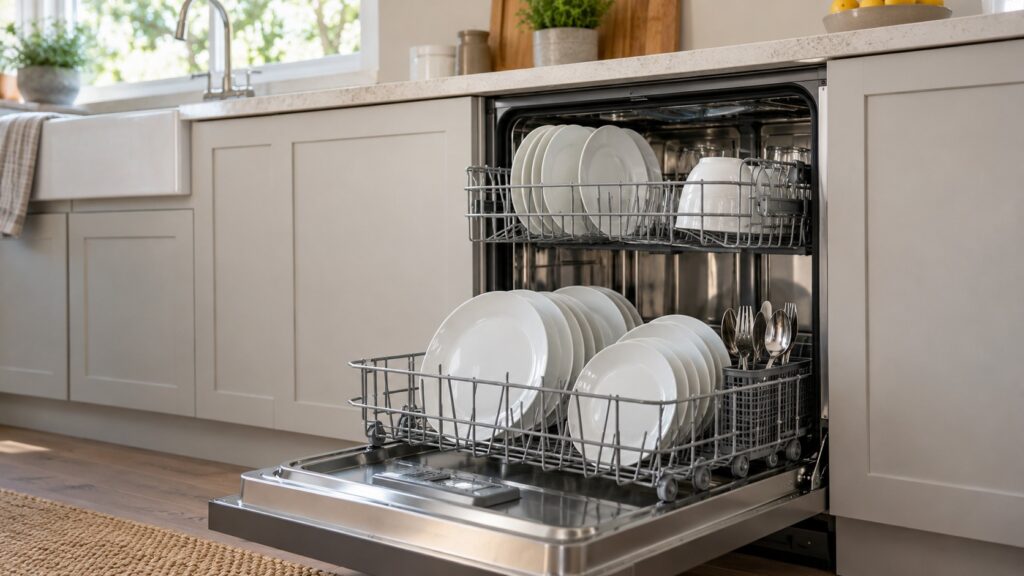
AccuSense is the name Whirlpool uses for the soil sensor on some of its dishwashers. In general terms, a soil sensor lets the dishwasher judge how dirty the load is and adjust the cycle instead of running the same program every time. On our site the AccuSense soil sensor is listed for the WDF520PADM, a front-control dishwasher with 14 place settings, a 1-Hour Wash, Sani Rinse and Heated Dry. Our pages do not say what exactly the sensor measures or how the cycle changes on that model, so this guide explains the general idea, what you can see and do as an owner, and where the manual takes over.
What is the Whirlpool AccuSense soil sensor?
AccuSense appears in the key features of the WDF520PADM model page as an “AccuSense soil sensor”. It is a brand name for a sensing feature. In general, a soil sensor is a part inside the dishwasher that the control uses to judge how dirty the load is, and the control uses that information to decide how to continue. The idea is that a lightly soiled load does not need the same wash as a pan with baked-on food.
Our site does not say whether the sensor works by looking at how cloudy the water is, by another method, or how many sensors there are. We are not going to guess. If you need those details, the owner’s manual for your exact model number is the right source, and the Whirlpool model listing on our site shows only the feature name.
How does a dishwasher soil sensor change the cycle?
In general, a dishwasher with a soil sensor can add or skip steps based on what it reads. A dirty load can mean a longer wash or an extra rinse, and a clean load can finish sooner. That is also why the run time on a sensing dishwasher can differ from one load to the next: it is working to a result, not to a fixed clock. How much the cycle changes, and which cycles use the sensor at all, is model-specific, and this is where the manual matters.
Our guide to how a Whirlpool dishwasher works describes the basic stages that every cycle moves through: fill, heat, wash, filter and drain. A soil sensor sits on top of that sequence. It does not replace the filter, the spray arms or the drain pump, and it cannot make up for a clogged filter or a blocked spray arm.
What can you do to help the sensor give a good result?
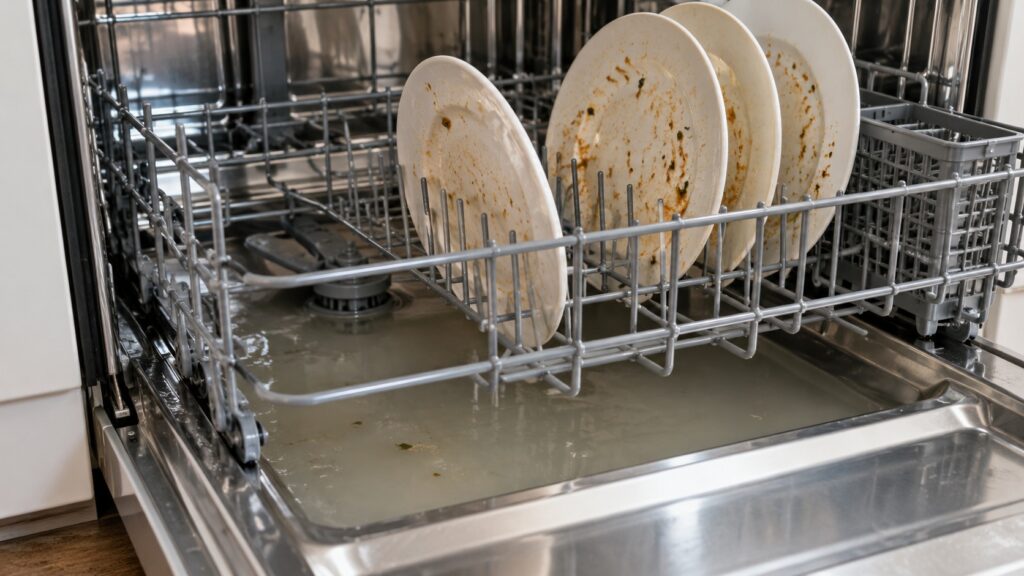
A sensor reads what the washer gives it, so the best help is a clean and sensibly loaded machine. Scrape large food off plates, but do not wash them until they are spotless, because a sensing dishwasher is meant to cope with ordinary soil. Do not block the spray arms with tall items, and keep the detergent compartment clear. Clean the filter on the schedule your manual gives; our dishwasher filter cleaning guide shows the general steps. A filter packed with food makes the wash water dirtier than it should be, which can make any cycle look worse.
It is also worth knowing that a sensing cycle can take a different time on the same load. If the cycle seems to run longer than usual after you fill the machine with heavily soiled pots, that may be the dishwasher doing what it was designed to do. If the clock shows a very long cycle every time, even for a half-empty load of clean glasses, mention it when you call. Do not open any panel on the door or the base to look for the sensor; it is not an owner’s job.
What problems can look like a sensor problem?
Many dishwasher complaints that seem to be about “the sensor” are really about something simpler. Cloudy glasses, a gritty film or dishes that come out dirty usually point to a clogged filter, a blocked spray arm, too little or too much detergent, or hard water. Our dishwasher not cleaning guide goes through those in order. A cycle that never seems to end, or one that ends in seconds, points at the control or at a sensor connection, and a technician is the right person to check it.
The WDF520PADM page lists the codes we see most on that model as F6E1 (low water fill), F8E1 (slow fill), F9E1 (will not drain), F3E1 (thermistor) and F7E1 (wash motor). Those codes are about water, temperature and the wash motor, not about the soil sensor, and our pages do not give a code for a soil sensor fault. If your display shows a code, write it down exactly as shown before you do anything else. Our dishwasher error codes glossary explains each one.
When should you call a technician?
Call when the dishwasher runs the wrong kind of cycle every time, shows a code that returns after a restart, leaves water standing in the tub or leaks. If you see water at the base, sparks or a burning smell, switch off the breaker at the panel while standing on a dry floor, and never pull a plug from a wet outlet. Do not open the door panel or the lower access panel to look inside; that is a technician’s job. We are an independent repair company, and you can read about our Whirlpool dishwasher repair or schedule a visit online.