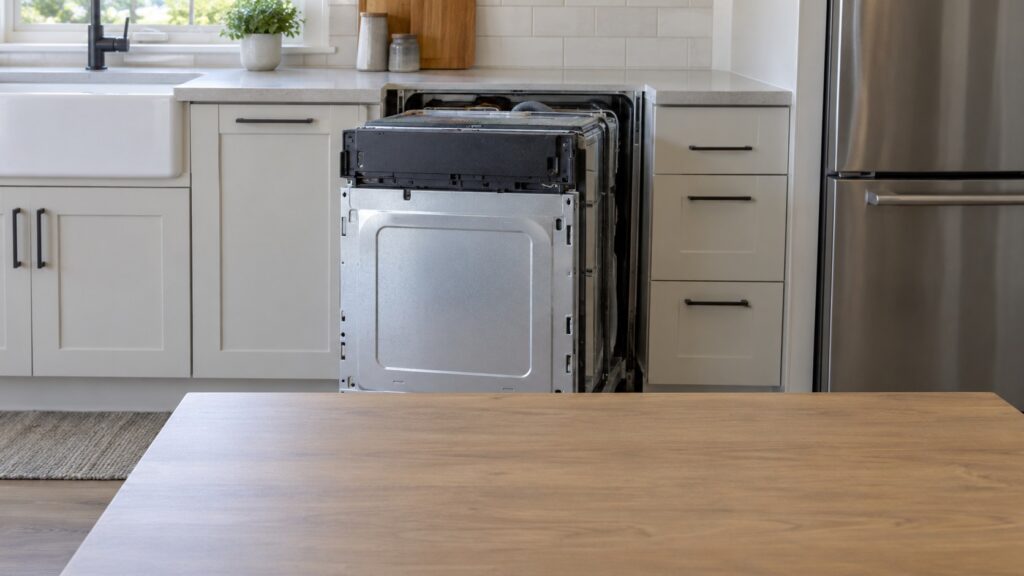
A Whirlpool dishwasher control board is worth replacing when the codes and symptoms point at the board itself and the rest of the machine is sound. It is not worth replacing when the real problem is a leak, a clogged filter or a worn pump that only looks like a board fault, because a new board will fail the same way. Rule out the cheap causes first, have a technician confirm the board, and then weigh a board replacement against a new dishwasher, since the board is the better choice unless the tub, the racks or a second major part are also failing.
How do you know the control board is the problem?
The control board is the dishwasher’s brain: it starts the cycle, opens the inlet valve, runs the pump, heats the water and reads the sensors. Because it sits between everything, many different faults show up on its display. Four of the dishwasher codes on this site name the board or its inputs directly. F1E1 means the control board’s own temperature sensor has failed, so the dishwasher cannot regulate wash and dry temperatures. F2E1 means the board sees a key held down and will not start a new cycle. F3E1 is a wash water temperature sensor reading an open circuit, and the site lists a control board sensor input failure among its causes. F7E1 is a heating circuit that is not drawing the expected current, and a failed heating relay on the board is one of the listed causes. Our Whirlpool dishwasher error codes glossary lists every code in one place.
A board problem also shows up as symptoms without a code: a panel that does not respond, a cycle that stops and will not restart, buttons that act on their own, or a problem that repeats after a reset.
What should you rule out before paying for a board?
Most dishwasher complaints are not the board, and the order matters. Work through these in turn:
- Reset the power. Switch the dishwasher’s breaker off for five minutes, then back on. The code pages recommend this for F1E1, F2E1, F3E1 and F7E1, and it clears a one-time glitch.
- Dry and clean the panel. For F2E1, wipe the control panel clean and dry it thoroughly, then press and release every button to free one that sticks.
- Check the door. A latch or door switch that does not register closed stops the dishwasher from filling or starting. That is F5E1, a different code from the board codes.
- Check water in and water out. A closed supply valve or a clogged inlet gives F6E1 or F8E1, and a clogged filter or kinked hose gives F9E1. If the dishwasher is simply not draining, our Whirlpool dishwasher will not drain guide comes first.
- Look for water near the controls. With the breaker off, look for signs of moisture around the control panel and the lower front. Do not remove panels yourself.
If the problem returns after all of that, the board moves from suspect to likely.
Why does water matter so much to the board?
The F1E1 page lists moisture reaching the control housing as one of the three common causes, along with a failed thermistor and a loose harness. That has a practical meaning: if a leak has been dripping on the board, replacing the board without fixing the leak only buys a second failure. A door seal, a loose hose fitting or an overfull tub can all send water toward the electronics. Fix the source of the water first, using our Whirlpool dishwasher how it works guide to understand where water travels, and only then replace the board. If you ever see water at the controls, sparks, a burning smell or a hot panel, switch the dishwasher’s breaker off on the panel while standing on a dry floor and call us.
When is replacing the control board the right call?
A board replacement makes sense when all of these are true:
- The same board-related code or symptom returns after a power reset and a dry panel.
- The cheaper causes, such as a latch, a valve, a filter or a wiring connection, have been checked or tested by a technician.
- There is no ongoing leak, and the tub, door and racks are in good condition.
- The dishwasher otherwise washes, drains and dries the way it did before the fault.
In that case the machine is a sound appliance with one failed electronic part, so repair is worth weighing against replacement. Ask the technician for the part and labor quote before you decide. The site says the right part is matched from your model and serial number, so have both ready when you book.
When should you replace the dishwasher instead?
Replace the dishwasher when the board is only the latest in a list of problems. Warning signs include a leaking or rusting tub, a failed pump or motor around the same time as the board, door hinges and latches that are worn out, or a board fault on a machine you were already planning to replace. Another warning sign is a second board failure soon after the first, which tends to mean something is feeding the board a problem, such as water or a wiring fault. Our general Whirlpool dishwasher repair or replace guide sets out the wider decision, and it applies the same way here.
If you do decide to repair, state the facts to the technician: the code, whether a reset cleared it, any leaks or water near the controls, and the model and serial number. That information saves a trip.
What does a technician check besides the board?
A technician starts at the cheap, testable parts before condemning the board. They look at the wiring harness and connectors, at the door hinge wiring that carries signals to the panel, at the thermistors, at the heating element and thermal protection, and at moisture inside the control housing. Only when those test good is the board the answer. A board is not a part to guess at, which is why Whirlpool dishwasher repair includes diagnosis rather than parts-swapping.