
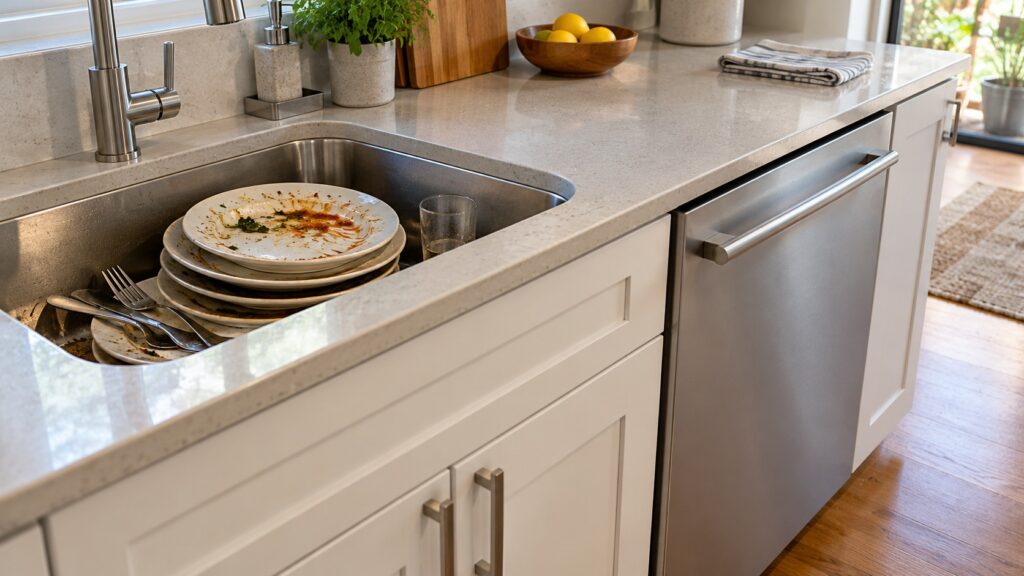
The Whirlpool dishwasher pre-rinse question has a short answer: scrape off the solid food, and then check your owner’s manual for what your model expects. Our site does not say that every Whirlpool dishwasher wants dishes rinsed first, and it does not say that none do. Different models have different filters and sensors, so a rule that works on one may not suit another. What we can give you are the general habits that help any dishwasher clean well, and a way to tell whether your dishes need more help than that.
Do you need to pre-rinse dishes for a Whirlpool dishwasher?
For most households the useful step is scraping, not rinsing. Scraping removes the solid food, such as bones, peels, rice and noodles, that would otherwise clog the filter and the drain. A dishwasher is built to wash off the thin layer that remains. How far beyond scraping your model wants you to go is in the owner’s manual, so use that as the final word. If the manual for your dishwasher says no rinsing is needed, you can skip it. If it says something different, follow that.
A few Whirlpool dishwashers list a sensor feature called AccuSense on their model pages. We do not describe how it works, because our pages only list the name, so check the manual to see what it does on your model before you decide how much to rinse. Do not assume that a sensor changes the advice about scraping.
What should you scrape or rinse, and what should you leave?
Scrape plates into the trash, not into the sink drain. Rinse off anything that would set hard, such as dried egg, cheese that has baked on, or rice that has dried to a crust. Dishes that sit for a long time before they go in the machine are harder to clean than ones loaded soon after a meal. If you will not be running the dishwasher for a while, a quick scrape and a wipe with a cloth is kinder to the machine than leaving the food to dry.
You do not need to wash the dishes by hand first. That makes the dishwasher an extra step instead of a time-saver. A thin film of grease or sauce is what the detergent is there for. Washing every dish thoroughly by hand before loading takes the work out of the machine’s hands and saves you nothing. Follow the detergent maker’s directions on the package for how much to use.
How should you load the dishwasher?
Loading matters at least as much as rinsing. Our guide on a dishwasher that is not cleaning lists the points: face soiled surfaces toward the center, avoid nesting items inside each other, and do not block the spray arms. Large pots or trays standing in front of the detergent dispenser or in the path of an arm stop the water from reaching the dishes. Give the arms room to spin by hand before you start a cycle. Put bowls and cups on the rack upside down so they do not hold water, and keep tall items from touching the arm above them.
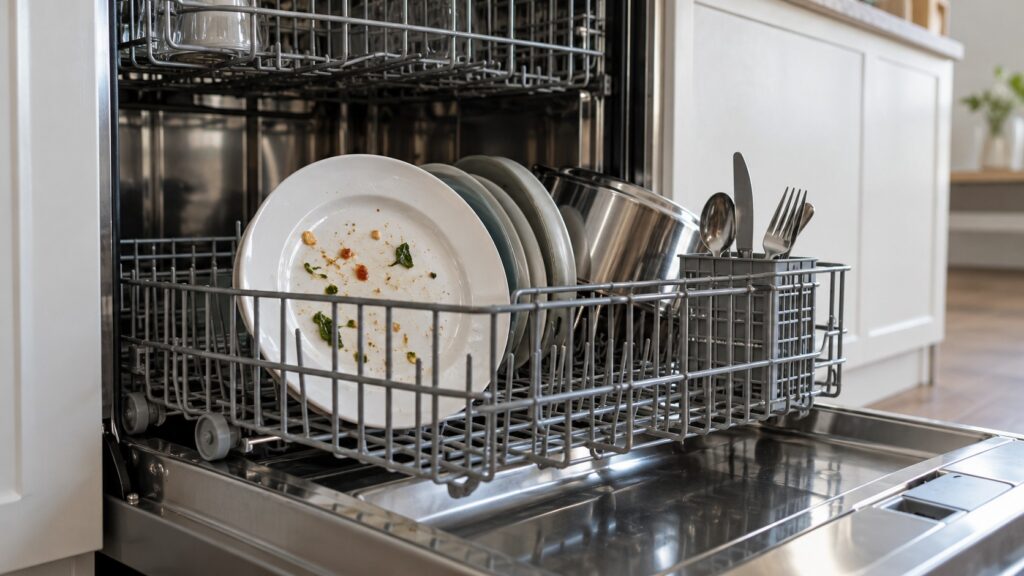
Why are my dishes still dirty after scraping?
When the scraping and loading are sound, the cause is usually the machine, not the habit. The most common cause is a clogged filter, which recirculates dirty water over the dishes. The manufacturer recommends cleaning it regularly, and our filter cleaning guide shows how. Blocked spray arm holes, an empty rinse aid dispenser and a drain problem are other causes. A dishwasher that leaves water in the tub may have a drain fault, which is covered in our page on a dishwasher that will not drain.
If you have changed to a heavier pre-rinse because the dishes come out dirty, that is a sign to check the machine instead. Rinsing every dish by hand to compensate hides the problem.
Does pre-rinsing matter for the filter and the drain?
Yes, in one way: what you leave on the dishes ends up in the filter. Large pieces that go through the cycle pack into the filter and the drain path, and a blocked drain is behind many of the complaints we hear. Scraping keeps the filter from filling too fast, which is a reason to do it even if your model does not ask for a rinse. It is also easier on the pump. If you hear a rattle or grinding from the bottom, stop the cycle and do not reach into the sump with your hands. Look for a broken glass piece or other hard object only with the dishwasher off, and call us if anything is stuck.
When should you get help?
If the loading is correct, the filter is clean and the dishes still come out gritty or cloudy, or if water stays in the tub, book a diagnosis. Do not open the lower panel or take parts off the door, since the electrical and water connections sit close together. If water reaches an outlet or wiring, switch off the breaker at the panel while standing on a dry floor, and never pull a plug from a wet outlet. See our dishwasher repair page for how a visit works.