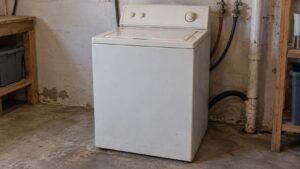
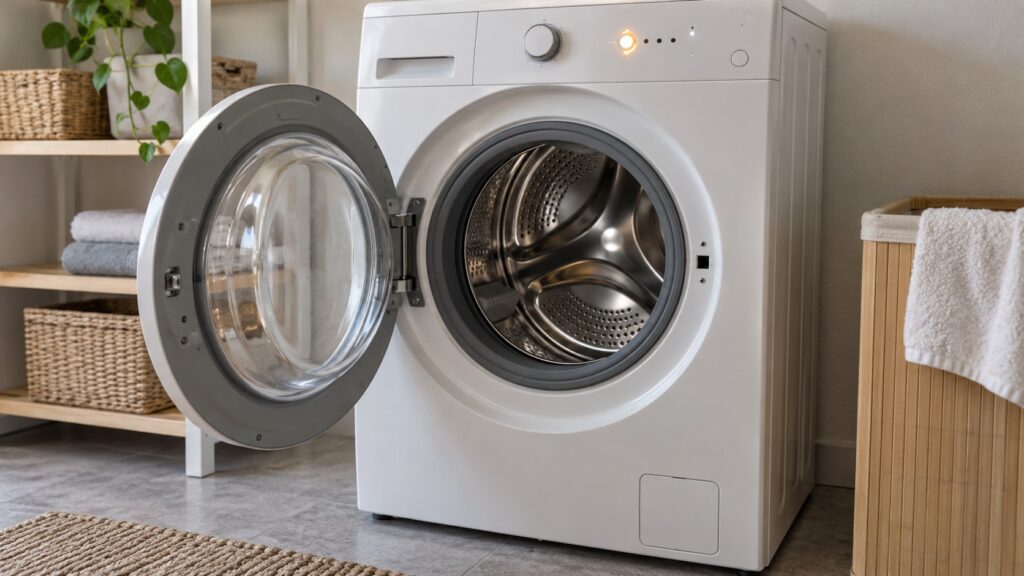
A Whirlpool washer stuck on sensing may be waiting on something it cannot confirm, such as water that is not arriving, a tub that is not clear or a load that is off balance. Our site does not say what the sensing indicator means on each model, so check the owner’s manual and start with the simple outside checks: make sure both supply valves are fully open, the hoses are not kinked, the lid or door is shut and the load is not bunched on one side. If it stays on sensing after a power reset, the cause may be a part behind a panel and needs a technician.
What does “sensing” mean on a Whirlpool washer?
On Whirlpool washers with auto sensing, the name points to the washer sensing the load before or while it fills. The WTW5057LW model page lists Auto Sensing among its features but does not describe the steps. What the indicator shows, and how long it normally stays on, is in the owner’s manual for your model. A washer that sits there with the drum still and no water coming in for far longer than the manual describes is worth a call.
We have to be honest about one limit. Whirlpool does not publish a fixed list of what each sensing light means on every model, and our site pages do not either. How long sensing lasts, and what the display shows beside it, differs by model, so for your washer check the owner’s manual and the nameplate. What we can do is explain what the washer needs in order to leave that stage.
What does the washer need before it moves on?
A washer works in stages: fill, wash, drain, spin. At the start the control watches for water to rise in the tub, as our water level guide describes. If water does not arrive, the washer may not be able to take the next step, and from outside it can look like a washer stuck at the beginning of a cycle. We cannot say from the symptom alone that this is what “sensing” is waiting for.
A wash that seems frozen at the start can be a fill problem. If a long wait ends with a code, F8E1 for water that did not arrive in time is the one to look up in our F8E1 long-fill guide.
Which checks should you do first?
Go through them in order, because the earliest ones solve the most.
First, supply. Open both water valves fully. Pull the washer forward only as far as is safe and look for a fill hose that is kinked or crushed behind it. Make sure hot and cold are both connected. If the water at a nearby tap runs weakly, the washer may be waiting on a supply problem, not a washer problem.
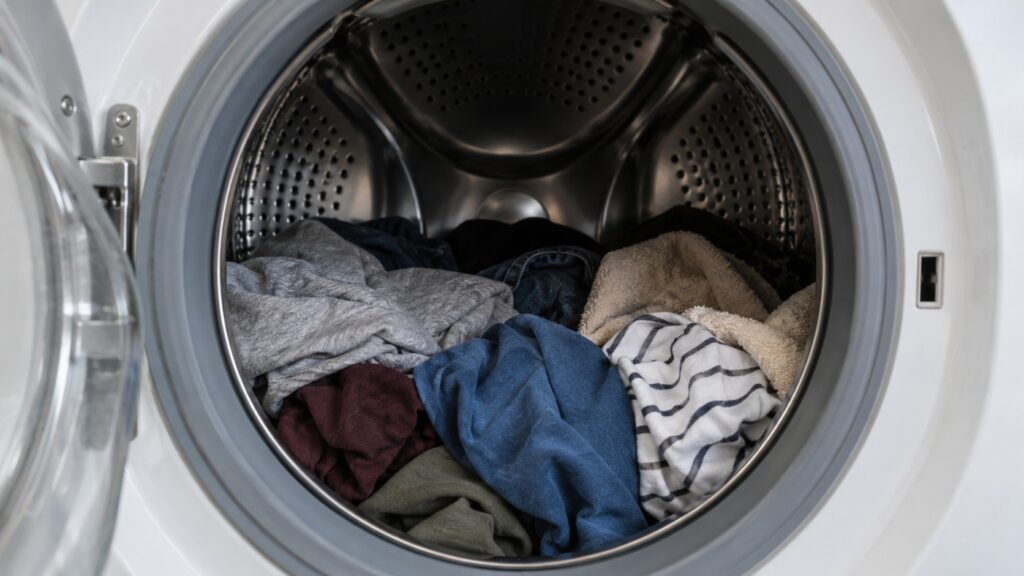
Second, the load. Open the lid or door, spread the clothes evenly and take out a single heavy item such as a comforter. Our F0E1 unbalanced load guide explains why an off-balance load can stop a cycle.
Third, the latch. Close the lid or door firmly and make sure nothing, such as a sleeve or a sock, blocks it. A washer cannot confirm it is safe to run if it cannot confirm the latch.
Fourth, the tub. If water is already standing in the drum from an earlier cycle, the washer may not be able to start. Use Drain and Spin per your manual and see whether it empties; our washer will not drain guide covers the filter and hose checks.
Will a power reset help?
It might. Our not-spinning guide notes that unplugging the washer for five minutes clears many transient motor and lock failures, and we suggest the same reset here as a reasonable first move, though we cannot promise it applies to this symptom. Cancel the cycle, unplug the washer, wait five minutes, plug it back in and start a small, balanced load. If it goes straight back to sensing, do not keep repeating it.
Do not unplug the washer if you see water on the floor near the outlet, smell burning or see the cord damaged. Turn off the water, stand on a dry spot, switch off the washer’s breaker at the panel and keep your hands out of the cabinet.
Could a failed part be the real cause?
Yes, and the usual suspects are the ones behind the fill and level logic: an inlet valve that will not open fully, a clogged inlet screen, a pressure sensor or a blocked air tube that misreads the level, or a latch that never confirms. The model pages for the WTW and WFW washers list long fill, long drain, lid-lock failures and motor or drum problems among the calls we see most. We do not name one part as the cause of a washer stuck on sensing, because the symptom alone does not say; the part is found by testing.
Those parts sit behind panels with electrical and water connections. Unplug the washer and shut off the water before anything is touched, and leave the testing to us. Our Whirlpool washer error codes glossary lists the fill, drain, lock and motor codes in one place if a code does appear.
When should you call a technician?
Call when the washer returns to sensing after the checks above, when it also shows a code, when you find water or hear a hum without movement, or when you cannot see anything wrong outside the machine. Wet clothes can wait in the tub; a washer left powered with a fault should not run. Our washer repair page explains the visit, and you can book a visit online.
For ongoing care that prevents many of these stops, see the Whirlpool washer maintenance checklist.