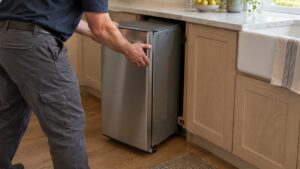
Whirlpool trash compactor repair or replace? This guide walks through exactly what to check and when an experienced technician should step in.
The honest question many owners ask — is a whirlpool trash compactor worth repairing — has an unusual answer compared with other appliances. Trash compactors are a discontinued, severely limited category: Whirlpool is one of very few brands with any current listings, and even those are often out of stock. That scarcity flips the usual math. For most appliances a major repair pushes you toward replacement, but with compactors a sound legacy unit is frequently worth keeping because a comparable new one may be hard to buy at all. This guide walks through how to decide.
Is a Whirlpool trash compactor worth repairing? Often, yes
Several factors favor repair on these units:
- The category is shrinking — new compactors are scarce and sporadically stocked, so replacement is not the easy default it is for, say, a microwave.
- The machines are simple and mechanical — switches, a motor, a belt, and power screws, all serviceable with genuine OEM parts that are still available for the GX, TU, TC8700, and TF8500 families.
- The common failures are cheap — a drawer-interlock switch, a start switch, or a drive belt are inexpensive parts, so the repair is often modest.
- A built-in cabinet cutout — if the compactor is built into a run of cabinets, a replacement also has to fit that 15-inch opening, which narrows your options further.
When replacement is the better call
Repair is not always right. Lean toward replacing — or removing the unit and using the cabinet space differently — when the cabinet or frame is rusted or structurally compromised, when the power screws and drive are badly worn (a costly assembly), or when several parts are failing at once on a very old unit. A single switch or belt on an otherwise solid machine is clearly worth fixing; a worn-out drive on a rusty cabinet usually is not. Be honest about how much you actually use it, too.
A simple repair-or-replace checklist
Run through these questions and the answer usually becomes obvious:
- Which part failed? A switch or belt is cheap and almost always worth fixing; a worn drive assembly or rusted cabinet leans toward replacement.
- How is the cabinet? Solid frame and clean cabinet means the bones are good and a repair pays off. Rust or structural damage is a strong replace signal.
- Is it built in? A 15-inch built-in cutout limits replacement options and tips the math toward repairing what you already have that fits the opening.
- How much do you actually use it? A compactor you run daily justifies a repair; one you rarely use may not be worth either repair or replacement.
- Is more than one thing failing? A single problem on an otherwise sound unit is an easy fix; several worn parts at once on a very old machine point to replacement or removal.
What replacement really involves
Because the category is so limited, replacement is rarely as simple as it is for other appliances. New Whirlpool compactors are listed only sporadically and often show as out of stock, and a built-in unit also has to match the existing cabinet opening, ductwork, and electrical. Some owners who cannot easily source a replacement choose to remove the compactor entirely and convert the space to a cabinet or pull-out drawer. That is a legitimate option, but if you value the compaction itself, repairing a sound legacy unit is usually the path of least resistance and least cost.
How to decide
Start by identifying which part failed, because that drives everything. A no-start traces to the safety switches — see our no-start guide — while a stalling ram usually means the belt or drive, covered in our drive-belt guide. Once you know the part, our independent service can quote the repair against the practical reality that a replacement may be hard to source. We charge a trip-and-diagnostic fee, use genuine OEM parts, and will tell you plainly when a unit is past saving. Schedule a diagnostic and we will give you a straight repair-or-replace answer for your specific compactor. You can also check current model availability and OEM parts at whirlpool.com to see for yourself how limited the replacement market has become.