
The whirlpool trash compactor drive belt is one of the most common wear parts on these legacy machines, and a tired belt produces unmistakable symptoms. The belt transfers power from the motor to the drive that pushes the ram, so when it glazes, cracks, or stretches, the ram loses force — it slips, stalls partway, or the motor hums while nothing moves. The belt itself is an inexpensive genuine OEM part for the GX, TU, and discontinued TC8700 and TF8500 families; most of the repair cost is the labor to reach it. This guide covers the symptoms, what replacement involves, and what the job realistically costs.
Symptoms of a failing Whirlpool trash compactor drive belt
- The ram stalls mid-stroke — the belt slips under the load of compaction and cannot finish.
- The motor hums but the ram does not move — a broken or thrown belt leaves the motor spinning with nothing to drive.
- Weak compaction — trash is not crushed as tightly as it used to be because the belt slips before full force is reached.
- A burning-rubber smell or squeal — a glazed belt slipping on the pulley can smell hot or squeal.
What replacement involves
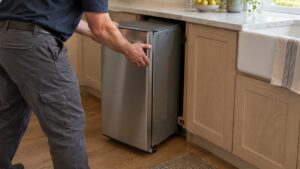
Replacing the belt means accessing the drive assembly, which usually requires pulling the compactor from its cabinet opening and removing a panel to reach the motor and drive. With power disconnected, the old belt is removed, the pulleys are inspected for wear, and a new OEM belt is fitted and tensioned. While the assembly is open it is worth checking the power screws and directional switches, since a belt that failed under strain can hint at a binding drive.
- Unplug the unit and slide it out far enough to reach the rear or lower drive panel.
- Remove the panel, note the belt routing, and replace the belt with the correct OEM part for your model family.
- Inspect the pulleys and power screws for wear or binding before reassembling.
- Reinstall, restore power, and run an empty cycle to confirm full, smooth travel.
Why drive belts wear out
A drive belt does not fail randomly; it wears in predictable ways, and knowing why helps you catch the next one early and avoid a stranded ram. Every compaction stroke puts the belt under heavy load as it transmits the motor torque that the power screws turn into ram force, and that repeated strain gradually glazes and stretches the rubber. Several things accelerate it:
- Chronic overloading — packing the drawer past the fill line makes the ram work at the edge of its force, so the belt slips and glazes faster.
- A binding drive — worn or dry power screws make the ram harder to move, which overstresses the belt; a belt that keeps failing is a clue the screws need attention.
- Age and heat — rubber simply hardens and cracks over the decades these legacy units have been in service.
- Compacting rigid items — glass and hard plastics resist the ram, spiking the load on each stroke.
Replacing a worn belt the moment it starts slipping, rather than after it strands the ram, keeps the repair to a simple belt swap instead of a clear-the-jam-and-replace-the-belt job.
What a Whirlpool trash compactor drive belt repair costs
The belt itself is one of the cheaper compactor parts. Most drive-belt repairs fall between a modest figure and a mid-range figure depending on the labor to access the drive in your installation, plus the trip-and-diagnostic fee that applies up front. We do not quote a fixed price before seeing the unit, because a belt that failed due to a binding power screw turns a simple belt swap into a larger drive repair. Because the belt is inexpensive and the unit is otherwise mechanical, a belt replacement on a sound compactor is usually worth doing — though if the machine is very old and other parts are wearing, weigh it against our repair-versus-replace guide. For the related symptom of a fully jammed ram, see our stuck-ram guide. You can confirm the correct OEM belt for your model at whirlpool.com, and to have it diagnosed and fitted safely, schedule a technician.