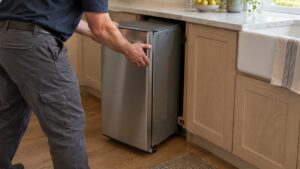

Understanding how a whirlpool trash compactor works makes these legacy machines almost transparent to troubleshoot, because there are no circuit boards or error codes involved — just a motor, a drive, a ram, and a chain of safety switches. Whirlpool compactors like the GX900QPPS and the discontinued TC8700 and TF8500 families share the same basic architecture: about a 1.4 cubic foot drawer, a roughly one-third horsepower motor, and a 4:1 compaction ratio that squeezes a week of trash into a single tied bag. Knowing how the pieces move tells you exactly where to look when something stops.
How a Whirlpool trash compactor works: the drive mechanism
- Motor and belt — a fractional-horsepower motor drives a belt that turns the drive system. The belt is a common wear part and a frequent cause of a ram that stalls.
- Power screws — most Whirlpool compactors translate that rotation into vertical force through a pair of large power screws (jack screws). The ram rides down these screws and back up.
- The ram — a flat compaction plate pushed down by the power screws compresses the trash against the bottom of the drawer, then reverses and parks back at the top.
- Directional switches — limit switches at the top and bottom of travel tell the control when to reverse and when to stop, so the ram parks correctly between cycles.
Why the safety interlocks matter
The reason a healthy compactor sometimes refuses to start is its safety chain, and it is deliberate. The ram exerts enough force to be dangerous, so the design will not let the motor run unless several conditions are true at once:
- Drawer interlock — the drawer must be fully closed and latched, proven by an interlock switch, before the ram can move.
- Key-knob / start switch — a removable key or a start control must be set to run, which also serves as a child-safety measure.
- Top-of-travel switch — the ram must be parked at the top for a new cycle to begin.
The 4:1 compaction ratio and what it means
The number you will see quoted for these units is a 4:1 compaction ratio, and it is worth understanding because it is the whole point of the appliance. A 4:1 ratio means the ram squeezes a given volume of loose trash down to roughly a quarter of its original size, so about a week of household waste fits into a single compacted bag in the 1.4 cubic foot drawer. That force comes from the fractional-horsepower motor multiplied by the mechanical advantage of the power screws — the screws turn many times to move the ram a short distance, trading speed for the strong, steady pressure that compaction needs. One spec to be careful with: while the 4:1 ratio, the 1.4 cubic foot capacity, and the roughly one-third horsepower motor are well documented, a specific pound-force figure is not reliably published for these units, so it is best not to quote one. What matters in practice is that the ram is powerful enough to demand the safety chain, and slow enough that a worn belt or binding screw shows up as a stall rather than a violent failure.
How the cycle and odor system fit together
Once the safety chain is satisfied and you press start, the motor drives the ram down, the power screws do the work, the directional switches reverse it at the bottom, and the ram returns to the top to wait. Many models add an odor-control fan and a charcoal filter that run alongside, plus a Touch-Toe drawer release so you can open it hands-free. Because every part of this is mechanical, a problem maps directly to a component: no start points to the safety switches, a stalled ram points to the belt or drive, and a smell points to the filter and cleaning. To put this understanding to work, see our no-start guide and our stuck-ram guide. You can confirm your model family and its drive parts at whirlpool.com, and when a drive or switch repair is beyond comfort level, schedule a technician who knows these older mechanisms.