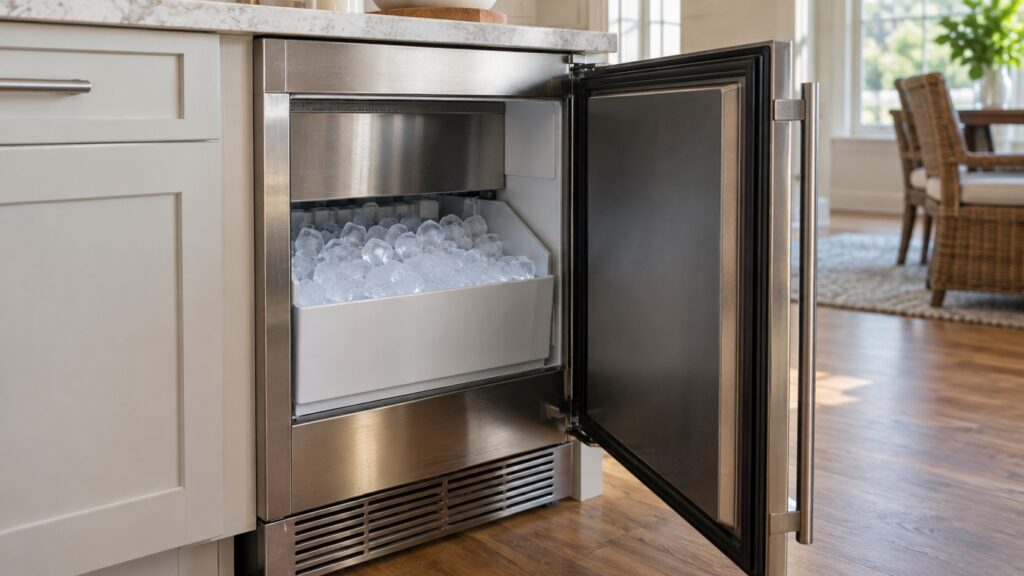
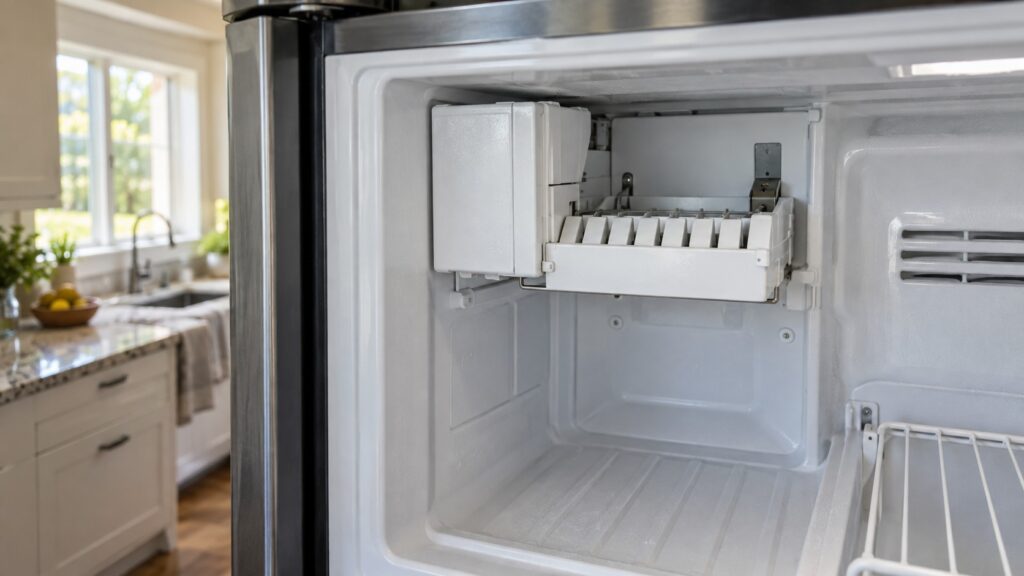
Two different appliances make ice, they are commonly called the same thing, and their faults have almost nothing in common. A Whirlpool ice machine is a standalone appliance that makes ice as its only job. The ice maker inside a refrigerator is a module that makes ice as a side activity in a freezer. Working through the wrong list is the most reliable way to waste an evening on this, so the first job is establishing which one you have.
Why the distinction changes everything
An ice machine holds a reservoir of water and circulates it over a chilled plate until ice forms, then releases the slab and starts again. Water sits, evaporates and concentrates its minerals, which is why scale is the dominant failure and why these machines need a descaling routine that a refrigerator ice maker does not.
A refrigerator ice maker fills a mold with fresh water each time, freezes it using the freezer’s own cold, warms the mold briefly to release the cubes and sweeps them out. Nothing sits, so scale is a minor issue — and the dominant failures are the fill path and the harvest mechanism instead.
If you have an ice machine
Start with water and airflow, in that order. Scale coats the evaporator plate and the machine makes progressively thinner, cloudier slabs before stopping altogether; descaling on a schedule prevents it and is not optional in a hard-water area. The drain is next: a blocked drain line backs water into the bin, and the symptom is ice that has fused into a lump rather than an absence of ice.
Airflow is third. These machines are usually built in under a counter and reject heat through a front grille at ankle height, which collects everything. A blocked grille produces a machine that runs constantly and makes less ice on warm days. Our guides on cleaning and descaling and how the machine works cover both.
If you have a refrigerator ice maker
- No water in the mold — the supply side. A closed valve, a blocked filter, or a fill tube frozen solid.
- Small or hollow cubes — partial flow. Usually the filter or a valve not opening fully.
- Mold fills, nothing ejects — the module: heater, motor or thermostat.
- The bail arm is up — the machine thinks the bin is full and has switched itself off. Knocked up by a bag of frozen food more often than anyone admits.
Our ice maker explainer covers the harvest cycle, and the cleaning and filter guide covers the routine.
The symptoms that mean different things on each
Cloudy ice. On an ice machine, that is usually mineral content and points at descaling or water quality. On a refrigerator ice maker, cloudy cubes are dissolved air and are cosmetic.
Ice fused into a block. On an ice machine it is often the drain backing up. In a refrigerator it means the bin partially melted and refroze, which points at a door seal or a freezer running warm.
Slow production. On an ice machine, the condenser or the water pump. In a refrigerator, freezer temperature or blocked airflow past the module.
A bad taste. On both it is nearly always the water filter, changed late. Taste is a late symptom of saturation, not an early one.
What both share
Three things are common to both, and they account for a large share of the calls we take. The water filter, which should be changed on a date rather than on a flavor. The bin, which sits open and absorbs whatever is around it, and needs washing in warm water with nothing scented. And the supply line behind the appliance, which should be inspected annually for kinks and damp connections — a weeping fitting does its damage invisibly for months.
The cube shape is a diagnosis on both
What comes out of the bin is the cheapest information available, and it is specific. On an ice machine, a slab that releases in pieces rather than whole points at an uneven evaporator surface — usually scale in patches. Thin ice across the whole plate points at a harvest cycle cutting short or at the water pump not delivering full flow. Ice with a milky core is trapped air, which follows a water supply that is aerated or a reservoir that is being refilled too fast.
On a refrigerator ice maker the vocabulary is different. Hollow cubes with a crater in the top are a mold that did not fill completely. Cubes stuck together in a ridge along one side mean the mold overfilled and spilled before freezing. And a handful of very small cubes among normal ones usually means the fill valve is opening inconsistently rather than not at all.
What is not a fault on either
Production rate is the big one. Neither appliance fills an empty bin in an hour; both take the better part of a day, and a party will outrun either. A freezer set warmer, or a door opened frequently, measurably reduces a refrigerator ice maker’s output without anything being wrong. And an ice machine on a hot day in an unconditioned space is working against its ambient rating, not failing.
When to call
On an ice machine: a unit that runs without producing, a compressor that never cycles off, water in the cabinet, or a harvest that never completes. On a refrigerator ice maker: a mold that fills and never ejects, a module that runs continuously, or a leak inside the freezer.
We are an independent repair company, not a factory service arm. Pricing starts from a diagnostic visit and we confirm the estimate before any work begins. Whirlpool ice machine repair and ice maker repair are separate services for exactly the reasons on this page, and you can schedule a visit online.