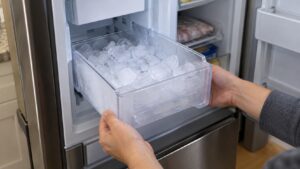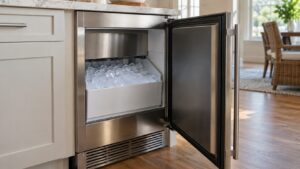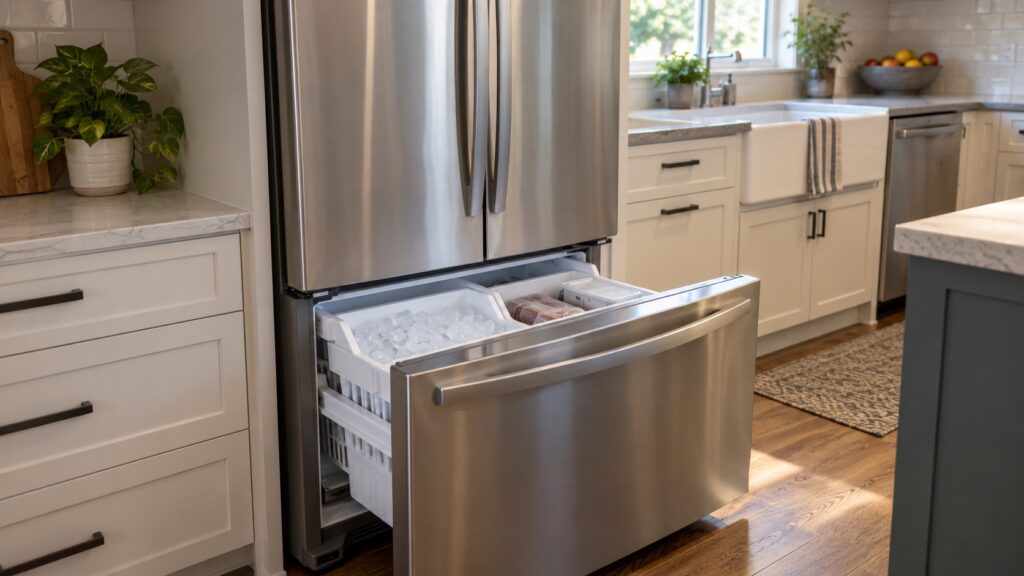
Whirlpool ice maker repair or replace comes down to one question: is the fault in the ice maker itself, or is the ice maker the first sign that the refrigerator around it is failing? A frozen fill tube, a clogged filter or a worn ice maker module is a modest repair on a refrigerator that is otherwise healthy. A weak ice maker on a refrigerator with a failing compressor, a leaking sealed system or a damaged cabinet is not worth fixing on its own. This guide helps you sort which case you are in, and gives you a short list of checks to do before you call anyone.
What usually goes wrong with a Whirlpool in-refrigerator ice maker?
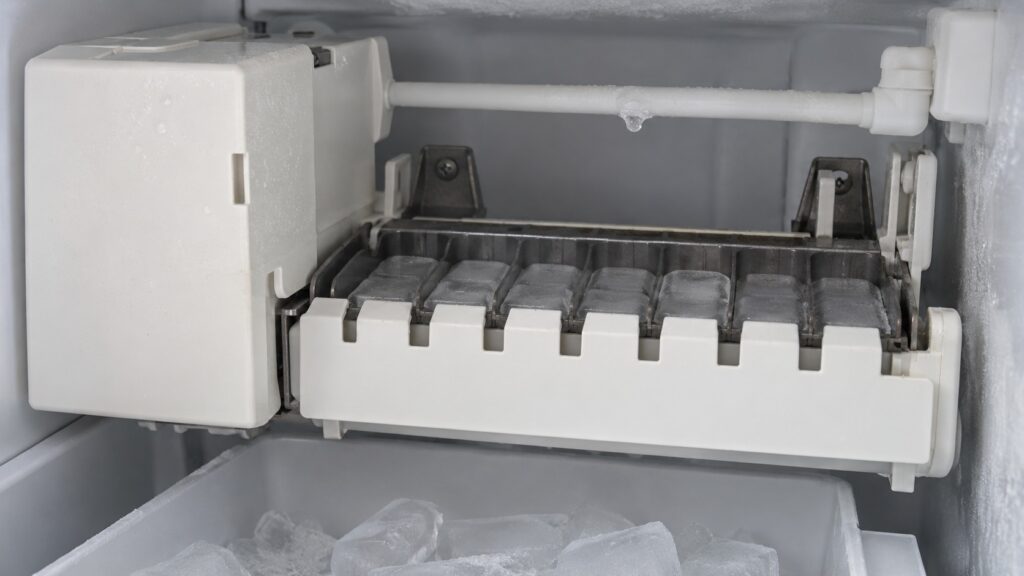
The most common problems fall into a short list. A frozen fill tube blocks water from reaching the mold, so the ice maker runs dry. A clogged EveryDrop water filter or inlet screen starves it of water, which gives small, hollow or slow ice. A failed water inlet valve either lets too little water in or dribbles water that refreezes. A stuck ejector or a worn module motor stops the harvest, and a dirty or fogged optical sensor makes the ice maker think the bin is full. Almost all of these are part-level repairs, and the ice maker itself is a replaceable module.
That is why the first answer to the question is usually “repair.” Our Whirlpool ice maker not making ice guide and the slow or low ice production guide list the safe checks that settle many cases without a part.
What should you check before you decide anything?
Start with the free checks, because they cost nothing and they change the decision. Look at the freezer temperature. An ice maker needs a freezer near 0 degrees F to harvest properly, and a freezer that has drifted warm is a refrigerator problem, not an ice maker problem. Check the age of the water filter, since a filter past its change interval restricts flow. Look in the ice bin for a cluster of cubes welded together, which means water is reaching the mold too slowly or leaking in after the harvest. Check that the shutoff arm, if your model has one, is lowered, and that nothing is stuck in the optical sensor window.
If the freezer is cold and the filter is fresh, the water path is the next suspect. A bead of ice in the fill tube is easy to spot and thaw. A tube that keeps freezing points at a leaking inlet valve, which is a repair, not a reason to replace the unit.
When is the ice maker module itself worth replacing?
A worn module, with a failed motor or a stripped ejector gear, is a clear repair when the rest of the refrigerator is in good shape. The module is a self-contained part, and replacing it is much cheaper than replacing a refrigerator. The same is true of a water inlet valve or a heated fill tube. The question to ask is not “is the part expensive,” but “does the refrigerator have enough life left to justify any repair at all.”
A refrigerator that is still cooling well and sealing well, and is in the middle of its normal life, passes that test easily. Our guide to how a Whirlpool ice maker works shows how the module, valve and fill tube fit together, which helps you understand what a technician will test first.
When does the ice maker problem point at the refrigerator instead?
Three situations change the answer. First, if the freezer will not hold temperature, the ice maker is a victim and the real fault is a defrost problem, a failing fan or a weak compressor. Second, if there is heavy frost, water pooling or a cabinet that sweats, the seals or the sealed system may be failing. Third, if the refrigerator is old and has already needed more than one repair, a fresh ice maker module on top of that is rarely a good use of money. In these cases, read our guide on Whirlpool refrigerator compressor repair or replace to weigh the bigger decision.
A useful rule of thumb is to count the problems, not just the parts. One isolated ice maker fault on a refrigerator that cools well is almost always a repair. Two or three unrelated faults on an old refrigerator is the pattern that leans toward replacement.
What does a fair decision look like in practice?
Write down the age of the refrigerator, the symptoms, and what a technician finds. If the diagnosis is a fill tube, a filter, a valve or a module, and the refrigerator cools and seals properly, repair it. If the diagnosis is a sealed-system leak, a failed compressor or a cabinet that will not hold temperature, replacement is more sensible than spending on an ice maker. For the cost side, see our Whirlpool ice maker repair cost guide, and if you are unsure which kind of appliance you have, the ice machine versus ice maker guide explains the difference.
We are an independent repair company, not the manufacturer, and we will tell you plainly if a repair is not worth doing. Our Whirlpool ice maker repair service can test the water path and the module, and you can book a visit online.