The whirlpool washer f0e1 code means the load is too large or too unbalanced for the machine to spin safely, so the washer stopped instead of spinning. It is not a part failure and it is not a fault in the motor: it is the machine refusing to throw an off-center drum around at several hundred revolutions a minute. Its companion, F0E5, is the same kind of refusal for a different reason — too much foam in the tub. Both usually get fixed by changing what goes into the washer, not what is inside it.
What does F0E1 mean on a Whirlpool washer?
A Whirlpool washer weighs its load and watches how the drum behaves as speed rises. Before a spin it ramps up slowly and measures the wobble; if the mass is sitting on one side, the machine redistributes by tumbling, adds a little water to help the load move, and tries again. It will do this several times. When the drum still will not balance after those attempts, the washer gives up and posts F0E1.
The number is therefore a report about the laundry, not about the machine. A spin at full speed with the mass off-center puts enormous load on the suspension rods or springs, the bearing and the tub. The control refuses because letting it happen would turn a bad wash day into a repair. Owners often read the code as a warning that something has broken, when in almost every case nothing has.
Why does one heavy item set it off when a full load does not?
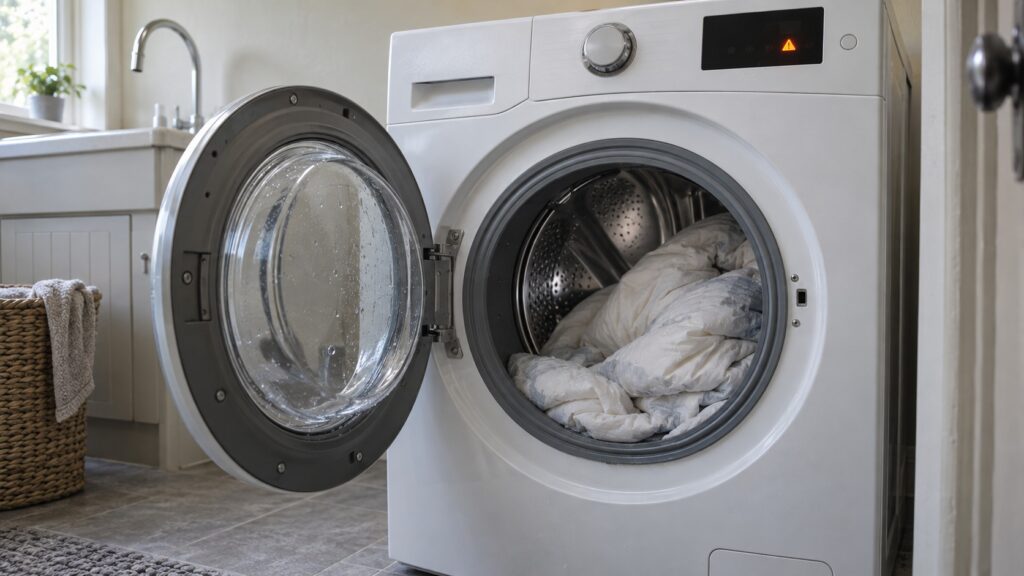
This is the part that surprises people. A drum packed evenly with mixed laundry balances easily, because the items are small enough to redistribute themselves. A single bath mat, one pair of jeans, a comforter or a bundle of towels behaves like one solid object: it soaks up several pounds of water, slumps to the bottom of the drum, and stays there no matter how many times the washer tumbles it.
Three other conditions produce the same result:
- A washer standing off-level. If one foot is short or the floor slopes, the load rolls to the low side every time. On a wood floor in a laundry room over a crawl space, a machine that was level at installation can be out of true a year later.
- Shipping bolts still fitted. On a front-load washer moved to a new home, bolts left in place lock the tub to the cabinet and the machine cannot damp anything.
- A load that doubles in weight. Anything waterproof or densely woven — a mattress protector, a car cover, a sleeping bag — holds far more water than its dry weight suggests.
How is F0E5 different, and why does foam stop a spin?
F0E5 is the suds code. A high-efficiency Whirlpool washer uses a small amount of water and relies on the load moving through it. Foam breaks that. It cushions the drum so the machine cannot read its own load, it stops water leaving through the drain at the rate the control expects, and it leaves detergent residue in the fabric. When the control sees the signs, it pauses the cycle, runs extra rinses and waits for the foam to collapse.
The cause is nearly always detergent. Regular detergent in an HE machine is the most common, followed by a correct HE detergent used at the dose printed on the cap, which is written for hard water and for a full load. In a soft-water area, half of that is often plenty. The residue that foam leaves behind is also what makes a washer smell, which is why our guide to a Whirlpool washer that smells and this code keep appearing together.
What should you do when the washer stops with this code?
- Open the washer and redistribute the load by hand. Spread items around the drum rather than leaving them in one lump, and add two or three towels to a single bulky item so it has something to balance against.
- Take half of it out. If the drum is packed above the level of the top row of holes on a front-loader, or above the agitator collar on a top-loader, it is too full for a wet spin.
- Restart on a spin-only or drain-and-spin cycle. There is no need to rewash. Most machines clear the code as soon as a balanced spin completes.
- For F0E5, run a rinse and spin with no detergent at all. Then cut the dose by a third for the next several washes and see whether the code returns.
- Check the machine is level. Push down on opposite corners of the top. If the washer rocks, adjust the feet until it sits solid on all four, then check again with the drum full of water.
Stop there. The drain pump, the pressure hose and the door lock all sit inside the cabinet next to standing water and mains wiring, and there is nothing in an F0E1 diagnosis that requires reaching them.
What if the code appears on a normal, balanced load?
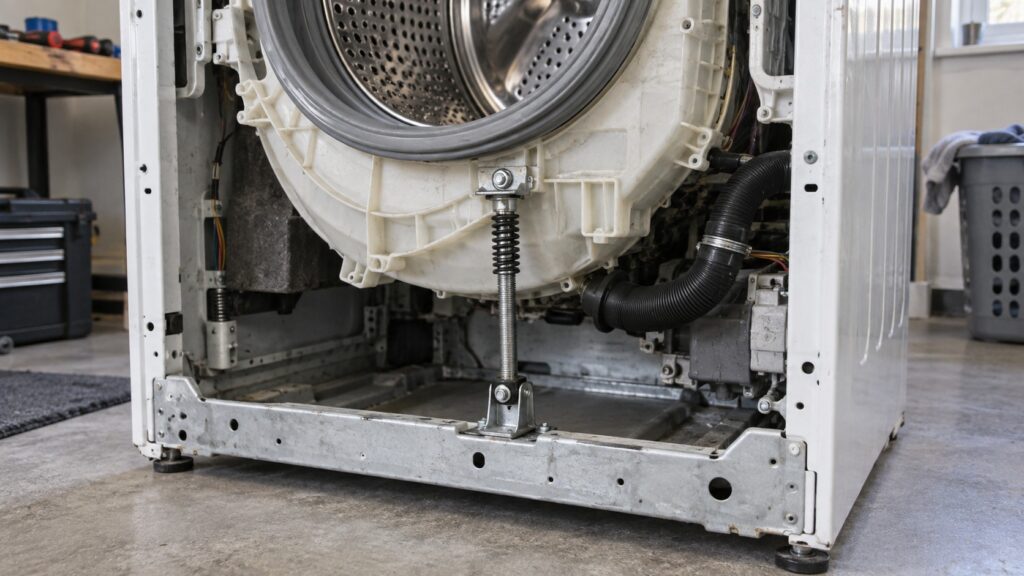
This is where the code stops being about laundry and starts being about the washer. A machine that posts F0E1 on a half-empty drum of shirts is telling you it can no longer control the wobble it is measuring. The usual causes are worn suspension rods on a front-loader, tired springs or a failed balance ring on a top-loader, or a bearing that has started to let the tub move where it should not.
Two symptoms confirm it. A washer that walks across the floor during a normal spin has lost its damping. A deep rumble or grinding that rises and falls with drum speed is a bearing rather than a load. Either one belongs to a technician, and both are the point at which this code overlaps with the mechanical faults behind a Whirlpool washer not spinning at all.
When is it worth booking a repair?
Book service when the code appears on loads that used to be fine, when the washer moves during spin, when you hear the drum knock the cabinet, or when F0E5 keeps returning after you have switched to a correct HE detergent and cut the dose. Habitual unbalanced spins wear the suspension quickly, so a machine that has been fighting this for months often needs the rods anyway — the checklist in our Whirlpool washer maintenance guide is what keeps that from happening again.
We are an independent repair company, not a factory service arm, and on this code that usually means telling owners honestly that nothing is broken. When something is, a suspension set is a straightforward job and worth doing on most machines. Pricing starts from a diagnostic visit and we confirm the estimate before any work begins. Bring the model number from the rim of the door or the back of the lid when you book Whirlpool washer repair, or schedule a visit online and say what was in the drum when the code appeared.