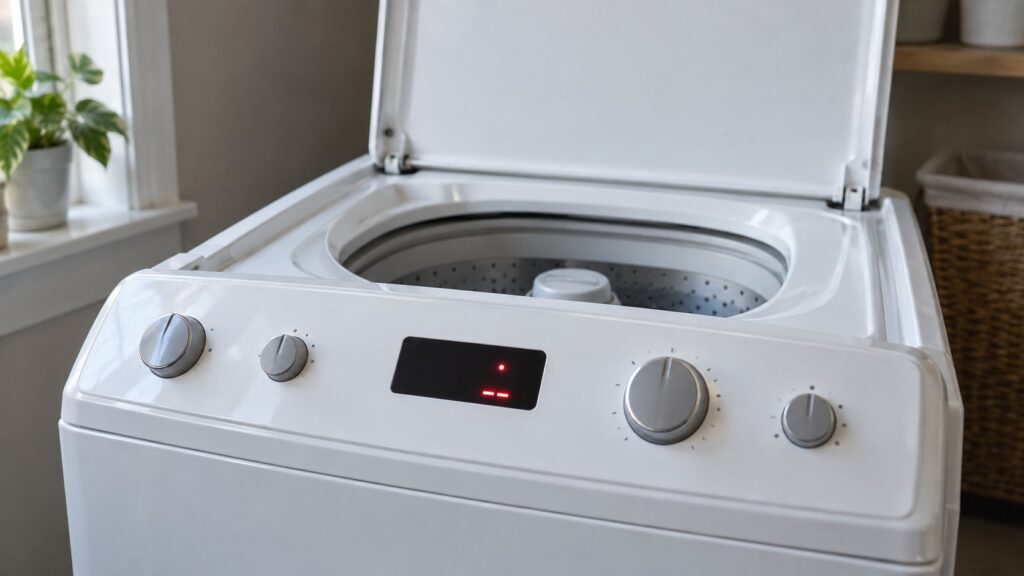
The whirlpool washer f3e1 code means the machine’s temperature sensor is reading a value outside the range the control accepts. The washer is not reporting cold water, a heater failure or a bad wash — it is reporting that it no longer believes its own thermometer. Until the reading is trusted again, the control falls back on defaults, and cycles that depend on water temperature stop behaving the way they should.
What does F3E1 mean on a Whirlpool washer?
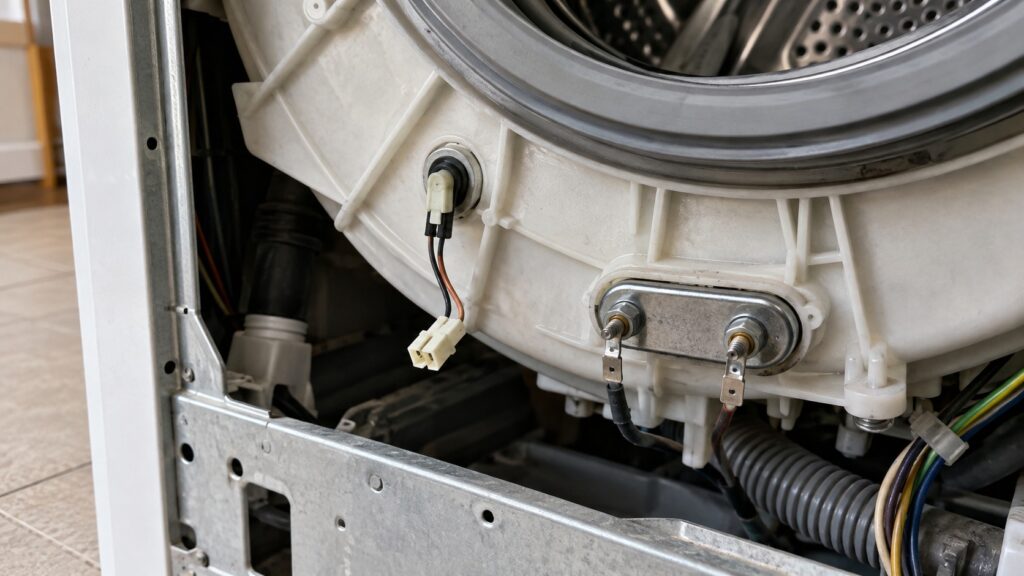
Inside the washer a thermistor sits in the water path — on most models against the outer tub or in the heater housing, where it can read the water rather than the air. It is a resistor whose resistance changes predictably with temperature, and the control converts that resistance to degrees. The conversion only works within a band. A reading far outside it cannot be a real water temperature in a laundry room, so the board treats it as a broken sensor rather than as a strange wash.
Two electrical faults produce that result. An open circuit — a broken wire, a corroded terminal, a thermistor that has failed internally — reads as effectively infinite resistance, which the board interprets as impossibly cold. A short, usually where a harness has chafed against a bracket, reads as near-zero resistance, which maps to a temperature no household supply can reach. Either way the code is the same, and the diagnosis is a resistance measurement rather than a guess.
Why does the same number mean something else on a dryer?
This is worth spelling out, because a search for the bare code will land you on the wrong page in seconds. Whirlpool numbers its faults by function group, not by part. The F3 group means “a sensor is reading something impossible”, and every appliance in the lineup has sensors. So F3E1 on a washer is a water temperature sensor, F3E1 on a dryer is the exhaust thermistor, and F3E0 on an oven is the bake probe. Three appliances, three parts, one number.
The same trap exists one digit over. F3E2 on a dryer is the inlet thermistor with the heat cut, which is why it shows up in our guide to a Whirlpool dryer not heating. F3E2 on a washer is the moisture sensor, a part that only exists on combination washer-dryer machines. If you have a plain washer and read a dryer explanation, you will go looking for a component your machine does not contain.
Identify the appliance first, then read the code. That order costs nothing and saves an evening.
What does the washer do while the sensor is untrusted?
A washer that cannot read water temperature does not simply stop. Depending on the model and the cycle, several things happen, and together they make a recognizable pattern:
- Temperature-dependent cycles behave oddly. Sanitize, Whitest Whites and Heavy Duty rely on heating to a target. Without a trusted reading the machine may skip the heat step or run the heater far longer than needed.
- Cycle times stretch. The control waits for a target it will never see confirmed, then times out and moves on.
- Water arrives at the wrong temperature. A cold wash that feels warm, or a warm wash that stays cold, with the mixing valve doing exactly what it was told.
- The code appears at the same point every time. Most often early, during fill, which is when the first reading is taken.
What you will not see is a machine that refuses to spin or drain, which is how this code separates itself from the load and drain faults. If the washer stops before a spin instead, that is the territory of Whirlpool washer F0E1.
What can you check before calling for service?
- Unplug the washer for five minutes. A single bad reading during a power dip can latch the code. If it clears and does not return within a few cycles, nothing is wrong with the sensor.
- Confirm both supplies are on and connected correctly. Hot and cold reversed at the faucets is a classic after a move or a remodel, and it makes every temperature the machine reports look wrong even when the sensor is fine.
- Check the water heater. A supply arriving at 160°F or above is outside what a washer expects. The usual household setting is 120°F.
- Look behind the machine. A harness crushed against the wall when the washer was pushed back is a real and common cause of a shorted sensor circuit.
- Note whether the code is constant or occasional. An intermittent fault is a connector; a permanent one is usually the part.
Do not go past that. The thermistor sits inside the cabinet, in the water circuit, next to the heater terminals and the mains wiring, and on most models it cannot be reached without draining the machine and removing panels. That combination of water and line voltage is where owner repairs go wrong.
Which parts does a technician replace for a Whirlpool washer F3E1?
The diagnosis is a measurement. A technician isolates the thermistor, reads its resistance cold, compares it with the specification for the model, then warms it and watches the value move. A sensor that reads open, short or flat is replaced. A sensor that reads correctly moves the search to the harness and the connector at the control board, where corrosion from a slow leak is a frequent finding. The heater element is tested on the same visit, because a shorted element can take the sensor circuit with it.
The part itself is small and the repair is contained, which makes this one of the better outcomes among washer faults. Our guide to how a Whirlpool washer works shows where the heater and the sensor sit relative to the tub and the pump.
When should you book a repair?
Book when the code returns after a power cycle, when wash temperatures are clearly wrong, or when cycles have started running far longer than they used to. A temperature sensor fault will not flood a laundry room, so there is no emergency — but a heater driven against a bad reading wastes power on every load and can cook fabrics on a hot cycle.
We are an independent repair company, not a factory service arm, so when a fault turns out to be reversed faucets or a water heater set too high, that is what we will tell you. Pricing starts from a diagnostic visit and we confirm the estimate before any work begins. Have the full model number ready when you book Whirlpool washer repair, or schedule a visit online and say at which point in the cycle the code appears.