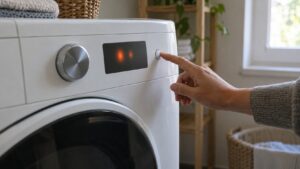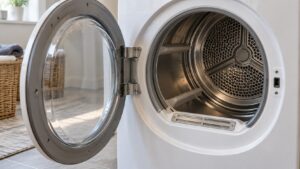
A whirlpool dryer not heating is one of the most common dryer complaints: the drum turns, the cycle runs, but the clothes come out cold and damp at the end. Because the drum spinning and the heat are controlled by separate parts, a no-heat dryer almost always has a heating problem rather than a motor problem. Whirlpool reports the most frequent cause — a burned-out element — as F4E3, and a failed exhaust thermistor as F3E1, so the code on the panel often points straight to the part.
Why a whirlpool dryer not heating happens
On electric WED and Cabrio dryers, several parts must all work for heat to reach the drum:
- Heating element (F4E3). The most common no-heat cause. When the element coil burns out, the drum tumbles with cool air.
- Thermal fuse. A safety fuse that blows when the dryer overheats, usually because of a blocked vent — and once blown, it kills the heat entirely.
- Thermistors (F3E1 / F3E2). If the exhaust thermistor reads open or the inlet thermistor reads shorted, the control cuts the heater to stay safe.
- Gas igniter or valve coils. On WGD gas models, a weak igniter or failed coils means no flame and no heat.
Steps to try yourself
- Check the exhaust vent first. A clogged vent causes overheating that blows the thermal fuse — and a blocked vent is also why elements and fuses fail repeatedly. Clean the vent from the dryer to the outside hood.
- Confirm it is truly cold. Run a short timed-dry cycle and feel the air. Cool air confirms a heat problem.
- Read the code. An F4E3 points to the element; F3E1 or F3E2 points to a thermistor.
- Reset the dryer. Unplug for 60 seconds to clear any transient control failure.
For the full diagnostic detail on these problems, our list of Whirlpool dryer error codes explains how to test the element and thermistors with a meter.
One pattern is worth calling out, because it explains why no-heat parts so often fail in pairs. On most electric Whirlpool dryers, the heating element and the thermal fuse sit on the same airflow path, and a restricted vent overheats both at once. When that happens, the thermal fuse blows to protect the dryer and the heat stops, but if you only replace the fuse without clearing the vent, the new fuse blows again within days. The same restricted airflow stresses the element until it eventually burns out as well. This is why a careful diagnosis always looks at the vent alongside the failed part, and why the element and the thermal fuse are typically replaced together — testing only one and ignoring the cause is the single most common reason a no-heat repair does not last. Gas WGD models follow the same logic, except the no-heat point is the igniter or the valve coils rather than an element.
When to call a technician
Replacing a heating element, thermal fuse, or thermistor involves accessing the dryer cabinet and testing for continuity, and on a dryer it is worth replacing the element and the matching thermal fuse together so you do not get a repeat failure. Our experienced technicians do exactly that with genuine OEM parts. If your dryer also runs hot and will not shut off, that is a different and more urgent problem (F4E1) — stop using it and book a repair right away. Whirlpool publishes model documentation at whirlpool.com.
How to prevent no-heat failures
Clean the lint screen every load and the full exhaust vent at least once a year. Most burned-out elements and blown fuses are caused by restricted airflow forcing the dryer to overheat. A clogged vent is also a fire risk, which is covered in our guide on a Whirlpool dryer that takes too long to dry. Our Whirlpool dryer repair service backs every heating repair with a 30-day labor warranty.