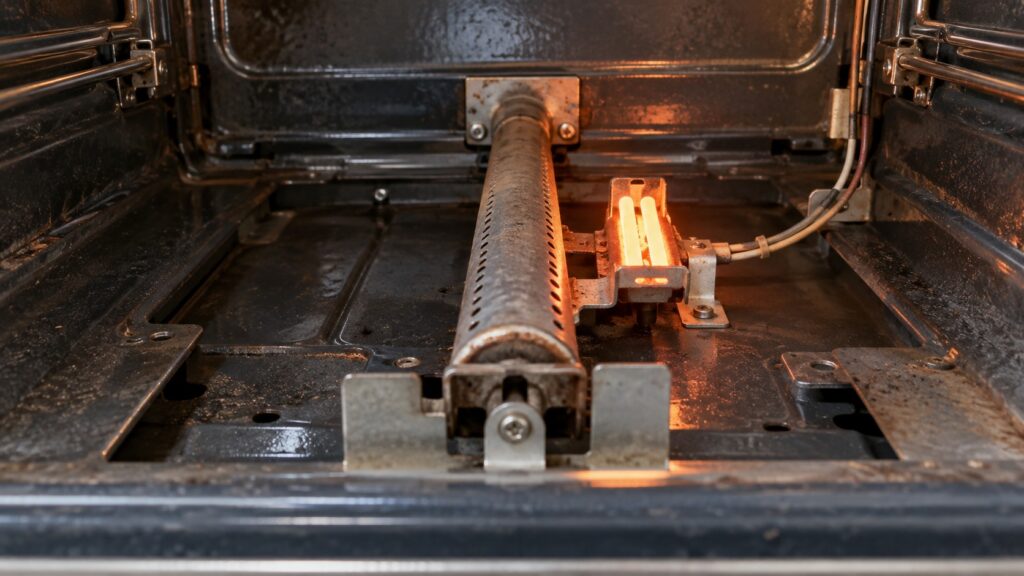
A Whirlpool gas oven igniter is a small ceramic heating element that glows hot when you start the oven, and the electric current it draws is what allows the gas safety valve to open. If the igniter glows but the burner never lights, the igniter has usually weakened and is not drawing enough current to open the valve, which is why this one part causes so many “my gas oven will not heat” calls. This guide explains the sequence step by step so you can tell which part is misbehaving.
How does a Whirlpool gas oven light the burner?
When you set a bake temperature, the control sends power to the igniter. The igniter is wired in series with the gas safety valve, so the same current that heats the igniter also flows through the valve’s small coil. The igniter warms up over roughly half a minute to a minute, and as it heats its resistance drops and the current rises. Only when the current is high enough does the valve coil release and let gas flow to the bake burner. The gas reaches the glowing igniter, lights, and the flame spreads along the burner tube.
That sequence is a safety design. If the igniter is cold or weak, the valve stays shut, so the oven can never release gas that has nothing to light it. The same arrangement is why the part feels like a villain when it fails: the oven is doing exactly what it was built to do.
Why does the igniter glow but the oven stays cold?
Because glowing is not the same as drawing enough current. An aging igniter can still turn orange while its resistance has risen so far that the current never reaches the level the valve needs. You will see it glow for a minute or more, then the bake attempt ends with no flame. This is the most common gas oven fault, and it explains why a part that looks fine can still be the one to replace.
The other pattern is an igniter that does not glow at all. That points to a break in the element, a loose connector, a failed oven control or a thermostat that is not calling for heat. A technician separates these by testing the igniter’s current draw and checking for power at its connector, a job that involves live wiring, so it is not a do-it-yourself check.
What does the safety valve do, and can it be the problem?
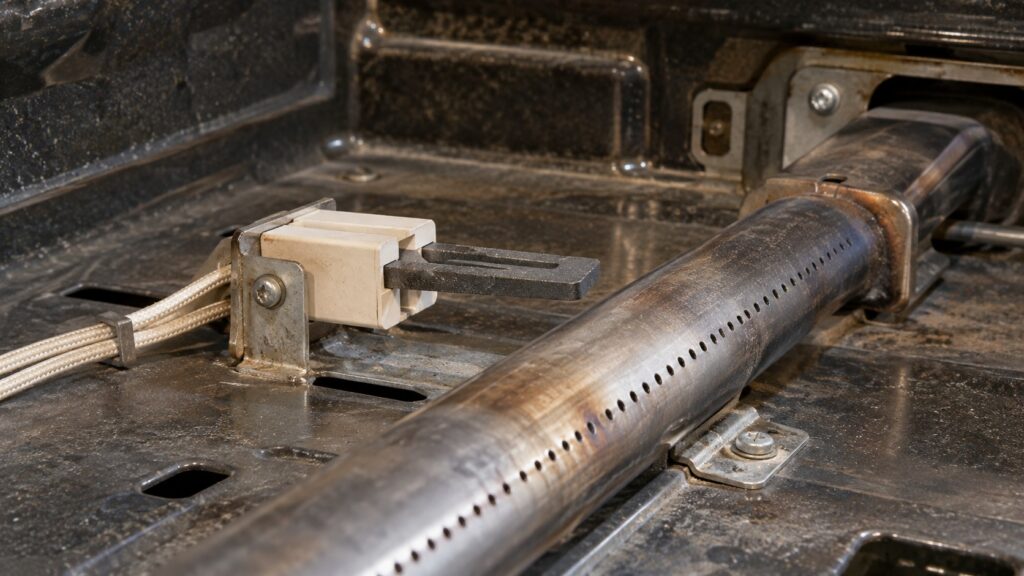
The safety valve is a gate for gas, held shut by a spring and opened by a small internal heater or coil that the igniter’s current feeds. The igniter must pass enough current through it. If the igniter is strong and the valve still stays shut, the coil in the valve may have failed, though that is less common than a weak igniter. Replacing the valve before testing the igniter is the usual way to spend money on the wrong part, so the order of testing matters.
If the burner lights but the flame is lazy, yellow or very small, that is a different problem, usually a blocked burner port or a restricted gas supply. It is a good reason to have a technician look rather than keep running the oven.
What should you do if you smell gas?
Stop. Do not turn any switch on or off, do not light anything and do not try to repair the oven. Open a window, leave the house and call your gas utility from outside. A faint, brief puff at ignition is normal in some ovens, but a lingering smell is not. Gas that builds up in a closed oven cavity can ignite with force when the burner finally lights, so a delayed ignition, where you hear a loud thump after a long wait, also deserves a technician visit promptly.
What should you tell the technician before the visit?
Three details save time. First, how long the igniter glows before you give up, in rough seconds. Second, whether the oven ever lit by itself later, for example after a second attempt, since an intermittent oven usually means an igniter on its way out. Third, whether the stovetop burners light normally, because that tells the technician the gas supply and the household side are fine. Having the model and serial number from the frame inside the oven door or the drawer opening also lets the right igniter be matched before the visit.
How does this connect to your other Whirlpool range symptoms?
An oven that will not heat might be a cooking problem or a safety problem depending on what it sounds and looks like. For the symptom side, including temperature drift, our Whirlpool range oven not heating guide and the broader oven not heating guide cover the symptom side. If the oven shows a code, such as F9E0, read the Whirlpool range F9E0 guide first, because a code points at a specific part rather than the igniter. If your top burners fail to light while the oven works, that is a different circuit, covered in our gas burner will not light guide.
We are an independent repair company, not the manufacturer, and we will tell you if a part is not worth replacing on an older range. If your gas oven glows but does not light, our Whirlpool range repair service can test the igniter and the valve, and you can book a visit online.