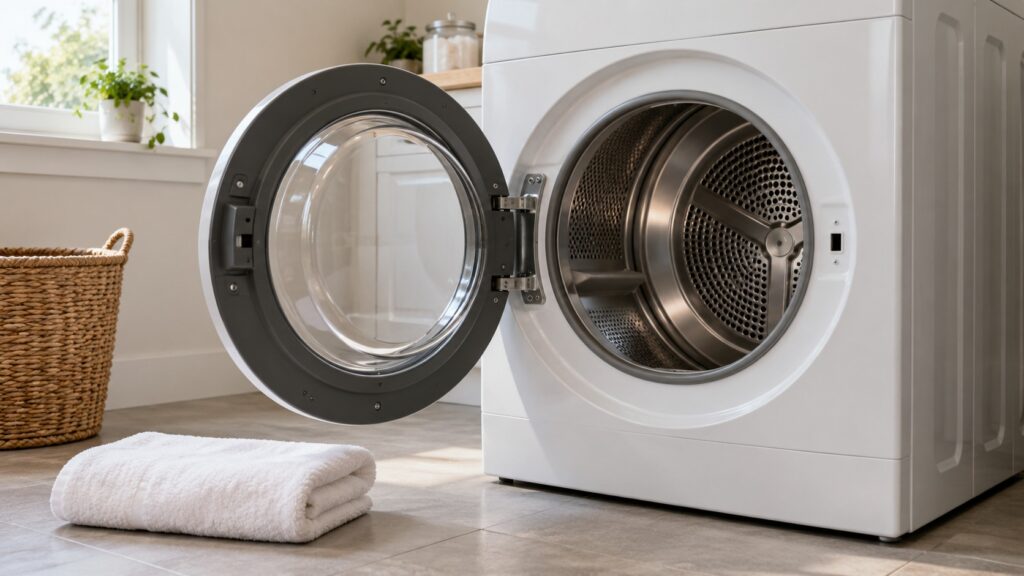
A Whirlpool dryer turns its drum with a thin drive belt that loops around the drum and the motor, and an idler pulley keeps that belt under tension. When the belt works, the motor and the drum move together. When the belt breaks, the motor keeps running and the drum does not turn at all. This guide explains what the belt and idler pulley do, what the symptoms of a problem sound and look like, and why a dryer that heats but will not tumble should be switched off and checked by a technician.
How does a Whirlpool dryer turn its drum?
Our guide on how a Whirlpool dryer works describes three jobs: heat, tumble and exhaust. The tumble part is simple: a motor spins the drum through a thin drive belt, lifting and dropping clothes so warm air reaches every surface. The same motor often also turns the blower that moves the air out of the dryer. So a single motor, a belt and a few moving parts keep the drum turning and the air moving.
The belt is a long, narrow loop. It runs around the outside of the drum, around a pulley on the motor, and past the idler pulley. The drum has no motor of its own, so the belt is the link between the two. How the belt is routed and how the cabinet opens on your exact model differ, so the owner’s manual or the service data for the model is the authority for a repair. It is not something to work out by taking the dryer apart.
What does the idler pulley do?
The idler pulley, sometimes searched as the whirlpool dryer belt idler, is a small wheel that presses on the belt. It does not drive anything; its job is to keep tension on the belt so it grips the drum and the motor pulley instead of slipping. In the dryers we service, it is commonly spring-loaded, so it takes up slack as the belt wears and stretches. This is a general description of how such dryers are usually built, so the details on your model may differ.
Like any wheel, an idler pulley wears. A worn bearing can make a squeal, a chirp or a rumble while the drum turns, and a seized one can drag the belt hard enough to stop the drum. That is why our drum-not-turning page lists worn drum rollers or an idler pulley as a cause, next to a broken belt and a failed motor. The sound often changes as the dryer warms up, and a noise that appears only while the drum is moving usually points to the parts in this guide.
Why do these parts fail?
The belt stretches and wears with use, and eventually it can snap. A dryer carrying heavy loads, an overloaded drum or a drum that has to turn against a worn roller puts extra strain on it. A belt that has been loose or damaged may squeak or thump with each turn before it breaks. None of these signs is a certain diagnosis. Several different parts produce similar noises, which is why we do not recommend guessing at the cause from the sound alone.
Many dryers have a belt switch, a safety device that cuts power if the belt breaks. If your dryer suddenly stops and will not start, that switch may be doing its job, so it is a safety feature and not a defect by itself. The way it works on your model is in the owner’s manual.
What does a broken belt look like?
The classic sign is a dryer that sounds like it is running but the drum does not turn. You may hear the motor hum, and the clothes stay in a heap at the bottom. Another sign is a dryer that runs, heats, and gives you damp clothes because nothing is tumbling. If it behaves like this, stop using it. Our drum-not-turning guide calls heat building up in a stationary drum a fire risk, since the hot air has nowhere to go. Our dryer drum not turning page covers the symptom and the code Whirlpool reports for a motor-control problem.
Our drum-not-turning guide describes one simple check, and only with the power disconnected: unplug the dryer at the wall first, and never touch the drum while it is plugged in. Then open the door and turn the drum by hand. If it spins freely with no resistance, the belt is likely broken. If it is hard to turn or grinds, suspect a seized roller or idler. On a gas dryer, if you smell gas, do not touch switches or plugs; leave the house and call your gas utility or 911 from outside. Do not remove the cabinet panels or reach behind the drum for a closer look. The parts are close to the heater and the electrical connections, and opening the cabinet is a technician’s job.
Can you replace a dryer belt or idler pulley yourself?
We do not give step-by-step instructions for replacing them, because the cabinet has to be opened, the drum lifted or held, and the belt routed around the idler in the right way for your model. A belt put on incorrectly can slip, wear fast or catch. If the drum will not turn, or you hear squealing from inside, book a diagnosis. A technician can check the belt, the idler, the rollers and the motor together, since a worn idler or roller that is left in place can break a new belt. Whether a repair or a replacement makes sense depends on the age of the dryer, the fault and the quote; our dryer repair or replace page describes how to decide for an older machine.
Which other problems look like a belt problem?
A dryer that tumbles but stays cold has a heat-side problem, and one that does both but dries slowly usually has an airflow problem, such as a blocked vent. Our dryer takes too long guide covers that case. A dryer that heats but will not tumble has a drive-side problem, which is where the belt, idler and motor live. If it will not start at all, there are other causes before the belt. For any of these, our dryer repair page explains how a visit works.