The Whirlpool range hood repair or replace decision comes down to the fault: repair is usually the better call when the fault is a filter, a light, a switch or a start capacitor, and replacement starts to make sense when the blower motor has failed on an older, basic hood or when the hood no longer moves enough air for your cooktop. Many hoods that seem dead only need a cleaning, so identify the symptom before you decide.
Should you repair or replace a Whirlpool range hood?
Start with what actually stopped working. A range hood has only a handful of parts that fail: the blower motor, the speed switch or control, the lights, the start capacitor and the damper. Most of those are cheap compared with a new hood. The one part that changes the math is the blower motor, and our Whirlpool range hood repair cost guide says it plainly: on an older or builder-grade hood, a failed motor can approach the cost of a new unit. Everything else, in most cases, favors repair.
We keep prices out of this page on purpose. A real figure is only known after the fault is confirmed, so the repair cost guide gives ranges by part and we give a firm quote on the visit.
Which symptoms point toward a cheap repair?
Alarming symptoms are often small. A hood that hums but will not spin sounds like a dead motor, yet the usual cause on our pages is a failed start capacitor, a modest part, with the motor itself fine. Weak suction that feels like a failing fan is usually a clogged grease filter or a blocked duct. Dead lights are almost always a bulb, an LED module or a socket, not anything in the fan circuit. A fan that never starts can also be a faulty speed switch.
That is why a diagnosis comes before the decision. Our pages for Whirlpool range hood weak suction and fan not working list the checks in order, and the grease filter cleaning guide covers the free one first.
When does replacing the hood make more sense?
Three situations tilt toward replacement. The first is a failed blower motor on a hood that is already old or builder-grade, where the repair would come close to the price of a new one. The second is a hood that never moved enough air for your cooking; cleaning and repair cannot add capacity. The third is a hood that is damaged in several places at once, such as a bad motor, a failed control and corroded housing. In that case you would be paying for several repairs on an aging unit.
If you do replace, size the new hood to the cooktop. Our Whirlpool range hood buying guide explains CFM, width and type, and the venting and ducting installation page covers how the duct path affects performance.
What does your hood’s model tell you?
Model pages give a feel for what a hood is built to do. The WVW53UC6LS, which draws many of the searches we see, is a 36-inch chimney wall-mount hood rated at 400 CFM with a three-speed fan, LED lighting and a removable grease filter. See the WVW53UC6LS model page. Compare that with the under-cabinet models on our list: the UXT4030ADS is a 30-inch ductless hood rated at about 140 CFM with a charcoal filter, and the UXT5530AAS is a convertible 30-inch hood rated at 400 CFM. A 400 CFM hood and a ~140 CFM ductless hood are rated very differently on our pages; if your hood moves the air your cooking needs, repairing it is usually the simpler path.
Whether a particular repair part is available for your model is a question for the visit, not the page. Read the nameplate on your hood and have the number ready.
What should you check before you decide?
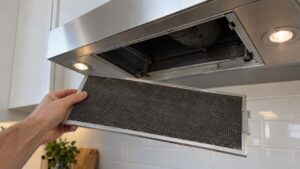
Work through the cheap things first. Turn the hood’s breaker off at the panel, standing on a dry floor, before you reach into the hood, and do not open the blower housing or touch the capacitor yourself; a capacitor can hold a charge. Remove and wash the grease filter, then check that nothing blocks the duct opening. Replace a dead bulb or LED module. Try every speed. Listen for a hum, a rattle or a scrape when the fan starts. Write down what happens and when, because a technician can use that to pick the likely part. Hoods are often a family of problems that look big and are small.
Never run the hood to clear smoke from a grease fire. If grease catches fire on the cooktop, cover the pan with a lid, turn off the heat and do not turn on the hood or pour water on it. If the fire does not go out at once, or spreads, leave the house and call 911 from outside. Keep the filter clean so grease does not build up where a spark could reach it, and cut the power at the breaker if you smell burning from the hood itself.
How do you get a straight answer on repair or replace?
Book the diagnosis. Our visit confirms the fault before any part is ordered, so you can weigh a firm price for that specific job against the cost of a new hood. We are an independent repair company; we repair, we do not sell hoods, so the comparison is yours to make with the number in hand. Our range hood repair page explains the visit, and you can book a visit online.