whirlpool range hood weak suction — where the fan runs but barely clears smoke and steam — is almost always an airflow restriction, not a failing motor. On Whirlpool range hoods (WVU, UXT, WVW series) air has to pass through the grease filter, through the motor, and out the duct or charcoal filter. A blockage anywhere in that path chokes the suction even though the fan sounds like it is working hard. This guide walks the path from front to back.
Why a Whirlpool range hood weak suction problem happens
The most common cause by far is a clogged metal grease filter — months of cooking grease congeal in the mesh until air can barely pass. The second is the ductwork: a crushed flex duct, a clogged wall cap, a closed or stuck damper, or an excessively long or twisty run all strangle airflow. On ductless (recirculating) models like the UXT4030ADS, a saturated charcoal filter is a frequent culprit since it cannot be cleaned and must be replaced. Less often, the blower wheel is caked with grease, throwing it off balance and reducing the air it moves.
Steps to restore airflow
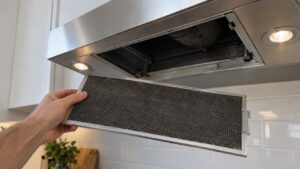
- Pull the metal grease filter and hold it to the light. If you cannot see through the mesh, it is clogged — wash it in hot soapy water or the dishwasher.
- On ductless models, check the charcoal filter date. These are not washable; replace them on the schedule in your manual.
- Trace the duct: look for crushed or kinked flex duct, and make sure the exterior wall or roof cap damper opens freely (birds and debris love to block them).
- Confirm the damper inside the hood flap opens when the fan runs.
- Clean the blower wheel if it is visibly greasy.
- Verify the highest fan speed actually engages — weak suction plus no top speed can point to a partly failed switch.
When to call a technician
If the filters are clean, the duct is clear, and suction is still weak, the blower motor may be losing power or the internal damper may be stuck — both worth a professional look. You can schedule a Whirlpool range hood repair and a technician will measure airflow and inspect the motor and damper. Our Whirlpool range hood repair overview describes the diagnosis. Repairs use genuine OEM parts and carry a 30-day labor warranty.
Ducted versus ductless suction expectations
Part of diagnosing weak suction is knowing what “normal” is for your setup. A ducted hood vented straight outside through a short, correctly sized duct moves the most air and clears smoke fast. A ductless (recirculating) hood, by design, will never feel as strong — it pushes air through a dense charcoal filter and returns it to the room, so even a healthy ductless unit clears odor and grease more modestly than a ducted one. If you have a ductless hood and it feels weak, the first suspects are a clogged grease filter and a saturated charcoal filter, not a problem. On a ducted hood, also check that the run is not far longer or more twisted than it should be — a hood rated for high airflow can be strangled to a fraction of that by a long flex-duct run with several elbows. Understanding your configuration keeps you from chasing a “repair” for what is really a venting design limit, while still catching the genuine restrictions a cleaning or duct fix can solve.
How to keep suction strong
Clean grease filters monthly, replace charcoal filters on schedule, and keep duct runs as short and straight as the layout allows. For the recommended filter type and CFM rating for your model, Whirlpool lists them at whirlpool.com.