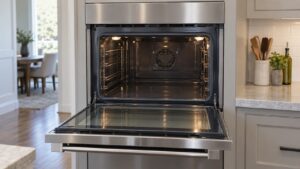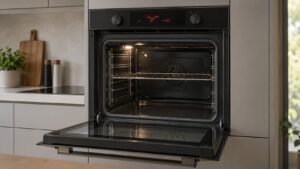
Whirlpool AccuBake is the temperature management system in the oven — the arrangement of sensor, elements and control logic that keeps the cavity at the number you set instead of swinging around it. Every oven cycles its elements on and off; what AccuBake does is cycle them in a way that keeps the swing small enough that a cake does not know about it.
What an oven is actually doing at a set temperature
An oven does not hold a temperature; it oscillates around one. The element heats until the sensor reads above the target, switches off until the reading falls below it, and repeats. The size of that oscillation is what separates a good oven from a frustrating one, and it depends on where the sensor sits, how quickly it responds, and how the control decides when to switch.
A crude system waits for a large drop before switching back on, which produces a wide swing. A well-managed one anticipates — switching earlier and for shorter periods, so the cavity stays inside a narrow band. That is the whole of what AccuBake is doing, and it is why the elements visibly cycle far more often than people expect.
Preheat, and the signal that is not quite what it says
The preheat indicator tells you the sensor has reached the set point. It does not tell you the oven walls, the racks and the air have all stabilized, and those carry a great deal of heat. An oven that beeps at ten minutes is genuinely at temperature at the sensor and still warming everywhere else.
For roasting this makes no difference. For baking, particularly for anything that sets quickly, giving the oven another ten minutes after the beep produces a noticeably more even result. This is not a fault in the indicator; it is a difference between what it measures and what you care about.
Why the door is the enemy
- Every opening dumps hot air and the oven pays to recover it, with a swing while it does.
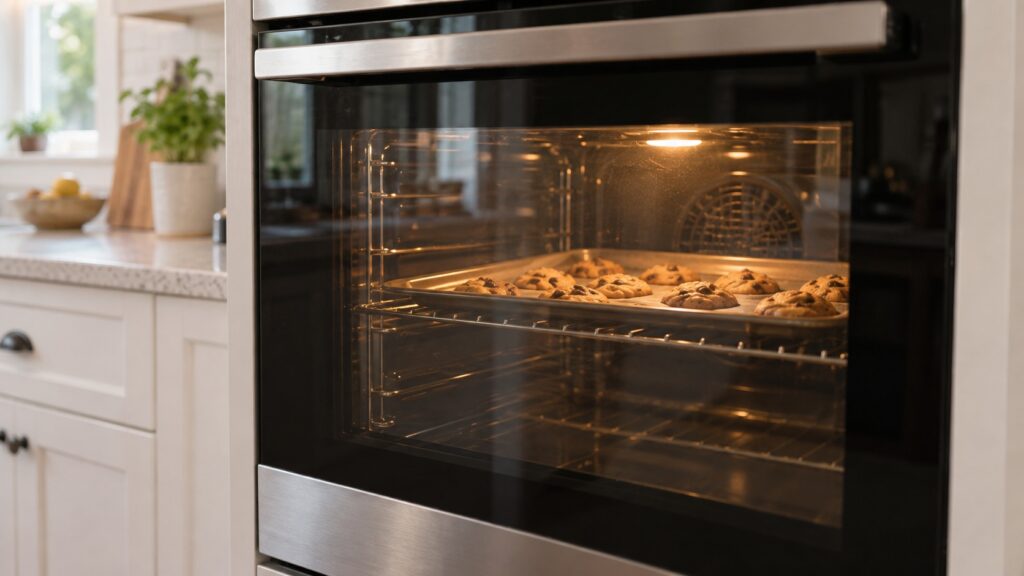
- Use the light and the window. The single most effective baking habit there is.
- A poor door seal does the same thing continuously. Check it with a strip of paper at several points.
- A sagging door that no longer pulls shut is a hinge, and it produces exactly the symptoms of an oven that will not hold temperature.
Hot spots are geometry, not a fault
Every oven has them. Heat rises, elements are at the top and bottom, and the back of a cavity is closer to insulation than the front. A tray that browns more at the back is reporting physics rather than a failure, and the fix is rotating the tray halfway through rather than calling anyone.
What is worth attention is a hot spot that has changed — one side suddenly browning when it never did. That usually points at an element that has partly failed, at a fan that has stopped on a convection model, or at a door that has started leaking on one side. Our page on an oven running off temperature covers the separation.
What you put in the oven changes the swing
The system is managing a cavity, and what is in the cavity is part of it. A heavy cast iron pot or a full baking stone stores a great deal of heat and smooths the oscillation considerably — which is why bakers use stones and why bread made on one is more forgiving. An almost empty oven, by contrast, has very little thermal mass and swings more with every cycle of the element.
This also explains an effect people find puzzling: an oven that bakes beautifully when full and unevenly when baking a single small item. Nothing changed in the appliance. If you regularly bake one tray at a time, leaving a stone or a heavy empty tray on a lower rack gives the control something to work against and makes the result noticeably steadier.
Calibration drift, and how to check it
Sensors age and controls drift, usually by a few degrees over years. Nothing has failed; the oven simply runs cooler or hotter than the dial, and every recipe has slowly stopped working. Because it happens gradually, people adapt without noticing and then conclude the oven is dying.
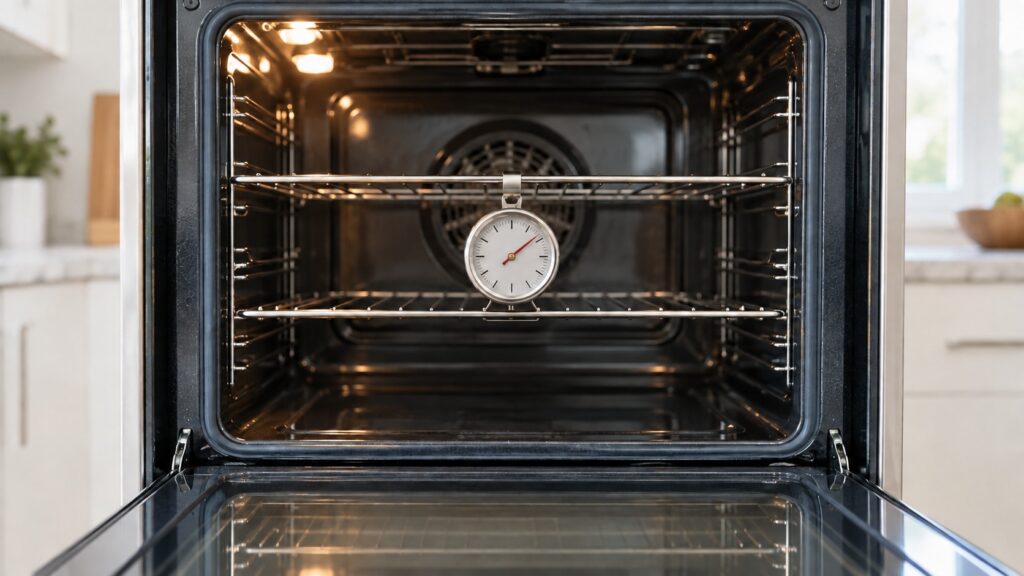
An oven thermometer on the middle rack settles it in one preheat. If the reading is consistently off by a fixed amount, most ovens allow the calibration to be adjusted — an adjustment rather than a repair, and one worth making rather than living around.
AccuBake and convection are different things
This is the most common confusion we hear. AccuBake manages temperature. Convection moves air with a fan so that heat reaches the food faster and more evenly. An oven can have either, both or neither, and a fault in one says nothing about the other.
If your oven has convection and the fan has stopped, the symptom is uneven browning with the temperature still correct — the sensor is happy, the air is not moving. Our explainer on how the cooktop works covers the other half of the range.
When it is the appliance
A cavity that never reaches temperature, one that overshoots badly, an element that glows unevenly or not at all, or a display reporting a sensor fault — those are parts rather than habits. The sensor itself is an inexpensive component and a common one to replace.
We are an independent repair company, not a factory service arm. Pricing starts from a diagnostic visit and we confirm the estimate before any work begins. Whirlpool oven repair covers sensors, elements and controls, and you can schedule a visit online. For the door itself, see our door lock glossary.