Whirlpool ice maker mineral buildup inside a refrigerator’s built-in ice maker shows up as ice that tastes off, cubes that come out smaller or cloudier than they should, or an ice maker that gradually slows its production over months — and the fix is routine cleaning and a water filter change, not a repair, in the large majority of cases. This is specifically about the ice maker built into your refrigerator, not a standalone commercial ice machine, which is a different appliance with its own descaling schedule.
Why does mineral buildup happen inside an ice maker specifically?
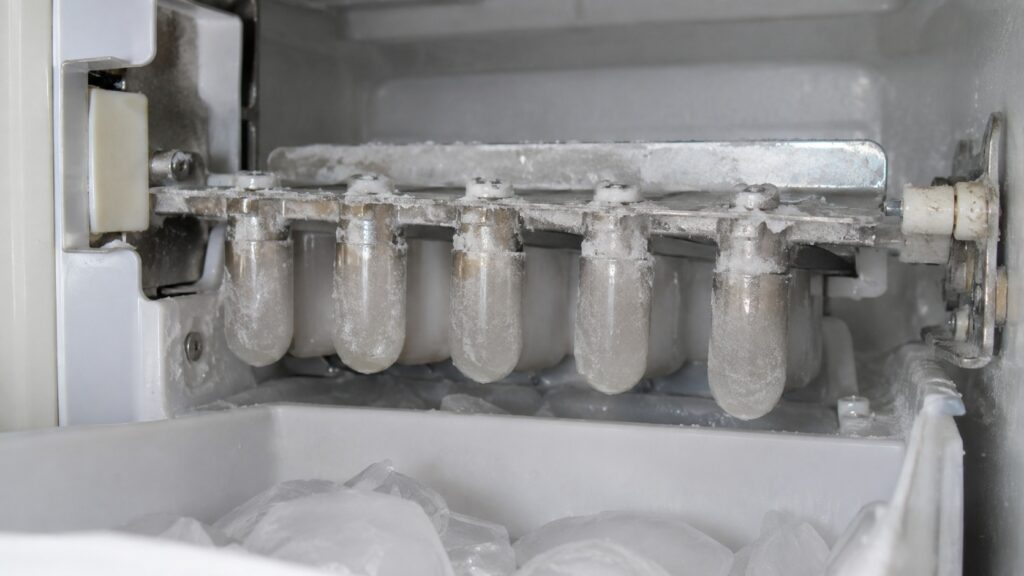
Every time your refrigerator’s ice maker fills its mold with water and freezes it into a cube, any dissolved minerals in that water — mostly calcium and magnesium in hard water areas — don’t freeze along with it in the same proportion. As the cube forms and later releases, a small residue of those minerals tends to stay behind on the mold surface and the fill tube walls. Over hundreds of ice-making cycles, that residue accumulates into a visible scale, the same white, chalky buildup you’d recognize from a kettle or a coffee maker in a hard water home. It’s a purely mineral, not biological, process, though a fully neglected ice maker can eventually develop both problems together.
How can you tell mineral buildup apart from other ice maker problems?
Mineral buildup produces a gradual change rather than a sudden failure — ice quality and production slowly decline over weeks or months rather than the ice maker stopping outright from one day to the next. If your ice maker has stopped producing ice completely and suddenly, that’s more likely a supply line freeze, a failed water inlet valve, or a mechanical fault than mineral scale, and our guide on a Whirlpool ice maker not making ice covers those causes separately. If ice production has slowed gradually and cubes look cloudier or smaller than they used to, our ice maker slow production guide covers that pattern in more detail, though mineral buildup is one of the most common underlying causes behind it.
Does a water filter actually prevent mineral buildup?
Partially. Whirlpool’s refrigerator water filters are designed primarily to reduce chlorine taste, sediment, and certain contaminants — not to soften water or remove all dissolved minerals, which would require a different kind of filtration entirely. What a fresh filter does help with is keeping sediment and larger particles from accelerating scale formation and from clogging the fill tube alongside mineral deposits. An old, saturated filter does the opposite: it can restrict water flow enough that water sits longer in parts of the system, giving minerals more contact time to deposit. Replacing the filter on Whirlpool’s recommended schedule — typically every six months for most models — is a meaningful part of managing buildup even though it isn’t the whole solution on its own.
How do you clean mineral buildup out of an ice maker safely?
Start by turning off the ice maker and removing any ice currently in the bin, then unplug the refrigerator or shut off power to the ice maker circuit if your model allows it separately. A solution of warm water and white vinegar, applied with a soft cloth or a soft-bristled brush to the ice mold and any visible scale on the fill tube opening, dissolves mineral deposits without the abrasiveness that could scratch plastic components. Avoid metal scrapers or abrasive pads entirely — the ice mold surface is designed to release ice cleanly, and scratching it can actually make cubes stick more often afterward, trading one problem for another. Rinse thoroughly with clean water before restoring power, since any vinegar residue left behind will flavor the first several batches of ice.
Our ice maker cleaning and filter guide covers this cleaning process step by step alongside the filter replacement schedule, if you’d like the fuller routine rather than the buildup-specific summary here.
Why does ice taste off even after you’ve cleaned the mold?
If ice still tastes wrong after a thorough cleaning, the residual taste is often coming from somewhere further upstream — a saturated filter that’s stopped removing chlorine taste effectively, or in some cases the ice bin itself, which absorbs odor from the freezer compartment over time if it’s not cleaned alongside the ice maker mechanism. Our ice maker tastes bad guide covers those additional causes beyond mineral buildup specifically, since taste problems don’t always trace back to scale even when scale is also present.
Does a water softener eliminate the need for this kind of cleaning?
It reduces the problem but does not eliminate it. A whole-house water softener removes most of the calcium and magnesium responsible for hard-water scale, which does slow buildup noticeably compared to unsoftened hard water. It does not remove every trace mineral, and softened water still leaves some residue behind over hundreds of freeze-and-release cycles, just at a slower rate. If your home has a softener, expect to clean the ice maker less often than the hard-water schedule above, but don’t skip it entirely on the assumption that softened water means no buildup at all — check the ice mold periodically rather than assuming the softener has made this maintenance unnecessary.
How often should you do this kind of ice maker maintenance?
In a hard water area, cleaning the ice mold every few months alongside your regular filter changes keeps buildup from reaching the point where it visibly affects ice quality. In an area with softer municipal water, buildup progresses more slowly, and cleaning once or twice a year alongside filter changes is usually enough. If you’ve never cleaned the ice maker and it’s been in regular use for a year or more, expect the first cleaning to make a more noticeable difference than subsequent ones, simply because there’s more accumulated scale to remove the first time through. Our how a Whirlpool ice maker works guide is useful background if you want to understand the fill and freeze cycle that produces this buildup in the first place.
If cleaning and a filter change haven’t restored ice quality or production, the ice maker mechanism itself may need attention — our technicians can schedule a visit and check the fill valve, mold heater, and ejector arm beyond what routine cleaning covers.