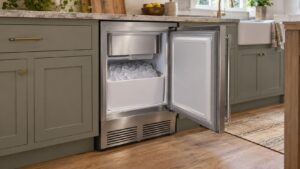

If you own a 15-inch undercounter unit, a few whirlpool ice machine terms show up constantly in manuals, parts listings, and repair quotes — and knowing them makes every conversation easier. Standalone ice machines borrow vocabulary from refrigeration that the little icemaker in a fridge never uses, so this glossary focuses on the words that matter for a WUI-series machine. Use it alongside our how-it-works and troubleshooting guides to understand exactly what a technician is describing.
Core Whirlpool ice machine terms
- Evaporator (or evaporator plate) — the chilled surface where water freezes into a sheet of ice. Scale on the evaporator is the most common cause of slow or no ice.
- Harvest cycle — the part of the cycle where the machine warms the evaporator (with hot refrigerant gas) to release the finished ice into the bin. A slow harvest stretches every cycle.
- Clear Ice Technology — the Whirlpool feature in current WUI machines that flows water over the plate so impurities wash away, producing clearer, slower-melting cubes.
- Condenser — the coil that rejects heat from the refrigeration system. A dirty condenser or blocked front grille makes the machine run hot and slow.
- Sump — the small reservoir at the base that holds the water being circulated over the evaporator during a freeze.
Water and drain terms you will hear
- Water inlet valve — the electrically controlled valve that admits fresh water. A failed valve or a clogged inlet screen starves the machine.
- Gravity drain — a drain that relies on the machine sitting above the drain point so waste water flows downhill. The WUI75X15HZ uses a gravity drain.
- Drain pump — a built-in pump that pushes waste water uphill to a higher drain, used on the WUI95X15HZ so it can be installed where gravity alone will not work.
- Storage bin — the insulated compartment that holds finished ice; the WUI series holds about 25 pounds. A bin sensor pauses production when it is full.
- Self-Cleaning cycle — the built-in routine that circulates descaler and sanitizer through the water path; running it on schedule prevents most failures.
Performance terms
- Production rate — how much ice the machine makes per day; published figures vary, so treat the 25-pound storage capacity as the reliable spec.
- Fast Ice — an option on WUI machines that speeds production temporarily to rebuild the bin.
- Ambient temperature — the air temperature around the cabinet; a hot location slows harvest and cuts output, which is why clearance matters.
Refrigeration and component terms
- Compressor — the heart of the refrigeration system; it pumps refrigerant through the loop that chills the evaporator. A failing compressor is the most expensive repair.
- Hot-gas harvest valve — the valve that diverts hot refrigerant to the evaporator to warm it and release the finished ice sheet during harvest.
- Refrigerant charge — the amount of refrigerant in the sealed system; a low charge from a leak causes long cycles, warm operation, and poor ice production.
- Sealed system — the closed refrigeration loop (compressor, condenser, evaporator, and lines). Repairs here require gauges and training and are the costliest category.
- Bin sensor — the control that detects a full storage bin and pauses production so the machine does not overflow.
Why knowing these terms saves you money
The practical payoff of this vocabulary is that you can read a repair quote and tell a cheap fix from an expensive one at a glance. A quote that names the inlet valve, the drain pump, or a cleaning is a water-side repair and almost always worth doing. A quote that names the compressor, a refrigerant leak, or the sealed system is the category where age and repair-versus-replace deserve real thought. Knowing which world a part belongs to turns an intimidating estimate into an informed decision.
With these terms in hand, the rest of the documentation reads much more clearly. To see the cycle these words describe, read how a Whirlpool ice machine works; to put the vocabulary to use on a real problem, see our no-ice troubleshooting guide. You can match these terms to your specific model and its parts at whirlpool.com. And whenever a term in a quote does not add up, schedule a diagnostic and we will explain in plain language what is actually failing.