Whirlpool trash compactor installation means sliding a 15 inch cabinet-width unit into a prepared opening, leveling it, plugging it into a grounded outlet and checking that the drawer opens freely. Some models are built in under a counter and others are convertible, meaning they can also stand freely in the kitchen. The work is simple when the opening and outlet are ready, and awkward when they are not, so most of this guide is about the planning that happens before the compactor comes out of the box.
Is your Whirlpool compactor built in or convertible?
This decides everything else. A built-in or undercounter compactor such as the TU950QPXS or GX900QPPS is meant to sit inside a cabinet run, with the cabinet doors and countertop around it. A convertible model like the GC900QPPB can go into a cabinet opening or stand on its own in a kitchen, a utility room or a garage. The model number is on the data label, usually on the frame inside the drawer opening or on a side panel. The older TC8700 family is built in and the older TF8500 family is freestanding or convertible, and both are discontinued, though we still service them.
Look up the model before you buy a panel, trim kit or toe-kick. Matching hardware to the wrong family is the most common reason a delivery turns into a second trip.
How should you prepare the opening?
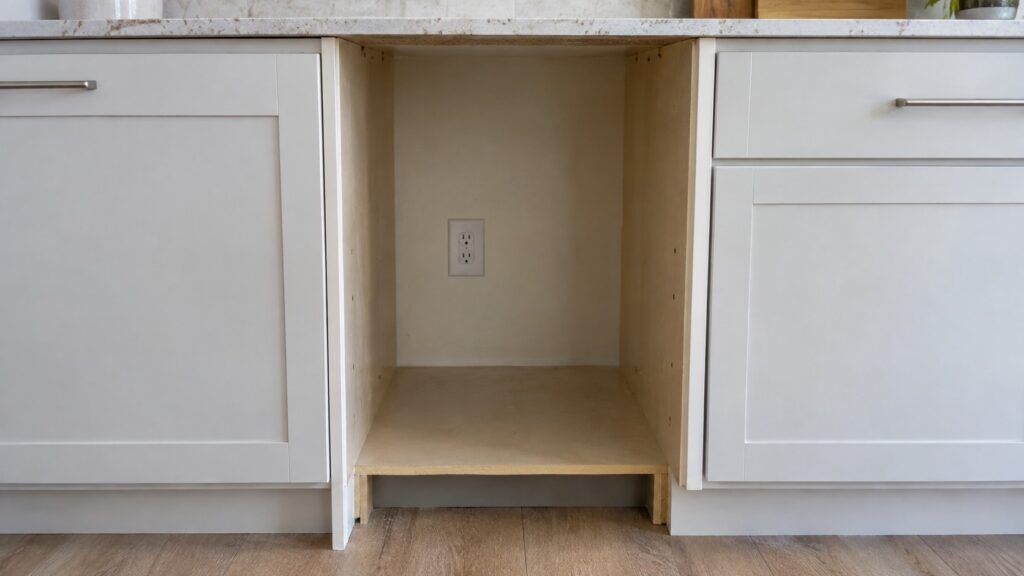
Start with width, height and depth, using the dimensions in your model’s installation sheet rather than a general rule. A 15 inch built-in needs a clear opening of the size that sheet gives, with the floor flat and the cabinet sides square. Check the floor for a trim board or flooring edge that would catch the front feet. Confirm that the finished countertop height leaves room for the compactor’s top and that nothing overhangs the drawer path. Remove anything from the opening that is not part of the installation, such as old drawer slides or leftover cabinet back panels.
If you are replacing an older compactor, measure the new unit against the old opening. Models change over the years, and a replacement that is slightly taller or deeper can need a small cabinet adjustment. Work out the finish at the same time: stainless fronts need clearance for the drawer handle, and a cabinet-panel trim, if you are using one, has its own thickness.
Where does the power go?
A compactor runs on an ordinary grounded household outlet. The outlet is usually placed in the side cabinet or at the back of the opening at a position the installation sheet specifies, so the plug and cord do not interfere with the unit sliding in or with the drawer. Do not use an extension cord. Do not cut or remove the ground pin. If the outlet is missing, in the wrong place or on a circuit that serves a heavy load, have an electrician fix it; this is not a place to improvise. Our Whirlpool trash compactor will not start guide explains what a compactor does when the supply is weak, which is a useful reason to get the outlet right the first time.
How do you set it in place and level it?
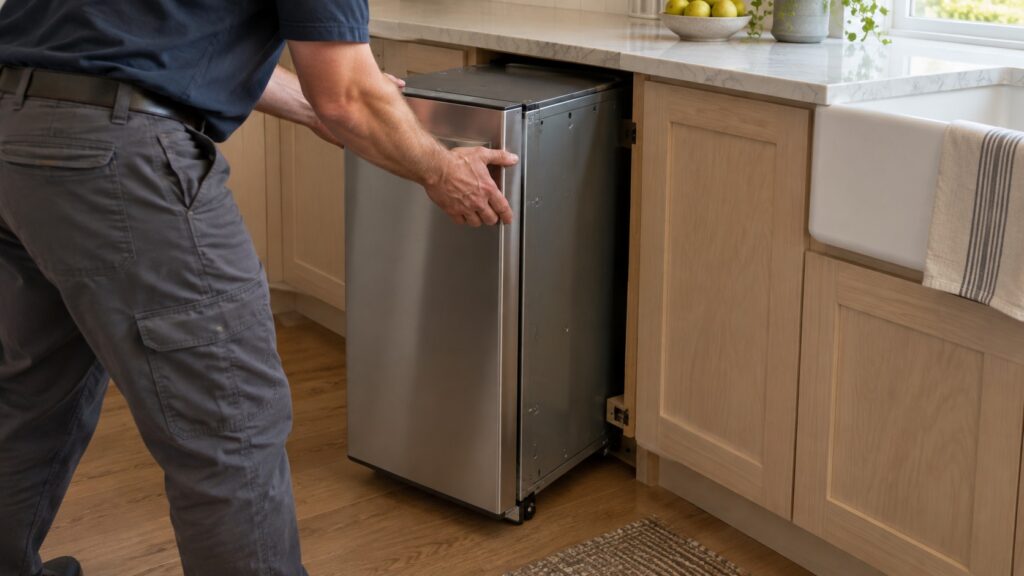
Move the compactor close to the opening, feed the cord toward the outlet and slide the unit in without pinching the cord behind it. Adjust the front leveling feet so that the cabinet sits level side to side and front to back. A compactor that rocks or tilts forward puts uneven load on the drawer and the ram, and an out-of-level drawer is a leading cause of a drawer that will not latch. If the unit is built in, secure it to the cabinet as the sheet describes, using the supplied brackets, and attach the toe-kick or panel kit only after the unit is leveled and tested.
For a freestanding or convertible install, check that the compactor sits on a hard, level floor with room around it for the drawer to open fully. Keep it away from heat sources and out of direct sunlight, and leave space for the cord.
What should you check before first use?
Run the empty compactor through a test before you load it. Pull the drawer out and push it closed; it should slide freely and latch with a firm click. Insert the bag as the manual shows. Run one compaction cycle with a small amount of light waste and listen: the ram should travel down and return without hesitation. If it stops partway, makes a grinding noise or refuses to return, stop and read our Whirlpool trash compactor ram stuck guide. Never put glass bottles or anything flammable, pressurized or liquid into the compactor, and keep the key or lock feature, where your model has one, in a safe place if children are in the home.
For how the machine moves waste in the first place, see how a Whirlpool trash compactor works, and for upkeep once it is installed, read the odor control guide.
When is it worth calling a technician for installation?
If the opening has to be modified, the outlet has to be moved, the floor is uneven in a way you cannot shim, or the compactor shows a fault on its first cycle, a visit saves time. We are an independent repair company, not the manufacturer, and we focus on repairs, but our Whirlpool trash compactor repair service can check a unit that was installed badly or damaged in transit. You can schedule a visit online.