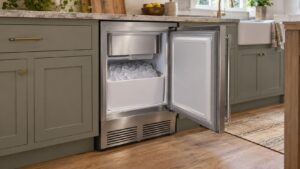

Routine whirlpool ice machine cleaning is not optional on a 15-inch undercounter unit the way it almost is on a fridge icemaker. These standalone WUI machines run an open water system over an evaporator plate, so minerals and biofilm build up steadily and are the leading cause of slow harvest, cloudy cubes, and eventual no-ice failures. Models like the WUI75X15HZ include a Self-Cleaning cycle precisely because regular descaling is part of normal ownership, not a repair.
How often a Whirlpool ice machine cleaning is needed
Plan on a full clean-and-descale at least every six months, and more often if you have hard water or run the machine hard. Two jobs are involved and they are different: descaling removes mineral scale from the water-contact surfaces, and sanitizing kills the slime and mold that grow in any wet ice system. Use a cleaner made for ice machines — household vinegar is a weak substitute and bleach left in the system can damage components and taint ice.
- Empty the storage bin and discard the ice. You do not want old ice contaminated during the clean.
- Start the machine’s Self-Cleaning / clean cycle and add the recommended ice-machine descaler when prompted by your model’s instructions.
- Let the descale solution circulate fully so it dissolves scale on the evaporator and water lines.
- Follow with a sanitizing pass per the owner manual, then run plain water cycles to rinse thoroughly.
- Discard the first one or two ice batches after cleaning so any residue flushes out before you use the ice.
Do not forget the condenser
Cleaning the water side is only half the job. The condenser and front grille collect dust and lint, and a choked condenser makes the machine run hot, slow, and short-lived. Vacuum and gently brush the grille and condenser fins every few months. Keep the required air clearance around the cabinet, especially in a built-in installation, so the unit can breathe.
- Hard water — descale more often; scale is the number-one enemy of these machines.
- Vacation shutdowns — if you will be away, empty the bin and consider draining the unit so standing water does not grow biofilm.
- Drain care — keep a gravity drain line clear and sloped; verify the pump runs on a pump-equipped model.
Why descaling matters more than people expect
It is worth understanding why scale is such a serious problem on these machines, because it explains why skipping cleanings is so costly. The evaporator plate has to chill water fast enough to freeze a clear sheet, then warm fast enough to release it. A layer of mineral scale acts like insulation on that plate: it slows the freeze, slows the release, and forces the refrigeration system to run longer and hotter for every batch. Over months that means lower output, cloudy or soft ice, and a compressor working harder than it should. Left long enough, heavy scale can turn a routine cleaning problem into a genuine refrigeration failure. In hard-water areas the buildup is faster still, which is why those homes should descale more often than the six-month baseline.
- Clear ice that turns cloudy is an early warning that scale is building on the plate.
- A clean cycle that has to run twice to clear the scale means you waited too long; shorten the interval.
- If your water is very hard, a whole-home softener upstream reduces how often you need to descale.
When cleaning is not the cure
If a thorough descale and a clean condenser do not restore production, you are likely past a maintenance issue and into a component or refrigeration problem. At that point our ice machine repair service can diagnose the water valve, harvest system, or sealed system. For the diagnostic walkthrough first, see our no-ice troubleshooting guide. Use the recommended cleaner and any model-specific steps published at whirlpool.com, and if scale keeps returning fast or the machine still struggles after cleaning, schedule a technician to check the water quality and refrigeration.