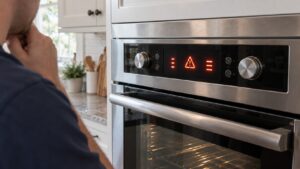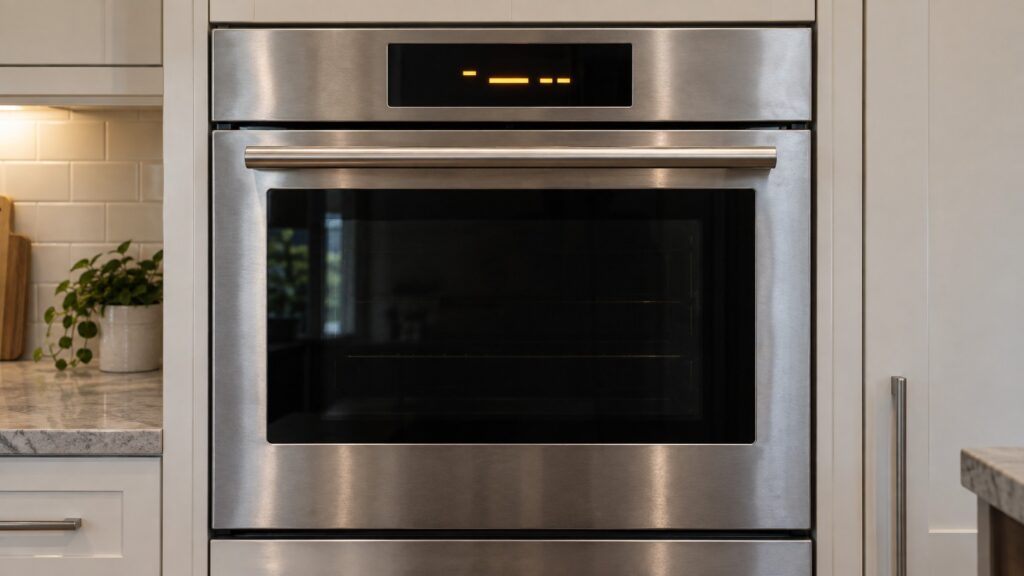
The whirlpool oven f1e0 code is the control board reporting that it cannot talk to its own memory chip. F1E1, its neighbor, says the memory answered but the contents no longer add up. Neither code is about heat, doors or sensors: both are about the small block of storage where the oven keeps its calibration and its configuration. That is why an oven with an F1 code can look perfectly healthy for ten minutes and then refuse to hold a setting.
What does F1E0 mean on a Whirlpool oven?
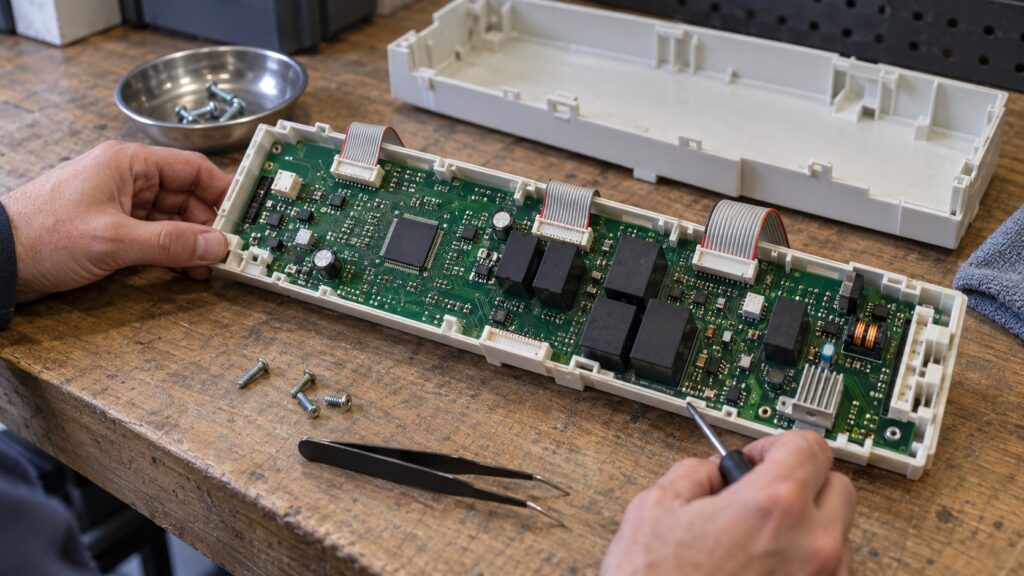
A Whirlpool oven control board is a small computer with two kinds of memory. Working memory holds what is happening right now — the setpoint, the timer, the current element state — and it empties every time power is lost. The EEPROM holds what has to survive: which model this board is fitted to, which features exist, and how far the temperature reading should be corrected. F1E0 means the path between the processor and that chip has failed. The board asks, and nothing answers.
What follows depends on the model. Some ovens lock out entirely and show only the code. Others run but forget: the clock resets, a saved setting reverts after every power interruption, or convection stops being offered on a model that clearly has a convection fan. The board is running on whatever defaults it has in program memory because the personalized copy is unreachable.
How is F1E1 different from F1E0?
F1E1 is the friendlier of the two, in the sense that the chip is answering. The board read its stored parameters, recalculated the checksum, and got a different number than the one saved alongside the data. Something in the stored block has changed without being written properly — a brownout during a write, an aging chip losing charge in one cell, or electrical noise on the bus at exactly the wrong moment.
Practically, F1E1 explains a specific and confusing symptom: an oven that suddenly bakes badly after years of being accurate. If the calibration offset is part of the corrupted block, the board may fall back to a default correction, and a twenty-degree swing appears overnight with no part having failed mechanically. If your complaint is accuracy rather than a code, start from our guide to a Whirlpool oven temperature off reading, which covers the sensor side of the same symptom.
Is a Whirlpool oven F1E0 dangerous to keep using?
An oven that shows an F1 code and still heats is running with an incomplete picture of itself, and that is the honest reason not to leave it in service. Two specific risks matter. The first is temperature: if the calibration data is unreadable, the correction applied to the sensor is not the one this oven was set up with, so the cavity can sit well above or below the display. The second is the self-clean cycle, which relies on stored parameters and on door-lock timing. Do not start a self-clean on an oven that has thrown an F1 code.
Beyond that, the fault tends to widen. A board that has lost contact with its memory once usually does it again, and the intervals get shorter. Treat the first appearance as notice rather than as a one-off.
What should you try before calling for service?
There is less owner-level work in an F1 code than in most Whirlpool faults, precisely because the problem is inside a sealed assembly. Two steps are still worth doing, and one piece of record-keeping matters more than either.
- Cut power at the breaker for five minutes, not at the switch. A full restart makes the board re-run its startup checks from cold. A code that clears and stays away for weeks was a transient; a code that returns on the next power-up is a hardware fault.
- Check that the oven is on a healthy circuit. Repeated brownouts, a shared circuit with a large motor load, or a loose neutral will corrupt an EEPROM write. If other appliances on the same circuit behave oddly, the board may be the victim rather than the cause.
- Write down the model number and every code the oven has shown. An F1 code alongside a stuck-key code such as the one in our guide to Whirlpool oven F2E0 points at the interface assembly as a whole rather than at one chip.
Do not open the control console. The board sits in the same compartment as line-voltage terminals and relay contacts, and on a built-in wall oven reaching it means pulling the unit out of the cabinet, which is a two-person job with a live circuit behind it.
What does a technician do about a memory fault?
The diagnosis is short and the repair is specific. A technician confirms the code with the board’s own service mode, checks the supply and the ground, and inspects the connectors and ribbon between the interface and the main board — a marginal connection produces the same symptom as a dead chip and costs nothing to fix. If the memory itself is at fault, the board is replaced as a unit. Nobody reflashes an oven EEPROM in a kitchen.
The part of the job owners do not expect is what comes after the swap. A replacement board arrives generic and has to be told which oven it is now living in: model configuration, feature set, and in many cases a calibration pass so the display and the cavity agree again. A board fitted and left unconfigured produces a working oven with the wrong feature list, which is the most common reason a second visit happens. Our technicians configure the board on the same visit and confirm the cavity temperature before leaving.
When is an F1 code a reason to replace the oven?
Control boards are one of the few appliance parts where the honest answer sometimes points away from repair. On an oven under about ten years old, with a sound cavity, working elements and a door that seals, a board replacement is worth doing. On a much older unit where the element, the latch or the fan is also tired, the board is usually the most expensive part left, and spending it on an oven with two more failures queued up is money badly placed. Our reference on how a Whirlpool oven works sets out which parts carry the load and which ones age first.
We are an independent repair company, not a factory service arm, so we have no reason to push a board sale on an oven that does not deserve one. Pricing starts from a diagnostic visit and we confirm the estimate before any work begins. Bring the model and serial from the tag inside the door frame when you book Whirlpool oven repair, or schedule a visit online and list every code the oven has shown — with memory faults, the sequence tells more than any single number.