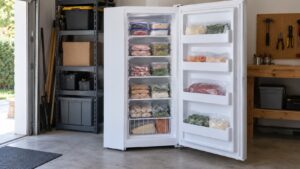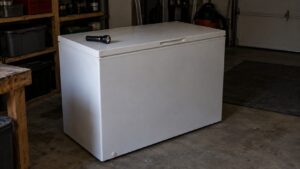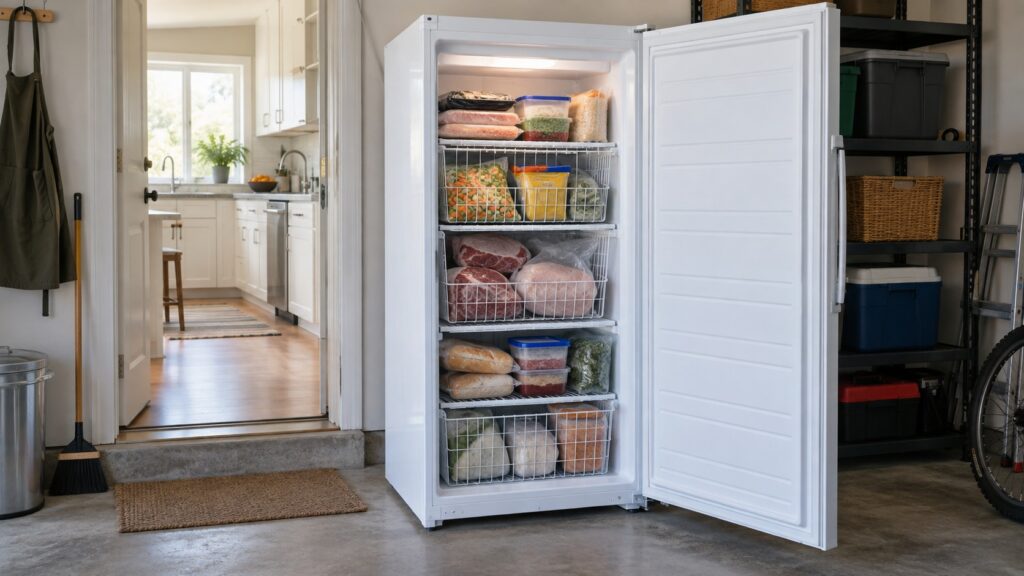
A standalone freezer is the appliance people notice least and depend on most. It sits in a garage or a basement, runs unattended for years, and the first sign that anything is wrong is usually a smell when you open it. Whirlpool freezer maintenance is a short list done a few times a year, and it exists to make sure the first sign of a problem is not several hundred dollars of thawed food.
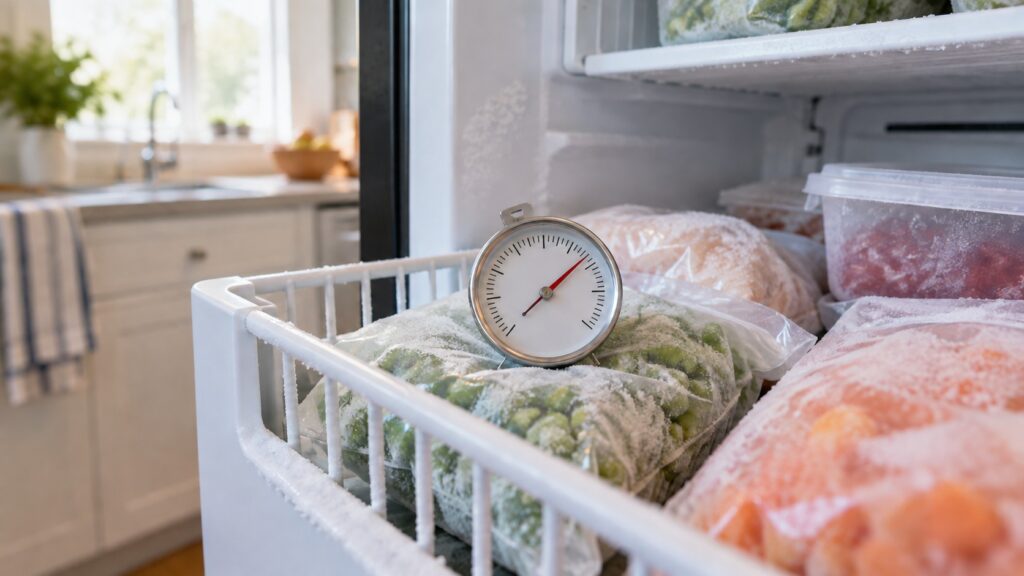
A thermometer is the whole early-warning system
A freezer has no way of telling you it is running warm. The contents look identical at 0°F and at 15°F, and by the time texture changes the damage is done. A cheap thermometer left inside and glanced at when you open the door is the entire monitoring system, and it is the single most valuable habit here.
What you are watching for is drift rather than an exact number. A freezer that has read the same for a year and now reads five degrees warmer is telling you something — a seal, a coil, a door left ajar, or the start of a component problem. Our page on repair or replace covers what the drift usually turns out to be.
Coils, and why a garage is harder than a kitchen
Condenser coils shed the heat the freezer removes from inside. Coated in dust, lint and cobwebs they cannot, so the compressor runs longer for the same result — quietly, continuously, and at a cost that never appears as a fault. A freezer in a garage or a basement collects far more than one in a kitchen, and gets vacuumed far less because nobody sees it.
Twice a year, unplug it, pull it out, and vacuum the coils and the grille. Five minutes, and it is the difference between a compressor working and a compressor straining.
The door seal does more than close the door
- Paper test. Close the door on a strip of paper and pull, at several points around the opening. It should drag everywhere.
- Clean the seal with a damp cloth. Sticky residue holds the seal open a fraction and ices the surrounding area.
- Check the hinge side, where a sagging door shows first.
- Frost around the opening means warm humid air is getting in continuously — a seal, not a fault in the cooling.
Manual defrost and frost-free need opposite things
A manual-defrost freezer accumulates ice on its walls, and that ice is an insulator: half an inch of it makes the compressor work measurably harder, and several inches steal usable space. Defrost it once a year or when the ice reaches about a quarter inch, whichever comes first. Never chip at it with anything metal — a punctured evaporator ends the appliance.
A frost-free freezer clears its own evaporator on a schedule and should have clear walls permanently. 🔴 Frost on the walls of a frost-free model is therefore a symptom rather than a chore: either the seal is letting humid air in, or the defrost system has stopped working and meltwater is no longer leaving. Our page on a unit that is not cooling covers the related diagnosis.
Keeping it full is a maintenance measure
Frozen mass holds cold; air does not. A full freezer rides through a door opening with barely a change, recovers quickly, and — importantly — carries far longer through a power outage. A nearly empty one loses its cold the moment the door opens and pays to recover it every time.
If you do not have enough to freeze, fill the space with containers of water. They cost nothing, they stabilize the cabinet, and in an outage they buy hours. Our installation guide covers siting, which matters for the same reason.
The annual clean, and the drain nobody checks
Once a year, empty it into a cooler, switch it off, and wash the interior with warm water and a little baking soda — never detergent or anything scented, because the plastic holds the smell and passes it to the food. Dry it fully before switching it back on.
While it is empty, find the defrost drain on a frost-free model and confirm it is clear. A blocked drain sends meltwater into the cabinet floor, where it refreezes into a sheet under the baskets and eventually finds its way out onto the floor.
Garage and basement: the conditions that catch people out
A freezer in an unconditioned space meets two problems that a kitchen freezer never does. In summer, high ambient temperature pushes the compressor beyond what it was rated for, and the cabinet struggles on the hottest afternoons. In winter the opposite and stranger problem appears: a freezer in a cold garage can stop running altogether, because its thermostat senses the room and concludes nothing needs doing while the contents slowly warm toward the room temperature.
That second case surprises people every year. Models sold as garage-ready handle it; an ordinary freezer in an unheated space does not, and the first sign is food that has softened in January. If the freezer lives somewhere that drops below the model’s rated minimum, it needs either heating in that space or a different appliance.
Power outages, and what to do afterward
A full freezer holds safe temperatures for roughly two days unopened; a half-full one for about half that. The single rule during an outage is to keep the door shut — every opening costs hours of that margin, and there is nothing inside worth checking.
Afterward, judge by temperature and by ice crystals rather than by how long the power was off. Food still holding ice crystals and at or below 40°F can generally be refrozen, with some loss of texture. Food that has warmed past that should go. This is the other reason a thermometer inside earns its place: after an outage it is the only thing that can tell you what actually happened while you were out.
When maintenance is not the answer
A freezer running constantly with clean coils and a good seal, one that has stopped reaching temperature, frost returning within days of a defrost, or water appearing on the floor — those are components rather than chores.
We are an independent repair company, not a factory service arm. Pricing starts from a diagnostic visit and we confirm the estimate before any work begins. Whirlpool freezer repair covers the sealed system and the defrost circuit, and you can schedule a visit online.