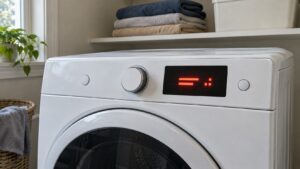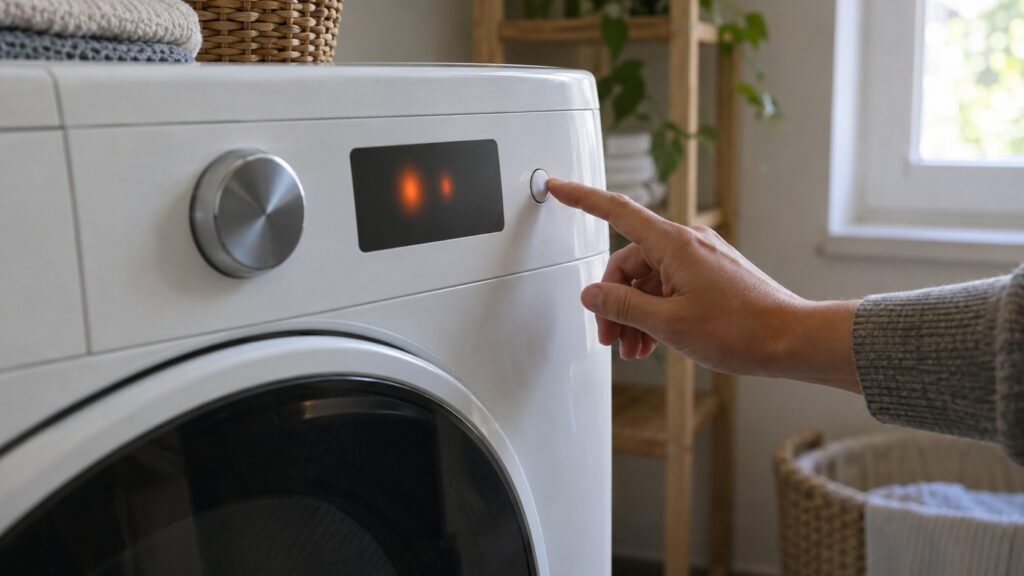
Whirlpool dryer f3e2 — written on the display as F3E2 — means the inlet thermistor is reading shorted and the heater has been cut as a result — the dryer’s control board detected an impossible or out-of-range signal from the temperature sensor that monitors incoming air, and it shuts off the heating circuit rather than keep running with a sensor it can’t trust. The components involved are the inlet air thermistor itself, the wiring harness connecting it to the control board, and the heater circuit that gets disabled when the fault triggers.
What does “inlet thermistor reading shorted” actually mean?
A thermistor is a small sensor whose electrical resistance changes with temperature, and the dryer’s control board reads that resistance to know how hot the incoming air is. A “shorted” reading means the board is seeing a resistance value that’s essentially zero, or at least far below anything a real temperature could produce — which tells the board the sensor itself, or the wiring between the sensor and the board, has failed electrically rather than that the air is somehow reading as impossibly hot. Because the board can no longer trust what the thermistor is telling it, it cuts the heater rather than risk running the heating element without a working temperature check in place. That’s a deliberate safety response, not a separate malfunction on top of the sensor fault.
Why does the dryer cut the heater instead of just ignoring the bad sensor reading?
The inlet thermistor exists specifically so the control board can regulate heat and avoid overheating the dryer — running the heater with no reliable way to monitor incoming air temperature removes a safety check the system depends on. Rather than guess or run the heater blind, the dryer disables the heating circuit entirely once it detects the thermistor has failed, which is why F3E2 shows up as a dryer that tumbles and runs through a normal cycle but produces no heat at all rather than one that stops working completely. If your dryer is running but not heating and displaying a different code, or no code at all, our broader guide on a Whirlpool dryer not heating covers other causes beyond this specific thermistor fault.
What should you check yourself before calling for service?
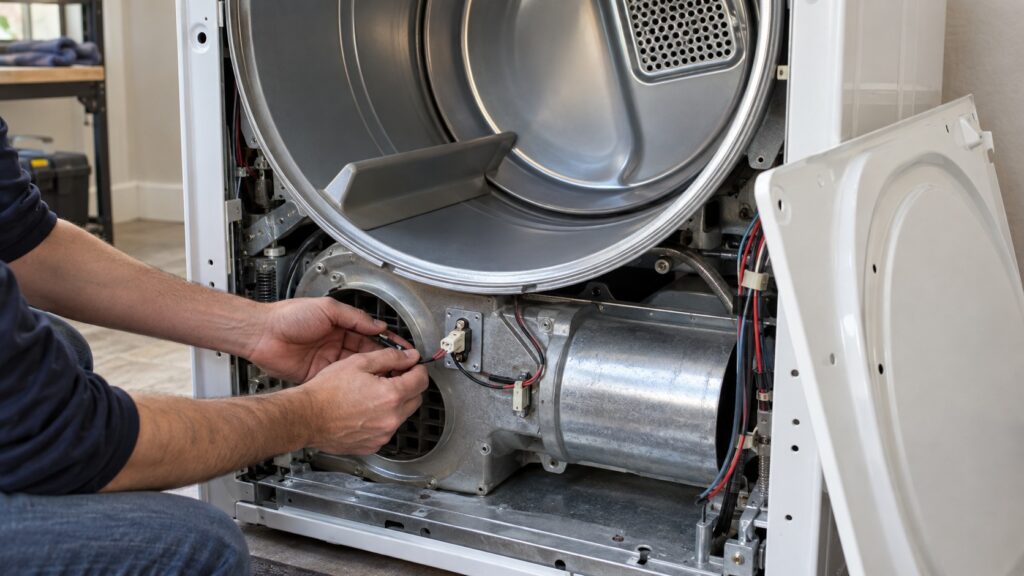
Start by unplugging the dryer for a few minutes and plugging it back in — some thermistor faults are conditions the control board latched onto rather than a fault that’s actively present every time the dryer runs, and a full power cycle clears a latched code that isn’t recurring. If F3E2 comes back as soon as you start a new cycle, the fault is live rather than a one-time glitch. If you’re comfortable removing the dryer’s rear or front access panel depending on where the inlet thermistor sits on your model, a visual check of the wiring connector at the thermistor is worth doing — a connector that’s worked loose from vibration over years of use is a common, low-cost cause of this exact fault, and reseating it can resolve F3E2 without any parts needed.
Beyond checking that connector, stop there. Confirming whether the thermistor itself has failed electrically, as opposed to its wiring, requires testing resistance with a meter against the manufacturer’s specification for that part, and a misread test can lead to replacing a thermistor that wasn’t actually the problem.
Could the wiring harness be the real problem instead of the thermistor itself?
Yes, and it’s worth taking seriously as a real possibility rather than an afterthought. The inlet thermistor sits near the airflow path at the front of the dryer, and its wiring run passes close to areas that see vibration, heat, and occasionally lint buildup over years of normal use. A connector that’s corroded slightly, a wire that’s chafed against a metal edge inside the cabinet, or insulation that’s degraded from heat exposure near the heater housing can all produce a reading that looks identical to a failed thermistor from the control board’s perspective. This is exactly why checking the visible wiring and connector first, before assuming the sensor itself needs replacing, can save you from buying a part that wasn’t actually broken.
How is F3E2 different from other F3 codes on a Whirlpool dryer?
F3E2 specifically names the inlet thermistor reading as shorted, but it’s not the only code in the F3 group, and mixing the two up leads to checking the wrong sensor. F3E1, the other dryer code in this group, means the exhaust thermistor is reading an open circuit — a different sensor, in a different part of the airflow path, failing in the opposite electrical way. An open circuit and a shorted circuit are opposite electrical faults on two different thermistors, which is exactly why the full code matters — always confirm the exact digits shown on the display, including the number after the E, rather than assuming any F3 fault points at the same sensor.
What happens if F3E2 is ignored and the dryer keeps running without heat?
The dryer will typically keep tumbling and running its full cycle time with no heat at all, which means clothes come out essentially as damp as they went in, cycle after cycle, until the fault is addressed. There’s no meaningful risk in running the dryer this way beyond wasted time and energy, since the whole point of the fault response is to disable heat rather than let something worse happen — but it’s not a problem that resolves itself, and running repeated damp cycles while hoping it clears up on its own just wastes electricity without fixing anything.
Is F3E2 worth repairing, or is it a sign of a bigger problem?
On its own, F3E2 is a straightforward, inexpensive fix in most cases — either a wiring connection or a single sensor part, not a sign of broader dryer failure. It’s not connected to the drum, motor, belt, or other major mechanical components, so a dryer that’s otherwise running well mechanically and throws this code is almost always worth repairing rather than treating as a signal to replace the whole unit. If your dryer has a history of other unrelated issues alongside this fault, our dryer repair or replace guide covers that broader decision, and our dryer maintenance guide covers the routine care that keeps the whole heating and airflow system reliable going forward.
If your Whirlpool dryer is showing F3E2 and checking the thermistor’s connector didn’t resolve it, our technicians can test the sensor and its wiring directly — schedule a visit and we’ll confirm which one needs replacing before ordering a part.