When a Whirlpool oven broil element is not heating, the oven bakes normally but broil gives you no glow, no sizzle and no browning. The most likely cause is a failed upper element: a break or a blister in the metal, which you can often see with the oven cool and switched off at the breaker. If the element looks fine, the next suspects are a failed relay or control on the board, the wiring to the element, or a mode and door-position mistake. This guide is for electric ovens and ranges; a gas broiler is lit by a burner and igniter and is a different problem.
How does a Whirlpool oven broil element work?
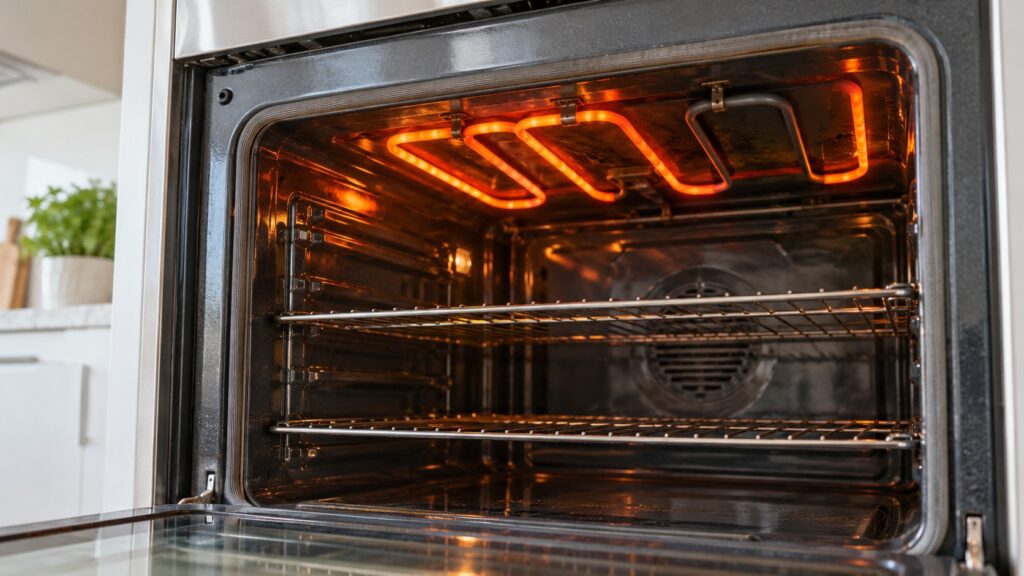
Our own Whirlpool oven how it works guide says the lower element handles bake, with steady heat all around the cavity, while broil energizes the top element at high intensity for direct radiant heat. That is why broil can fail on its own: the two elements are separate parts on separate circuits. A bake element that works tells you the oven’s power supply, sensor and door switch are all fine, and the problem is narrowed to the top element and what feeds it.
The top element is also the one that has to cope with the harshest conditions. It glows hot every time you broil, and splatter lands on or near it. Over time the metal can blister, crack or develop a thin spot, and when the heating wire inside breaks, the element stops glowing even though it looks mostly intact.
What should you check first?
Before you suspect a part, rule out the simple things:
- Confirm the mode. Select Broil, not Bake or a convection mode. Some ovens broil with the door closed and some expect it ajar, so check your owner’s manual for how your model is meant to broil.
- Check the delay and lock settings. A delayed start, a control lock or Sabbath mode can leave an element cold. Clear the setting and try again.
- Reset the oven. Switch the oven’s breaker off briefly, then restore it, and try broil again. A one-off control glitch sometimes clears this way.
- Look at the element, not just the glow. When the oven is switched off at the breaker and completely cool, look at the upper element. Check for a visible break, a blister or bubble in the metal, a dark or burned patch and loose or damaged terminals at the back.
Do not take the oven apart. Stay on the inside of the cavity and leave the back panel and the wiring to a technician.
What does a failed broil element look like?
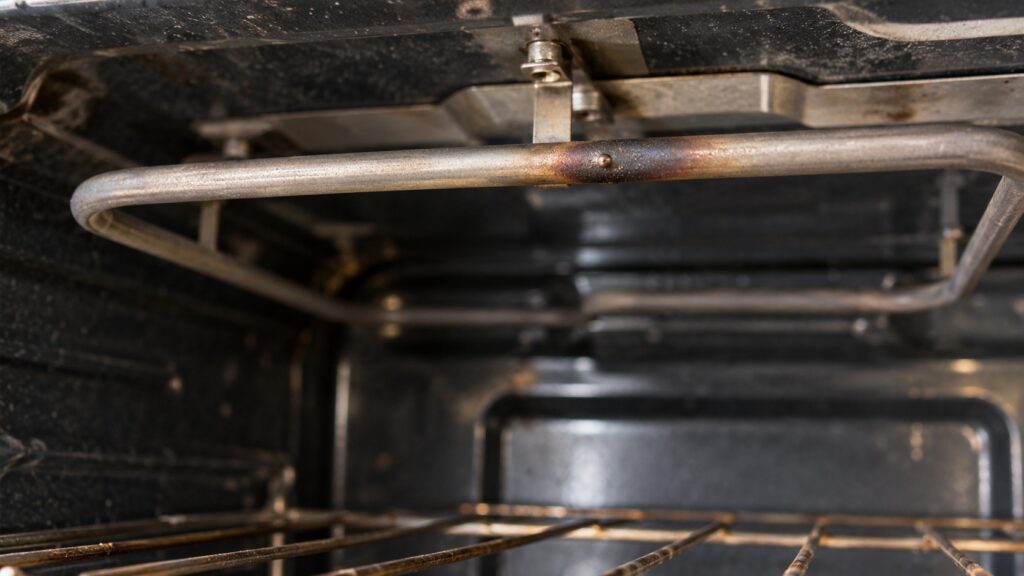
A failed element usually shows itself in one of three ways. A break is a visible gap or crack in the metal. A blister is a raised bubble on the surface, which means the heating wire inside has overheated at that point. A dark or burned patch shows where the element has been running hotter than the rest. You may also see that one part of the coil glows while another stays dark during broil, which means the element is open at the dark section. Any of these is a reason to replace the element, not to keep using it. An element that is blistered or cracked can spark, so do not keep using it.
If you see sparks, hear popping or smell burning, switch the oven’s breaker off while you are standing on a dry floor, leave the door closed and do not use the oven until it has been checked.
What if the element looks fine?
A normal-looking element can still fail inside, or it can be fine while something upstream is not feeding it. The possible causes on an electric oven include:
- An open circuit inside the element that is not visible from outside.
- A loose or burned connection at the element terminals or the wiring behind the oven wall.
- A failed relay or control that does not send power to the top element. The site’s oven guides note that a relay on the control board can stop heating.
- A door switch or lock problem that interrupts heating. If a code such as F9E0 appears, read our Whirlpool oven F9E0 guide.
Testing any of these means working with 240-volt wiring, a meter and the back of the oven, which is a technician’s job. Tell the technician which modes work, which do not, what the element looks like and any code that appeared, so they can bring the right part.
How is this different from “oven not heating” or “temperature off”?
If nothing heats, or the oven heats but not to the temperature you set, you have a different problem. Our Whirlpool oven not heating guide and the range oven not heating guide cover whole-oven failures, the bake sensor failure guide covers the temperature sensor, and the oven temperature off guide covers drift. Broil-only failure is narrower than all of these, and it is the one problem where the oven still works for everything else.
Is it worth replacing a broil element?
Often, yes. A broil element is a single part, and an oven or range that otherwise works may be worth repairing. Ask the technician for a quote on the part and the labor. A repair makes more sense than a new range when the rest of the oven heats evenly, the door and controls are in good shape and the fault is limited to the element. If the oven has several faults, or the cavity itself is damaged, weigh it against a new range. Our Whirlpool oven repair and range repair pages explain what a visit covers.